
IN Brief:
- SEMPER NOR Flash has joined the approved vendor list for ASPEED's AST2700 BMC.
- The memory stores management firmware used for monitoring, secure boot, updates, and recovery.
- Server availability increasingly depends on the integrity and serviceability of supporting management electronics.
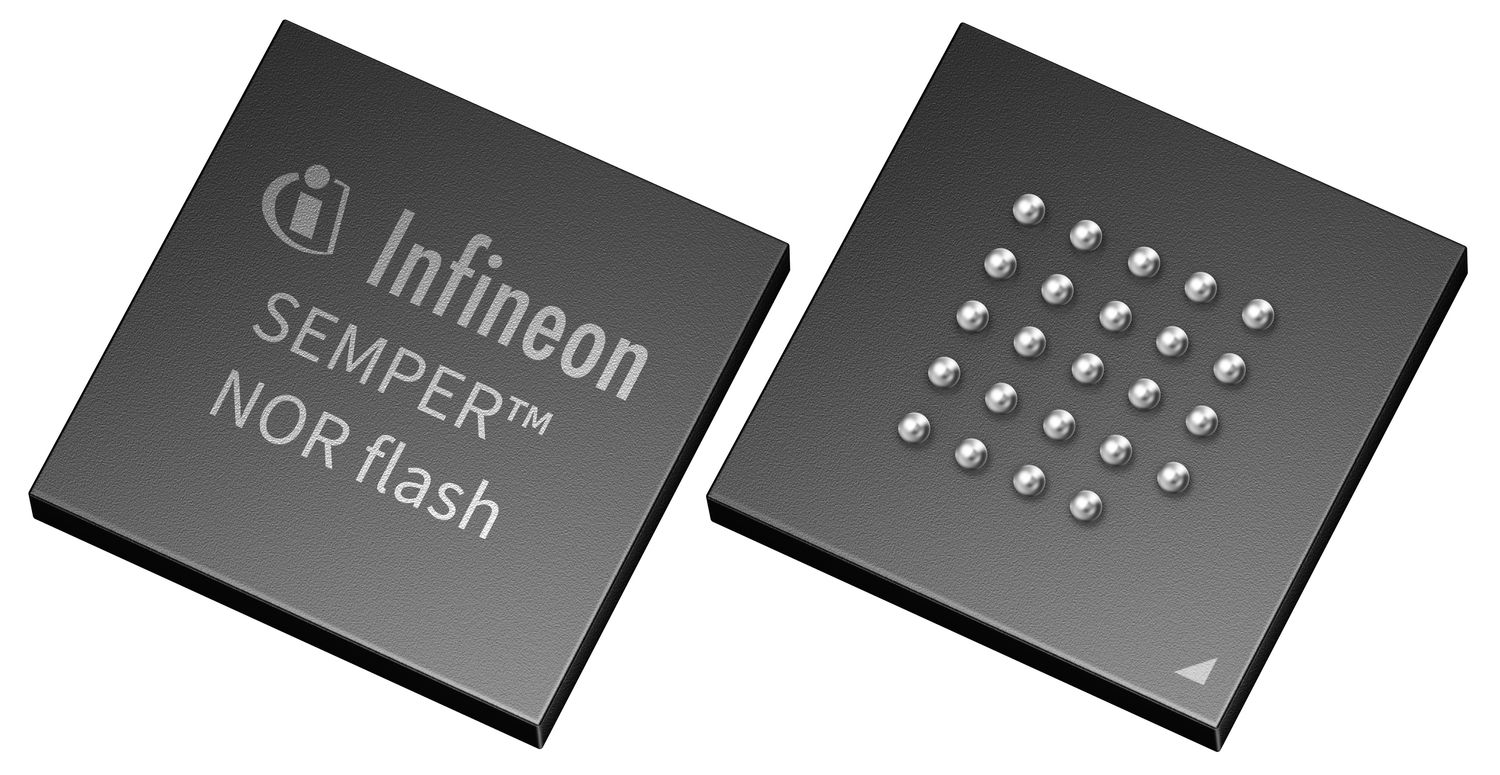
Infineon Technologies has qualified its SEMPER NOR Flash Memory for ASPEED Technology’s AST2700 baseboard management controller, adding the family to the controller’s approved vendor list. The qualification gives server manufacturers a validated option for storing the firmware executed by the AST2700.
A baseboard management controller operates independently of the main processor and operating system, monitoring temperatures, voltages, fans, power states, and hardware condition while providing remote access for configuration, diagnosis, updates, and recovery. Because the controller may remain active when the host is shut down, its firmware storage forms part of the server’s availability and security architecture.
SEMPER NOR Flash connects through serial peripheral interfaces and is designed for high endurance with fast read performance. Integrated cyclic redundancy checking and error correcting code support the detection and correction of stored data faults, helping preserve the firmware image through repeated reads, updates, and long service periods.
The device stores code used for secure boot, power sequencing, health monitoring, remote firmware installation, access control, and recovery. Corruption or unauthorised modification at that layer can prevent management functions from starting, leave equipment inaccessible, or create a privileged route into the wider server.
ASPEED’s AST2700 is the company’s eighth generation BMC and is manufactured on a 12nm process. Greater processing capacity, security functionality, and system integration are intended to support servers that combine dense accelerator, memory, storage, networking, cooling, and power subsystems.
Approved vendor qualification confirms compatibility with the controller platform and reduces one part of component selection, although the finished board still requires validation of interface timing, signal integrity, power sequencing, firmware drivers, thermal behaviour, package choice, and update recovery.
Management silicon carries more operational weight
AI servers concentrate substantial power and capital within each rack, magnifying the effect of a management failure. A BMC may coordinate several accelerators, high bandwidth memory, liquid cooling hardware, high current distribution, and multiple network interfaces while remaining reachable when the host software has stopped responding.
Liquid cooling integrated with AI rack busbars demonstrates how thermal and electrical infrastructure now depends on continuous monitoring across the cabinet. Temperatures, flow rates, pump condition, current, and voltage need to be observed early enough for the management system to protect equipment without causing unnecessary shutdowns.
Because the BMC remains available outside the host environment, its firmware storage must satisfy competing requirements. Code has to resist unauthorised changes, yet secure field updates remain essential throughout the server’s working life; recovery images and rollback mechanisms must also survive when an update is interrupted or a newly installed version fails to boot.
NOR flash remains widely used for boot and management code despite the greater capacities available from NAND storage. Direct random access, predictable execution, retention, endurance, interface timing, and hardware protection can be more valuable than raw capacity when the memory contains the first trusted instructions executed by the controller.
Although the memory protects stored data, security extends beyond the flash device itself. Root of trust implementation, signed images, key storage, update authentication, debug control, write protection, and recovery policy determine whether data integrity features contribute to a secure boot chain or merely protect an unauthorised image from random corruption.
Long server lifecycles add a supply consideration because changing the memory after launch may trigger another qualification cycle, firmware revisions, manufacturing changes, and updates to security provisioning. A stable product roadmap and diversified supply base can reduce disruption long after the initial bill of materials has been approved.
As baseboard controllers gain processing power and network reach, they also require continuing software maintenance. Vulnerability handling, signed updates, access logging, and clear ownership of obsolete platforms become as important as the endurance specification of the memory that holds the code.
SEMPER’s inclusion on the AST2700 approved vendor list places a relatively small component within a much larger reliability problem. The server remains manageable only while its independent control plane can boot from trustworthy firmware, observe the hardware, install controlled updates, and recover equipment when the main computing environment is unavailable.

