IN Brief:
- TLE9744QK combines traction-inverter power supplies, resolver excitation, and independent safety logic.
- Infineon says replacing external circuitry can reduce PCB area for the affected devices by up to 70%.
- A redundant supply keeps the independent safety path available if the main low-voltage rail fails.
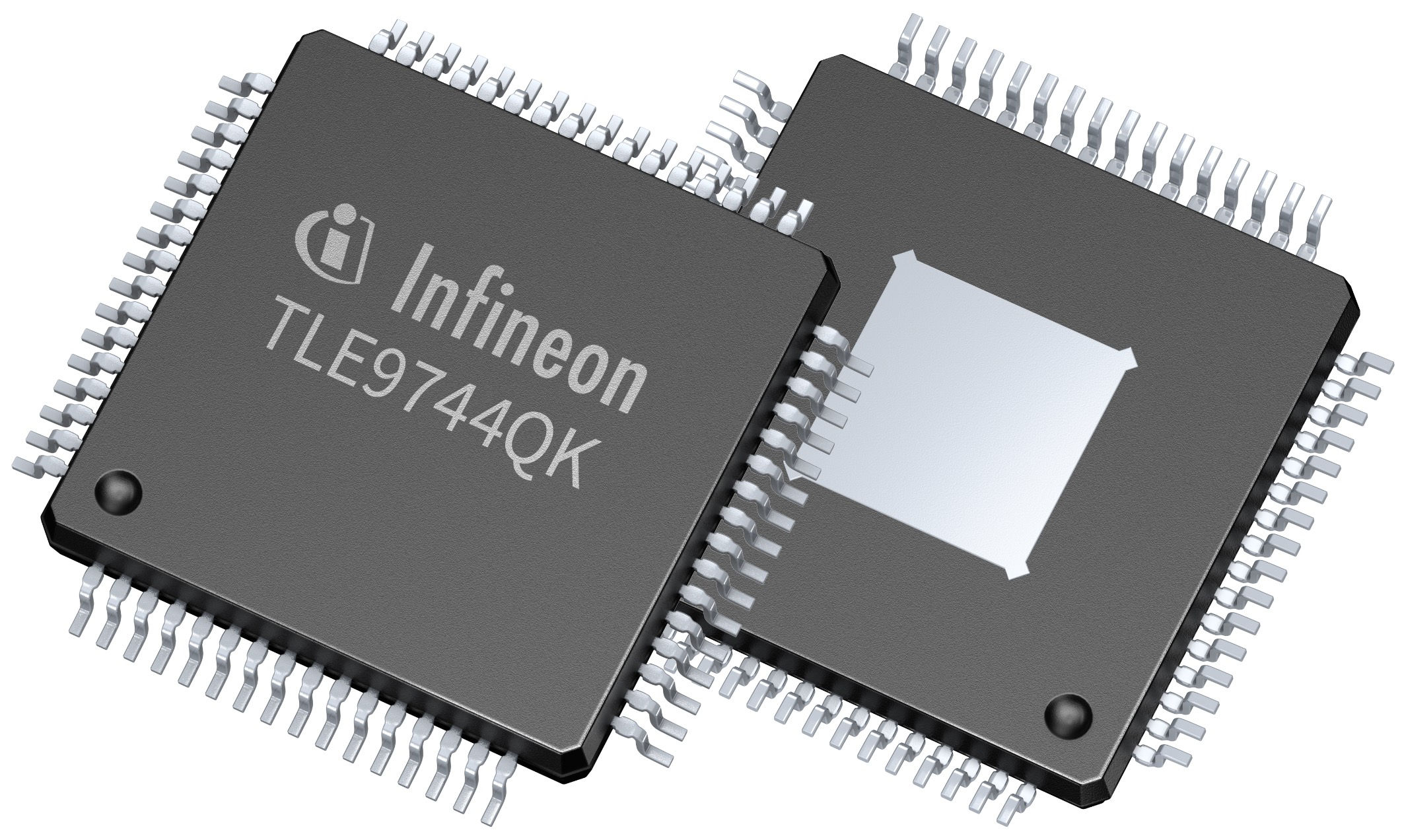
Infineon Technologies has introduced the OPTIREG TLE9744QK power-management IC for high-voltage traction-inverter control units, combining power-supply functions, resolver excitation, and an independent safety engine in one device. The PMIC is intended to reduce the external circuitry surrounding the inverter controller while retaining a separate hardware path for fault supervision.
Traction-inverter ECUs have to supply microcontrollers, communications devices, sensors, gate drivers, and position-feedback circuitry while operating alongside high-voltage switching hardware. Infineon says consolidating several of those support functions can reduce bill-of-materials count and shrink the PCB area occupied by the replaced devices by up to 70%.
Resolver excitation is integrated directly into the PMIC. Resolvers are commonly used to determine rotor position in traction motors, and their excitation and monitoring normally require dedicated supporting circuitry. Generating the excitation signal inside the TLE9744QK allows that external circuitry to be removed where the inverter architecture is compatible.
The device is also designed to work with a range of microcontrollers and gate drivers, allowing existing controller platforms to be retained rather than forcing the complete inverter ECU to be redesigned around one processor family. Off-board sensor-supply support provides further flexibility where sensing elements are distributed around the power stage.
Functional safety is handled through Infineon’s Integrated Safety Logic, which operates independently of the main microcontroller. It supervises parameters including phase currents, DC-link voltage, MCU health, and gate-driver status, and can enforce a safe state if the primary controller fails.
A redundant supply input keeps that safety path powered if the main low-voltage supply is lost. The separation is important because the controller responsible for normal inverter operation cannot simply be relied upon to identify every failure affecting itself. Infineon states that the architecture was developed according to ISO 26262 requirements for ASIL-D compliance.
Integrating those functions reduces component count, but it also concentrates more of the inverter’s supporting electronics into one device. That places greater emphasis on qualification, diagnostics, supply redundancy, and the independence of the safety path, particularly in applications where loss of control could result in unintended torque or failure to shut down the power stage correctly.
The launch comes as traction-inverter designers continue to reduce the size of the control electronics around increasingly power-dense switching modules. Current sensing, gate driving, position measurement, communications, power management, and safety monitoring all compete for board area while operating in an electrically noisy environment close to high-current conductors.
Recent multiaxial current-sensing hardware for traction inverters addresses another part of the same packaging problem, compensating for mechanical displacement and magnetic crosstalk without requiring a bulky magnetic core. The two developments sit on opposite sides of the control loop but reflect the same pressure to reduce support circuitry without weakening measurement or fault response.
The TLE9744QK is available now. Infineon is also offering samples, evaluation boards, reference designs, documentation, software, and tools, moving the device directly into design-in rather than presenting it as an early technology demonstrator.