IN Brief:
- Two independently controlled 20GHz signal sources fit within one 2U test instrument.
- Phase noise reaches -135dBc/Hz at 10GHz and 10kHz offset, with a -166dBc/Hz broadband noise floor.
- SCPI support and familiar connections are intended to reduce integration work in existing automated test systems.
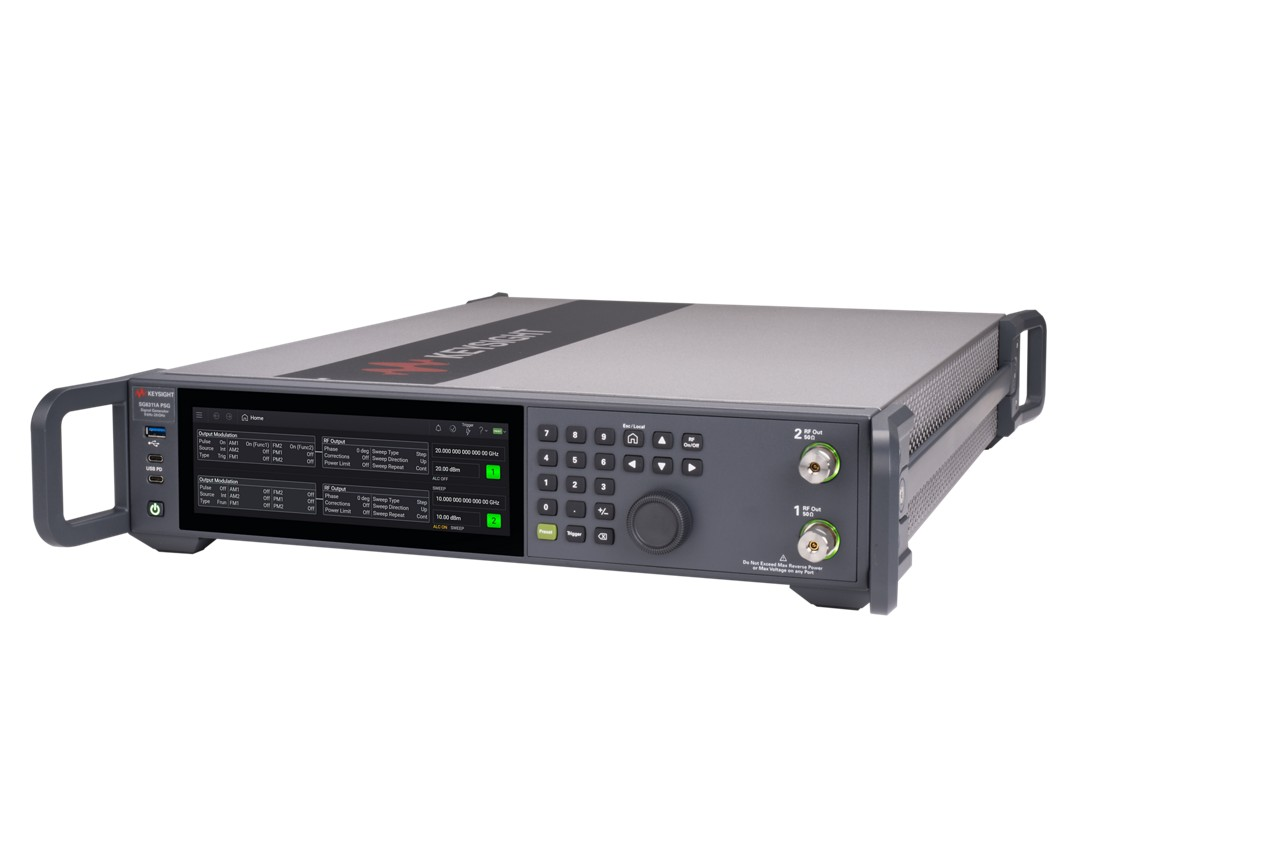
Keysight Technologies has launched a 20GHz PSG XG7-class analogue signal generator that places two independently controlled RF channels in a 2U chassis, increasing source density in laboratories where additional rack space, cabling, and control hardware can be as inconvenient as the cost of another instrument. The SG6311A is aimed at aerospace and defence, advanced wireless, and high-speed electronics development, with Keysight concentrating its specifications on phase noise, amplitude modulation noise, broadband noise, and calibrated output power rather than treating the second channel as the main engineering achievement.
At 10GHz with a 10kHz offset, the instrument is specified at -135dBc/Hz phase noise and -150dBc/Hz amplitude modulation noise, while its broadband noise floor reaches -166dBc/Hz at 10GHz and calibrated output extends to +22dBm. Those figures determine how far the generator itself intrudes into a measurement, since source noise approaching the performance of a receiver, converter, amplifier, or subsystem makes it increasingly difficult to separate the characteristics of the instrument from those of the device being tested.
The additional output power provides margin for losses through cables, fixtures, switches, attenuators, and other hardware in the signal path, potentially reducing the need for external amplification in test arrangements where several passive elements sit between the source and the device under test. With both channels operating independently, one chassis can also provide separate stimuli for multi-signal measurements or support two automated test paths without duplicating the complete instrument.
RF validation systems frequently accumulate several sources alongside analysers, network analysers, synchronisation hardware, switching matrices, attenuators, and control equipment, so rack density becomes a practical limitation long before a laboratory runs out of individual measurement functions. Compressing two sources into 2U reduces that physical overhead, although the advantage only holds if each channel preserves enough spectral purity and output performance to replace the separate generators it displaces.
Jun Chie, vice president of Keysight Core Product Management, said the new platform builds on the established PSG family with increased purity, power, and productivity. Keysight has supported that positioning with a hybrid architecture and software-controlled mode switching, allowing the instrument to alter its operating behaviour according to the combination of frequency, power, and signal-quality requirements presented by a particular measurement.
Compatibility with existing automated test environments has been given similar attention because replacing a long-established RF source can create more engineering work in software than in hardware. The SG6311A supports Standard Commands for Programmable Instruments and retains familiar operating conventions and rear-panel connectivity, reducing the need to rewrite scripts, switching logic, calibration routines, and operator procedures simply to adopt the denser platform.
That migration issue matters particularly in production and qualification systems, where an instrument can remain embedded in a test rack for years after its original introduction. Better phase noise or higher output power is useful only when the replacement can be introduced without invalidating the automation, traceability, and calibration processes built around its predecessor.
Keysight’s recent participation in Verizon’s 6G Innovation Forum places the company in pre-standard wireless work where test equipment has to accommodate changing waveforms and experimental spectrum, but the SG6311A addresses a more immediate requirement shared across several RF sectors: adding usable sources without sacrificing the measurement margin required to characterise increasingly quiet or complex devices.
The headline -135dBc/Hz phase-noise figure and -166dBc/Hz broadband floor therefore provide more useful reference points than the 2U height alone, although engineers will still need to examine performance across the precise carrier frequencies, offsets, and output levels relevant to their systems. A dual-channel generator only increases effective rack capacity when both channels can take the place of existing sources without forcing additional amplification, filtering, or software changes elsewhere in the test chain.