
IN Brief:
- Keysight and CATARC NEV Inspection Center have established a Joint Innovation Laboratory for Charging Test Technology.
- The lab will address charging compatibility, safety, overseas compliance, infrastructure, and next-generation standards.
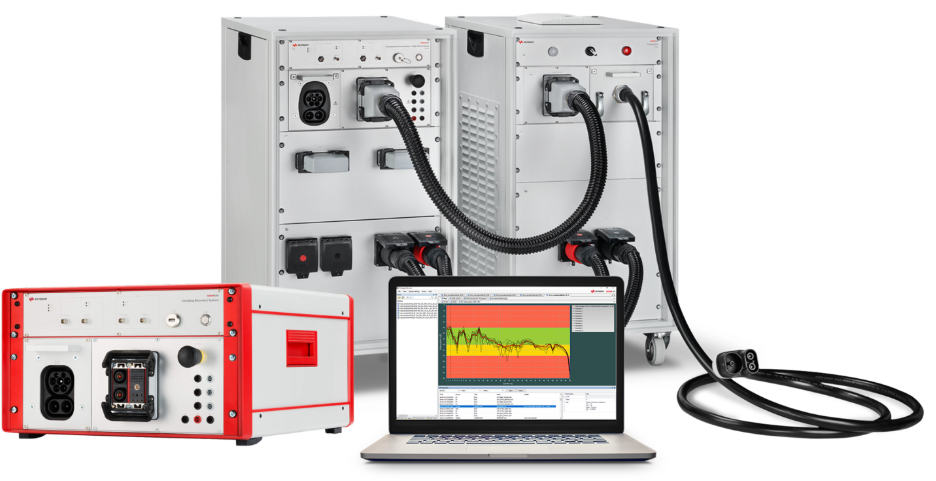
- CATARC has adopted Keysight vehicle-to-charger conformance testing solutions for European, North American, and Chinese standards.
Keysight Technologies and China Automotive Technology and Research Center New Energy Vehicle Inspection Center have expanded their strategic collaboration through the establishment of a Joint Innovation Laboratory for Charging Test Technology.
The laboratory will focus on new energy vehicle charging test methods, standards development, and validation technologies. It will address charging compatibility, safety, overseas compliance, and charging infrastructure requirements across current and next-generation standards.
The collaboration includes support for China’s upcoming National Standard 2024 and international combined charging system requirements. CATARC NEV Inspection Center has adopted Keysight’s vehicle-to-charger conformance testing solutions to support certification and verification across European, North American, and next-generation Chinese charging standards.
The lab brings together Keysight’s electrification and validation technologies with CATARC’s role in domestic standards, testing, and certification. The two organisations will work across charging compatibility, safety, overseas compliance, charging infrastructure, and future charging standards as vehicle platforms and charging networks continue to scale.
Electric vehicle charging validation is becoming more complex as automakers and suppliers move towards higher power levels, broader international deployment, and more software-controlled charging behaviour. A vehicle that performs correctly in one regional charging environment may still need additional validation before it can be sold or operated elsewhere.
Conformance testing now sits at the intersection of power electronics, embedded software, communications, safety engineering, and regulatory compliance. EVs and charging equipment have to manage physical interfaces, communication protocols, voltage and current profiles, isolation monitoring, safety states, fault behaviour, thermal limits, and recovery sequences.
Higher-power charging increases the engineering burden. As current and voltage levels rise, control errors, communication timing problems, connector issues, or thermal behaviour can have more severe consequences. Validation must therefore cover normal operation, abnormal states, interoperability with different chargers, and response to communication loss or fault conditions.
Keysight’s charging test portfolio supports EV and EV supply equipment validation through real-time emulation, automated conformance testing, and interoperability checks. Test systems can emulate vehicle or charger behaviour in the lab, allowing engineers to reproduce conditions without needing multiple physical vehicles and charging systems for every test case.
That approach is increasingly valuable as standards evolve. The charging ecosystem includes CCS, CHAdeMO, GB/T, and regional or application-specific requirements, while bidirectional charging and vehicle-to-grid functions add further complexity. Test coverage has to include not only charging power transfer, but also negotiation, authentication, grid interaction, failure recovery, and software behaviour.
The CATARC collaboration gives Keysight a stronger role in standards-aligned validation for one of the world’s largest electric vehicle markets. For vehicle manufacturers, suppliers, and charging infrastructure providers, laboratory-based conformance testing can reduce late-stage validation risk and support export programmes where compliance requirements differ by region.
EV charging is no longer a discrete hardware interface. It is a combined power, communications, safety, and software system that has to operate across vehicles, chargers, grids, and jurisdictions. The Joint Innovation Laboratory gives Keysight and CATARC a platform for developing test methods around that full system, rather than treating charging validation as a final certification step.

