
IN Brief:
- Kyocera AVX has introduced new 48V automotive-grade multilayer varistors in its TransGuard VT Series.
- The devices combine overvoltage protection and EMI/RFI attenuation in compact SMT packages.
- The launch reflects growing protection requirements in EV, mild hybrid, industrial, and transportation electronics.
Kyocera AVX has expanded its TransGuard VT Series with high-temperature, automotive-grade multilayer varistors designed for 48V power supply systems.
The new devices are ZnO-based ceramic semiconductor components that combine bidirectional overvoltage protection with EMI and RFI attenuation in compact SMT packages. They are intended to reduce reliance on separate transient suppression and filtering components, lowering board-space demand and simplifying protection design in dense power electronics.
The 48V devices are designed and tested for motor vehicles using 48V electrical systems, with operating temperatures up to 150°C and qualification to VDA-320. The family is available in five EIA chip sizes — 0805, 1206, 1210, 1812, and 2220 — with 56VDC or 40VAC working voltage ratings, 100–110V clamping, 48V jump-start capability, 30–1,500A transient current handling, 0.2–9J transient energy ratings, and capacitance values from 80pF to 2,800pF.
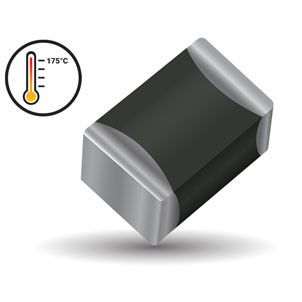
The wider TransGuard VT Series supports operation up to 150°C or 175°C, depending on variant, and is qualified to AEC-Q200, IEC 61000-4-2, and ISO 10605. Several part numbers are also available with FLEXITERM terminations, designed to withstand severe vibration, mechanical board flexure, and repeated temperature cycling. That mechanical resilience is increasingly valuable as 48V electronics move into vehicles, charging equipment, industrial machinery, and smaller electric mobility platforms.
Perrin Hardee, Product Marketing Manager at Kyocera AVX, said the TransGuard VT Series provides bidirectional overvoltage protection and EMI/RFI attenuation in a single SMT package, with high operating-temperature ratings and no derating over the specified temperature range. He said the new 48V versions extend those cost and performance characteristics into automotive systems exposed to harsh electrical environments.
Vehicle electronics are moving in two directions at once: higher data rates through sensing and zonal architectures, and more demanding power protection as electrification changes the electrical environment. That dual pressure is also visible in Molex’s 25Gbps automotive Ethernet connector system, where data bandwidth and signal integrity sit beside the need for robust power and EMC behaviour across the vehicle.
The spread of 48V architectures is no longer limited to mild hybrid systems. Passenger and commercial vehicles, e-bikes, e-scooters, golf carts, industrial transport equipment, and charging stations all expose low-voltage electronics to transients from motors, relays, jump starts, load dumps, and harsh environmental conditions. Protection devices that combine clamping, filtering, temperature resilience, and mechanical robustness can reduce the number of failure points around sensitive electronics.
Module density is also raising the protection burden. More functions are being placed into smaller control units, often closer to motors, power converters, switching devices, and harnesses carrying noisy loads. Microcontrollers, transceivers, sensors, memory, and analogue front ends therefore operate in less forgiving electrical environments, where repeated stress can shorten lifetime or create intermittent faults that are difficult to isolate.
Varistors remain familiar components, but their use in 48V automotive systems still requires careful attention to clamping voltage, capacitance, response behaviour, leakage, surge energy, temperature rating, and mechanical endurance. Underspecified protection can expose downstream electronics to cumulative damage, while poorly matched protection can add capacitance, layout burden, or cost that works against compact module design.
Kyocera AVX’s 48V additions address that practical design pressure. As vehicle and industrial platforms add more electronics around motors, charging, sensing, and connectivity, transient suppression has to be selected earlier and verified under realistic operating conditions. The new TransGuard VT variants add another qualified route for 48V protection, where long-term reliability will depend on small components preventing large electrical events from reaching sensitive silicon.

