
IN Brief:
- Lane Electronics is stocking HellermannTyton heat-shrink boots, shapes, tubing, and adhesives.
- The range supports insulation, strain relief, sealing, and environmental protection for interconnects.
- Raychem cross-reference support helps simplify sourcing for aerospace and defence assemblies.
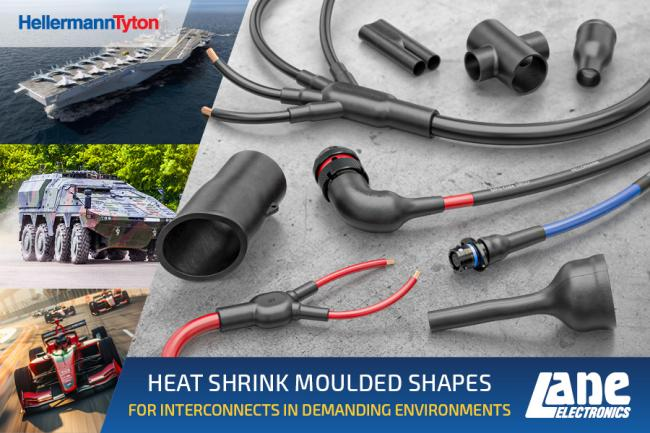
Lane Electronics is stocking HellermannTyton heat-shrink boots, moulded shapes, tubing, and adhesives for connector and cable assemblies operating in demanding electrical and electronic environments.
The range is aimed at aerospace, defence, automotive, rail, renewable energy, agriculture, construction vehicles, and other harsh-environment applications. Products are available as individual components, including adhesive-lined and plain moulded shapes, or as part of complete connector solutions assembled to order by Lane’s sister company, Weald Electronics.
Heat-shrink boots provide connector sealing, strain relief, insulation, and environmental protection. The HellermannTyton range includes boots, transition shapes, breakout shapes, end caps, tubing, and adhesives, allowing designers to protect backshell-to-cable transitions, harness junctions, and complex multi-leg assemblies.
Lane is also supporting specification work through a Raychem-to-HellermannTyton cross-reference tool. HellermannTyton moulded shapes are widely used as equivalents to TE Connectivity Raychem heat-shrink boots in aerospace and defence applications, with common Raychem references including 202K, 202D, 222K, and 222D.
The stocked series include the 150 Series bottle-shaped straight heat-shrink boots with rib, the 1100 Series 90-degree right-angle boots with rib for compact harness routing, and the 100 Series straight bottle-shaped boots suitable for aerospace and defence use. The range also includes SE28 2:1 elastomeric heat-shrink tubing and V9500 epoxy adhesive.
Interconnect protection is a reliability issue long before it is a finishing detail. Cable assemblies can fail through moisture ingress, chemical exposure, vibration, flexing, poor strain relief, inadequate sealing, or mechanical damage even when the connector and cable are correctly specified. In mobile, exposed, and high-vibration systems, the transition between connector and cable is often one of the most vulnerable parts of the assembly.
Ruggedised electronics coverage has increasingly moved beyond active devices alone. Astute’s defence antenna design support and Diodes’ automotive signal-integrity work both underline the same engineering reality: system performance depends on packaging, cabling, shielding, interconnects, and mechanical protection as much as on silicon selection.
Aerospace and defence harnessing brings particularly demanding constraints. Assemblies must tolerate vibration, temperature variation, fluids, handling, and maintenance cycles while remaining serviceable and traceable. Heat-shrink moulded shapes give designers a controlled way to manage bend relief, sealing, and environmental exposure without relying on improvised protection during build.
Availability and cross-referencing also influence engineering decisions. Many cable-harness designs are built around established part references, and substitution can be slow when specifications, drawings, or approvals are tied to legacy numbers. A clear route from Raychem references to HellermannTyton parts can reduce sourcing friction while preserving a recognisable specification path.
As more industrial and defence electronics move into compact, mobile, or exposed platforms, interconnect protection becomes part of the design envelope. Lane’s stocked HellermannTyton range gives engineers another supply option for assemblies where electrical performance, sealing, and mechanical durability have to be designed together.

