
IN Brief:
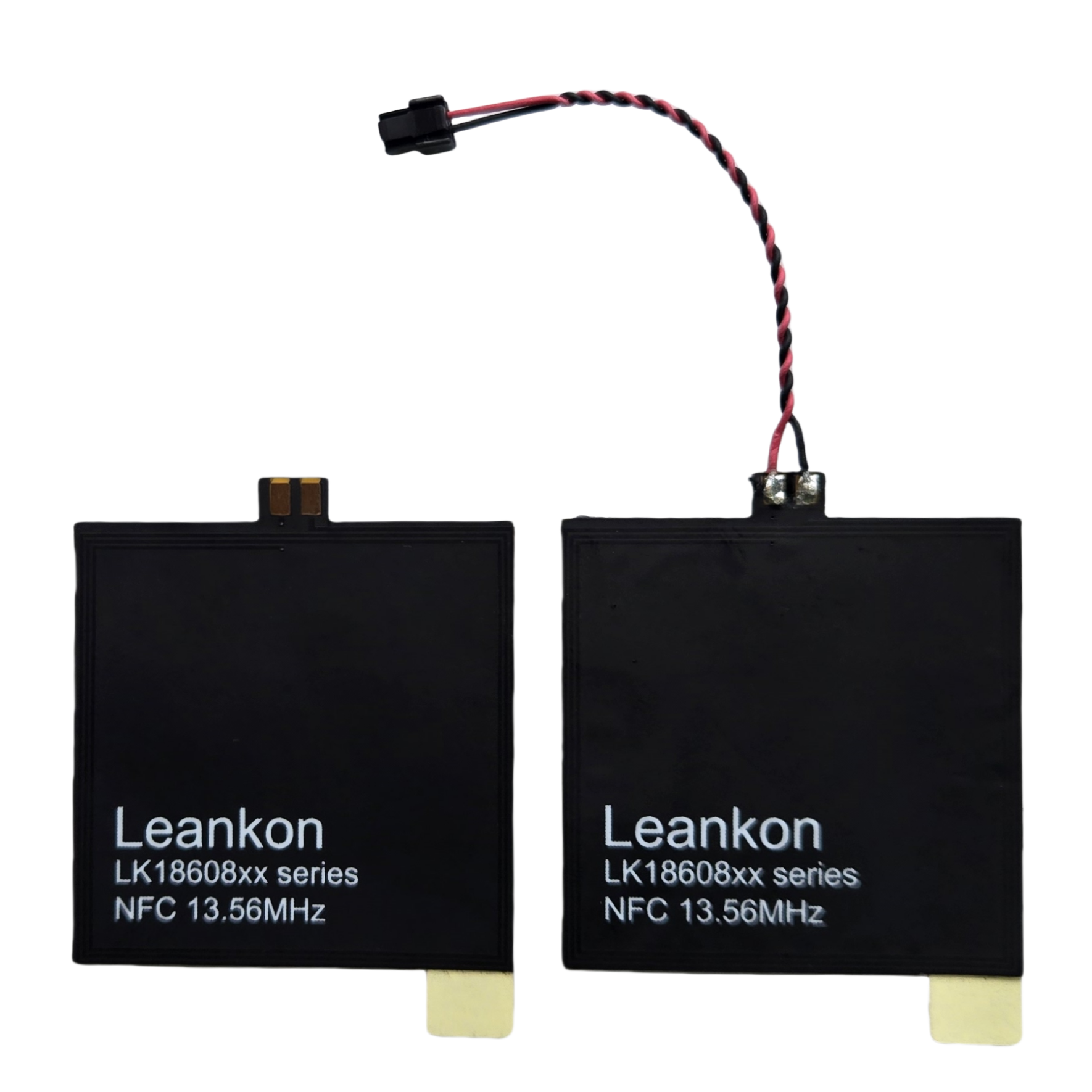
- Leankon’s current NFC catalogue now spans nine off-the-shelf 13.56 MHz antenna formats, from 15 mm x 15 mm to 50 mm x 40 mm, plus 20 mm and 30 mm round designs.
- Ferrite-backed variants, cable options, and connector-ready versions are aimed at speeding integration where metal surfaces, battery placement, and cramped enclosures complicate NFC tuning.
- Free samples, evaluation boards, and customisation options position the range as a bridge between early prototyping and production-specific antenna design.
Leankon has expanded its 13.56 MHz NFC offering into a nine-product off-the-shelf range, giving hardware teams a broader set of readymade antenna formats at a time when NFC is being pushed deeper into compact healthcare, access, payment, and industrial devices. The portfolio now stretches from 15 mm x 15 mm and 25 mm x 15 mm miniature formats through to larger rectangular designs up to 50 mm x 40 mm, alongside 20 mm and 30 mm round coils and a 40 mm x 40 mm square option.
The timing reflects a familiar design problem in NFC hardware. The radio itself is rarely the only challenge; enclosure geometry, metal proximity, battery placement, and cable routing tend to shape real-world performance just as aggressively as the controller IC. By packaging ferrite-backed versions alongside standard variants, Leankon is trying to remove one of the more persistent stumbling blocks in short-range wireless design, especially in products where the antenna has to sit directly on metal or close to other conductive structures.
The company’s product pages put that point plainly. Ferrite-equipped versions are intended for installations where an antenna would otherwise suffer a sharp drop in detection distance when mounted over metal. Across the range, Leankon is also offering versions with twisted-pair cabling and connector options, which makes placement away from the main PCB more practical when industrial packaging or wearable form factors leave little room for an ideal board-level layout.
That mechanical flexibility matters because NFC integration is increasingly being treated as a system packaging task rather than a single-component decision. In access readers, compact medical devices, smart wearables, and industrial handhelds, antenna location is often being decided in parallel with battery architecture, shielding, and industrial design. A broader menu of off-the-shelf coils can shorten that loop, particularly when developers are trying to reach proof-of-concept stage before committing to a custom antenna programme.
Leankon has also published distance-testing data for the range using NXP’s PN7160 and ST’s ST25R3911B NFC chipsets, a useful signal that the products are being positioned for real integration rather than catalogue presence alone. The antennas support both reader and card modes, and the company is pairing the standard line with custom options covering cable length, connector selection, and geometry changes where the stock parts do not fit a final enclosure.
For projects still at the prototyping stage, Leankon is also pointing developers toward a free sample request page, with evaluation boards and small-quantity sample support available for selected antenna part numbers. That is a practical way to compete in a part of the market where design-in speed often matters as much as RF performance.

