IN Brief:
- VersaBeam Mini carries 16 fibres in a 3.5 x 9mm VSFF footprint and can support up to 3,456 fibres in 1RU.
- Expanded-beam optics reduce sensitivity to contamination, while 16-fibre granularity limits the number of channels affected during maintenance.
- Limited customer sampling begins in Q4 2026, with general production scheduled for the first half of 2027.
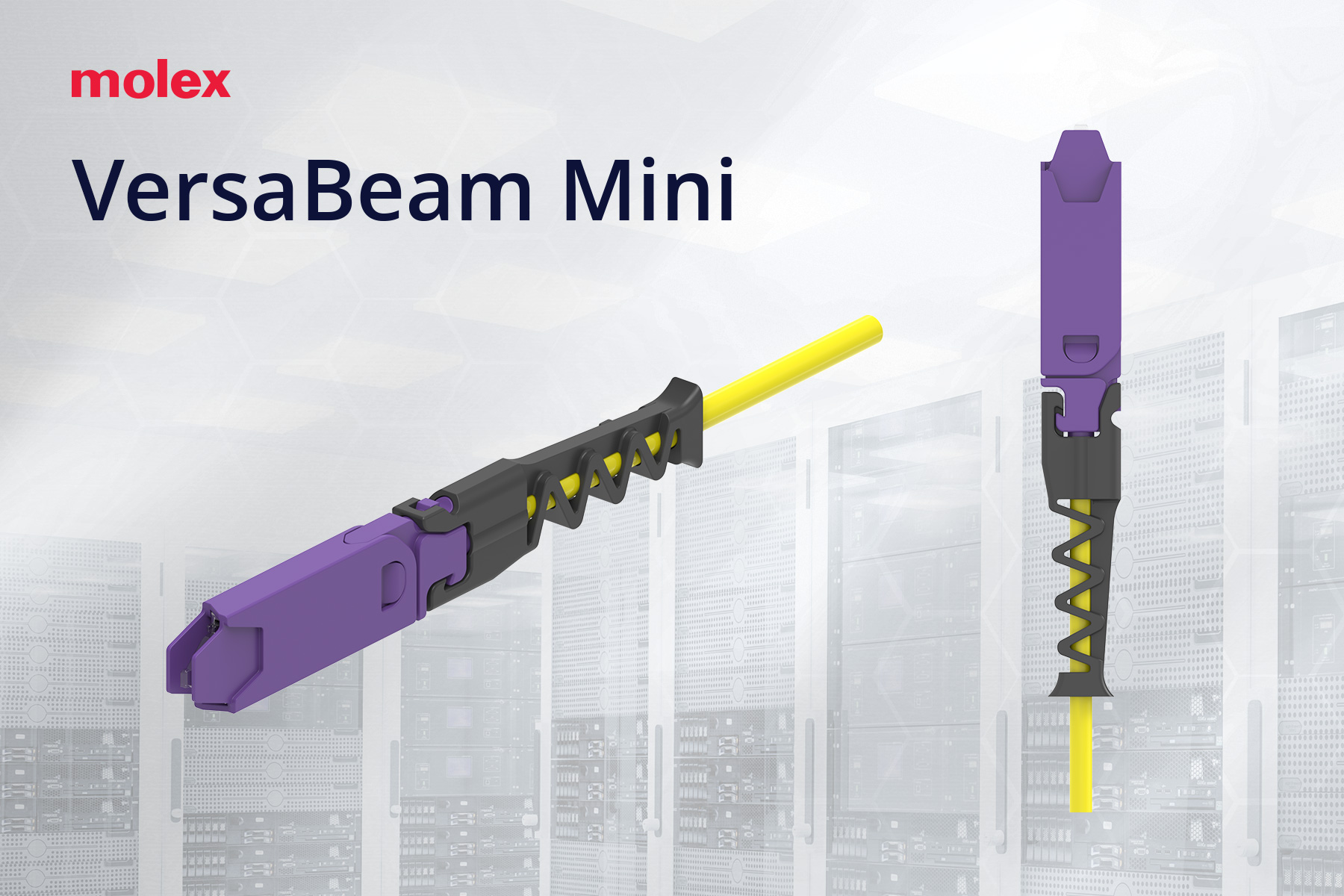
Molex has introduced VersaBeam Mini, a 16-fibre expanded-beam optical connector designed to increase front-panel and backplane density in AI and hyperscale datacentre systems. The connector uses a 3.5 x 9mm very-small-form-factor footprint and can support up to 3,456 fibres within a standard 1RU panel.
The connector extends Molex’s VersaBeam expanded-beam family into a smaller service unit than its existing high-fibre-count interfaces. Each connector carries 16 fibres, allowing individual groups of optical lanes to be isolated, rerouted or replaced without disturbing a substantially larger bundle. Molex calculates that the smaller service unit reduces the number of channels affected during maintenance by nine times compared with its larger VersaBeam configuration.
Fibre density is only one constraint inside AI switches and accelerator racks. The same connectors have to tolerate installation and maintenance without turning contamination control into a disproportionate operating burden. Conventional physical-contact fibre interfaces require careful inspection and cleaning because debris at the mating surface can produce insertion loss or damage.
VersaBeam uses expanded-beam optics based on the 3M EBO ferrule. The optical beam is enlarged between connector surfaces, reducing sensitivity to small particles and alignment variation compared with direct fibre-to-fibre contact. Molex says the design can reduce deployment, inspection and cleaning overhead by up to 85%, while inherent laser eye-safety measures are intended to simplify routine handling around active optical infrastructure.
An optional mass-insertion mechanism can engage nine VersaBeam Mini connectors, representing 144 fibres, in a single operation. That gives equipment manufacturers a faster way to assemble or commission high-density systems while retaining individual 16-fibre modules for subsequent field maintenance. Installation density and service granularity therefore remain separate design choices rather than forcing the operator to disconnect a large fibre group whenever one section needs attention.
The groove-based 3M EBO ferrule also removes conventional guide pins and guide holes from the mating interface. Fewer mechanical parts simplify the connector assembly and allow greater use of robotic pick-and-place equipment during cable production. At high port counts, manufacturing throughput and assembly repeatability become increasingly important because connector cost and labour scale alongside the number of optical channels.
VersaBeam Mini is intended for front-panel switches, optical backplanes, near-ASIC optics and co-packaged optical architectures. Moving optical conversion closer to switching silicon shortens the highest-speed electrical paths but transfers more of the integration problem to fibre routing, laser delivery, connectors and mechanical packaging inside the chassis. A smaller connector therefore has value only if it can maintain acceptable insertion loss, alignment and serviceability in the denser mechanical environment.
The new interface sits within Molex’s broader work on serviceable AI optics, including expanded-beam backplanes, external laser connectivity and optical circuit switching. VersaBeam Mini narrows that systems programme to the physical interface between dense optical assemblies, where front-panel area and internal fibre routing can limit the number of links available to switches and accelerator systems.
Molex lists the broader VersaBeam family with single-mode insertion loss below 0.7dB and multimode insertion loss below 0.3dB, with return loss above 55dB and 25dB respectively. The family is specified for operation from -10°C to +60°C. Final system performance will depend on fibre type, mating count, optical architecture and the other components included in the link budget.
Limited customer sampling of VersaBeam Mini is due to begin in the fourth quarter of 2026, with general production scheduled for the first half of 2027. Equipment manufacturers therefore have a defined evaluation period in which to assess panel density, automated assembly and field-service behaviour before committing the interface to future AI switch and compute-rack designs.