IN Brief:
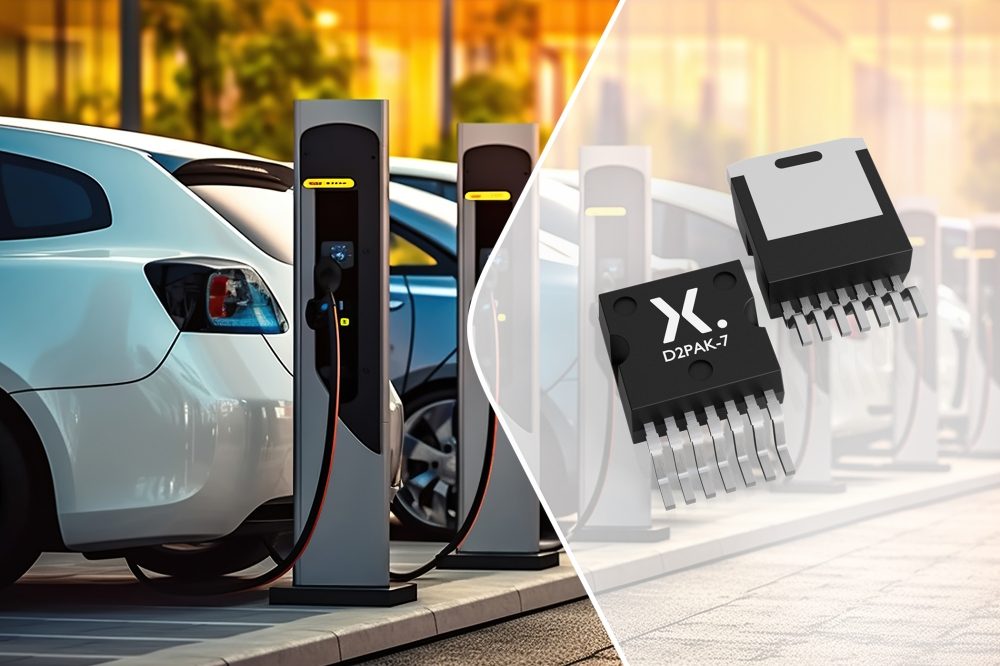
- The 750 V trench SiC MOSFET family targets industrial power conversion, photovoltaic inverters, EV charging, and automotive applications.
- The TOLL-packaged range includes 20 mΩ, 40 mΩ, and 60 mΩ variants, with a separate Kelvin source connection to support gate-drive control.
- Industrial and AEC-Q101-qualified automotive versions are available, with package selection dependent on electrical, thermal, and assembly requirements.
Nexperia has expanded its silicon carbide power semiconductor portfolio with a family of 750 V trench MOSFETs for industrial and automotive power conversion. The devices combine low switching losses, relatively stable on-resistance across operating temperatures, and several packaging options, including the introduction of transistor-outline leadless (TOLL) packaging to the company’s SiC range.
The new voltage class targets EV charging infrastructure, photovoltaic inverters, industrial drives, onboard chargers, DC-DC converters, and high-performance computing power supplies. Nexperia is offering industrial and AEC-Q101-qualified automotive variants, allowing equipment developers to select components according to their application and reliability requirements.
Silicon carbide is a wide-bandgap semiconductor material capable of supporting comparatively high electric fields. Its electrical characteristics make it suitable for power transistors operating at elevated voltages and switching frequencies, although the efficiency of a completed converter depends on its circuit topology, control strategy, and operating conditions.
Nexperia’s trench MOSFET structure is designed to limit conduction and switching losses. Conduction losses occur when current passes through the transistor’s on-state resistance, expressed as RDS(on), while switching losses arise during the transitions between conducting and blocking states.
These mechanisms affect the total energy dissipated in the semiconductor. A device with lower on-resistance can reduce conduction losses at a given current, but its switching characteristics, capacitances, gate-drive requirements, and operating temperature must also be considered when selecting a component.
The company identifies temperature stability as a feature of its latest family. Since on-resistance normally changes with junction temperature, a predictable resistance characteristic helps establish the heat generated during operation and the thermal conditions that the converter must accommodate.
The TOLL-packaged portfolio includes the NSF020750LLB0, rated at 750 V with a nominal on-resistance of 20 mΩ. Other available TOLL variants are rated at 40 mΩ and 60 mΩ, giving designers different options for current handling, switching behaviour, and power-stage construction.
The electrical selection cannot be made from resistance alone. A lower-resistance device may have different switching capacitances and gate-charge characteristics, influencing the energy required to turn it on and off. Loss calculations therefore need to account for both the conduction interval and the switching events that occur during each operating cycle.
Nexperia also identifies fast reverse recovery and robust body-diode operation among the characteristics of its new devices. In bridge configurations, current may flow temporarily through a MOSFET’s intrinsic body diode during commutation. The resulting recovery behaviour can affect switching losses and voltage disturbances.
Gate-drive timing influences those transitions. If switching is too slow, the transistor can spend longer in a high-dissipation state. Excessively rapid switching, however, may increase voltage overshoot and electromagnetic interference because of the inductance and capacitance present in the circuit.
Package construction consequently forms part of the electrical design. Connections between the semiconductor die, the external terminals, and the printed circuit board introduce parasitic inductance that can disturb switching waveforms. TOLL provides a compact surface-mount arrangement intended to reduce package-related inductance while accommodating substantial power dissipation.
The NSF020750LLB0 also incorporates an additional Kelvin source connection. This separates the gate driver’s source reference from the main current path, reducing the extent to which voltage developed across common source inductance interferes with gate control.
That connection can improve switching behaviour, but the benefit depends on the complete power-stage layout. Gate-driver placement, conductor geometry, decoupling, and the return-current path must be considered together, particularly where fast switching generates substantial current and voltage transitions.
The package range complements Nexperia’s existing through-hole, bottom-cooled, and top-cooled SiC options. The appropriate arrangement depends on how heat can be transferred from the semiconductor into the surrounding assembly, including the printed circuit board, thermal interface, heatsink, and equipment enclosure.
A compact package does not automatically provide the lowest junction temperature. The thermal resistance between the semiconductor and the cooling structure, available mounting area, operating current, and ambient conditions determine how effectively heat can be removed during continuous operation.
At 750 V, device selection also requires sufficient margin for the voltage experienced during normal operation and transient conditions. Switching overshoot, supply variation, and fault behaviour must remain within the device’s electrical limits, with suitable derating determined by the intended converter architecture.
Automotive qualification introduces further requirements. AEC-Q101 establishes a component-level reliability qualification framework for discrete semiconductors, but it does not replace the testing required for a complete vehicle power-conversion system. Thermal cycling, electromagnetic compatibility, electrical protection, and application-specific operating conditions remain subject to system validation.
Nexperia lists the 750 V family as available in industrial and automotive-qualified forms. Its introduction broadens the company’s SiC offering with an additional voltage class and package choices for power systems where switching efficiency, electrical stress, and thermal integration must be evaluated together.