IN Brief:
- Nordic Semiconductor’s nRF54L15 Tag is a coin-cell prototyping platform for low-power wireless IoT devices.
- The board supports Bluetooth Channel Sounding, edge AI, Matter, Thread, sensors, and asset-tracking development.
- Wireless prototyping is moving towards integrated sensing and software ecosystems rather than bare radio evaluation boards.
Nordic Semiconductor has launched the nRF54L15 Tag, a compact coin-cell prototyping platform for ultra-low-power wireless IoT devices.
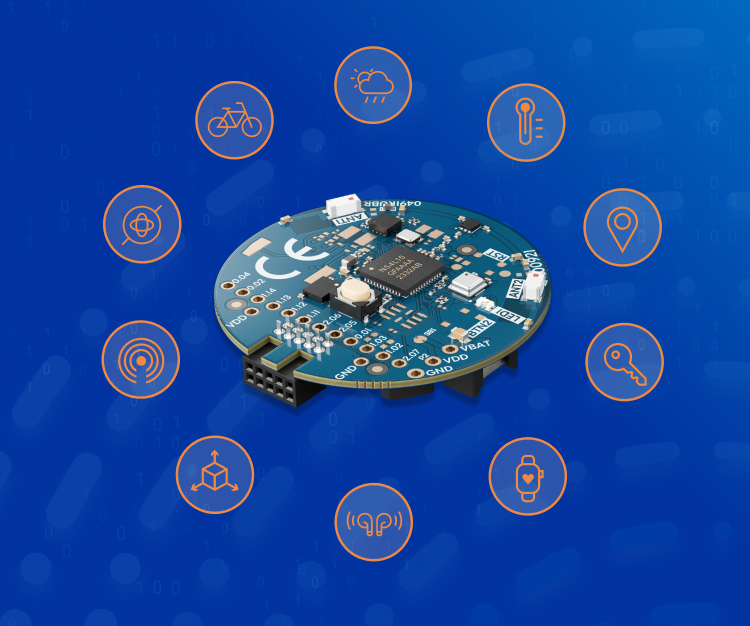
The board is built around Nordic’s nRF54L15 system-on-chip and is intended to shorten development of asset tags, Bluetooth trackers, distance-aware products, and Matter-enabled smart devices. It supports Bluetooth Channel Sounding, edge AI, Matter over Thread, environmental sensing, NFC, and multiprotocol wireless prototyping.
The nRF54L15 Tag includes dual antennas for Bluetooth Channel Sounding, allowing developers to evaluate distance measurement and secure ranging. It also integrates a six-axis IMU, environmental sensing for pressure, humidity, temperature, and gas including CO₂ levels, an RGB LED, NFC, and a CR2032 coin-cell power source. A low-power accelerometer supports motion-triggered wake-up, keeping the device in deep sleep when inactive.
The platform uses a 128MHz Arm Cortex-M33 processor in the nRF54L15 SoC, with memory resources suited to more advanced low-power designs. Nordic’s software support includes nRF Connect SDK samples for Apple Find My and Google Find Hub compatibility, as well as Matter and Bluetooth Channel Sounding development.
Wireless evaluation hardware has moved well beyond radio demonstration. Engineers working on low-power devices now need to assess antennas, sensors, power states, wake-up behaviour, mobile ecosystem support, security, firmware update paths, and mechanical constraints long before a product reaches layout freeze. A compact tag that already includes sensing, battery power, antennas, and software examples gives development teams a more realistic starting point than a bare MCU board.
The same platform-led design approach is appearing in industrial robotics. The autonomous mobile robot reference platform developed by Arrow, eInfochips, and STMicroelectronics brings together motor control, sensing, compute, power management, and ROS 2 software to reduce integration risk. Nordic’s tag addresses a smaller device class, but the movement is similar: suppliers are packaging hardware and software around application problems rather than isolated components.
Bluetooth Channel Sounding is likely to shape many of the first use cases. Asset tracking and proximity systems have often relied on received signal strength, which can be unstable in real operating environments. Channel Sounding, introduced in Bluetooth 6.0, gives developers a route to more accurate ranging using phase and timing techniques. In warehouses, hospitals, factories, offices, and smart buildings, that can improve confidence in whether an asset is nearby, moving, misplaced, or at the intended location.
Edge-AI support adds another layer to the product’s role. Low-power tags are no longer limited to broadcasting identity and location data. With inertial and environmental sensing, local inference can support movement classification, gesture recognition, anomaly detection, and context-aware wake-up. Processing simple events locally can reduce radio traffic and extend battery life, especially in products that spend most of their time asleep.
Matter over Thread support brings the board into smart-building and connected-device development, where interoperability is becoming a design requirement rather than a later certification hurdle. Device identity, commissioning, security, and ecosystem compatibility can now be evaluated alongside RF performance and current consumption.
The nRF54L15 Tag gives developers a compact environment for exploring how wireless, sensing, power management, and software behaviour interact. Its value will be strongest where early prototypes need to reflect the final product’s constraints, rather than simply proving that the radio or processor works in isolation.