
IN Brief:
- PTC has moved MBD directly into Onshape’s live CAD and PDM environment, rather than treating it as a separate downstream task.
- The release adds embedded PMI, browser-shared annotated views, and STEP AP242 export for inspection and compliance workflows.
- It strengthens the case for a single, always-current product definition across design, manufacturing, and quality.
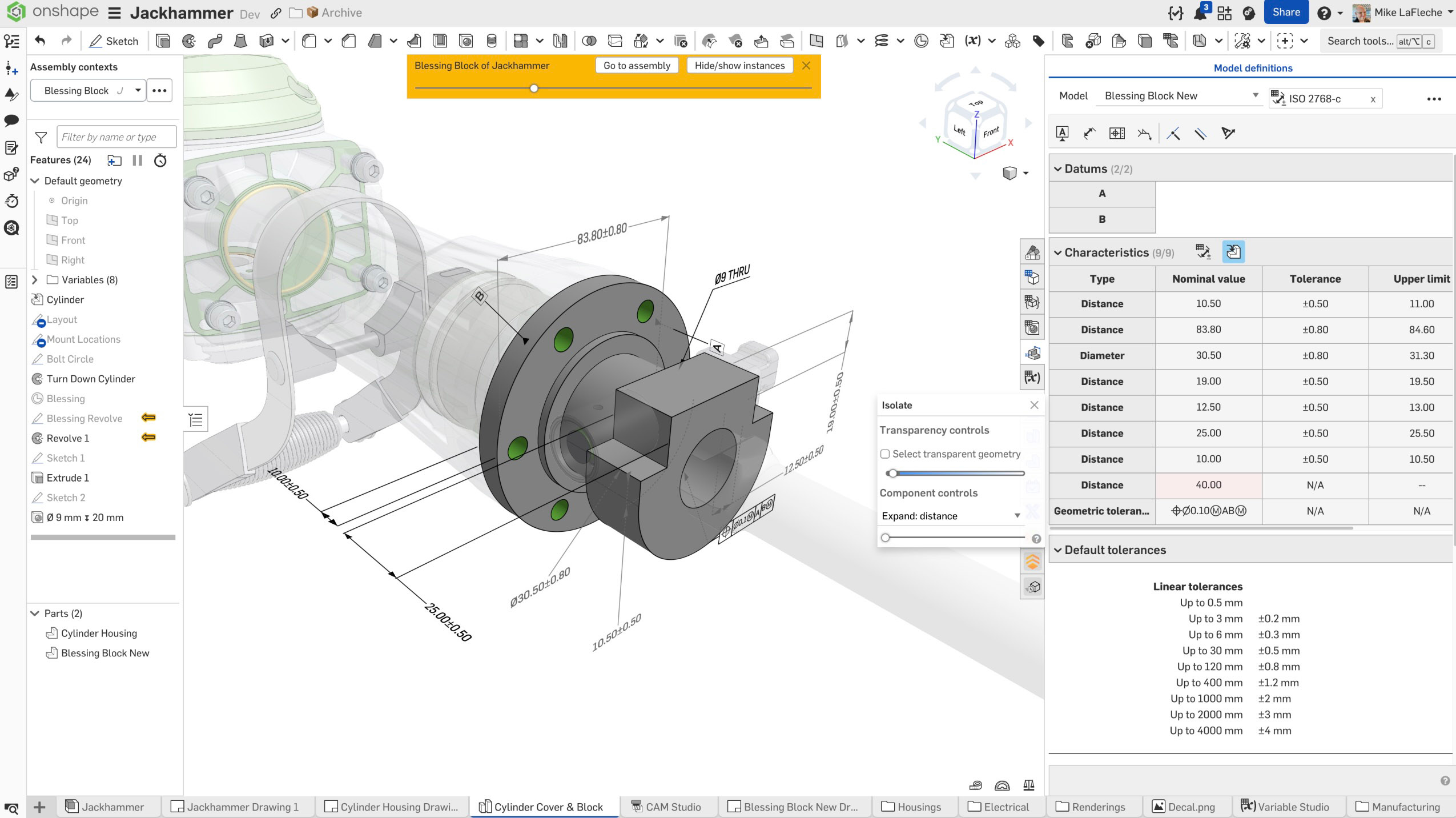
PTC has pushed model-based definition deeper into Onshape’s cloud workflow, releasing an MBD capability built directly into the platform’s core CAD and PDM environment. The change means manufacturing information can be attached to the live 3D model, rather than split across drawings, exports, and disconnected review cycles that drift as soon as a design changes.
The timing makes sense. MBD has been discussed for years as a cleaner route between design intent and downstream inspection, manufacturing, and quality processes, but adoption has often slowed once teams hit the usual friction points: extra modules, restricted viewers, stale exports, and the simple fact that not everyone in the chain is working from the same file at the same time. Onshape’s move is to treat product manufacturing information as part of the shared model from the outset.
The new capability lets engineers embed GD&T, datums, weld symbols, and related annotations directly in the model, while a smart inspection panel organises PMI into a structured, filterable view linked to the corresponding geometry. Shared web links preserve those annotated views in a browser, and feature-tree awareness keeps the specifications tied to the right geometry as the design evolves. For teams that need data outside the live platform, STEP AP242 export and integrations aimed at PC-DMIS and AS9102 workflows give the release a more serious downstream role than a simple annotation layer.
“When you build aircraft under strict regulatory oversight, ambiguity is expensive,” said Marc Germain, Chief Digital Officer at Aura Aero. “As an early user of MBD in Onshape, being able to carry certification and manufacturing requirements inside the model instead of across drawings and files is already cutting rework and review cycles and helping our teams work faster with fewer handoffs.”
This is less an annotation feature than an attempt to make the live model the authoritative handoff between design, quality, and manufacturing. File-based environments have a habit of turning the digital thread into a polite fiction, where the CAD model, drawing pack, inspection output, and supplier copy drift apart just enough to waste time and occasionally create a quality issue. A browser-native MBD workflow does not remove those risks by itself, but it does make it harder for different parts of the organisation to work from different truths.
PTC is also leaning into the wider cloud argument that sits underneath Onshape’s pitch: always-current data, real-time collaboration, and change control that is less dependent on who exported what and when. If MBD is going to move beyond tightly managed aerospace pilots and into routine engineering use, it will need to become visible, accessible, and ordinary. Putting it into the core modelling experience is a strong start.

