IN Brief:
- OV Spark uses a 1.2MP global shutter sensor, while Spark Pro raises resolution to 5MP in the same IP66 enclosure.
- Ten onboard inspection tools cover alignment, classification, segmentation, anomaly detection, OCR, measurement and barcode checking.
- Inspection recipes, model training, inference, image storage, industrial communications and the operator HMI run locally on the camera.
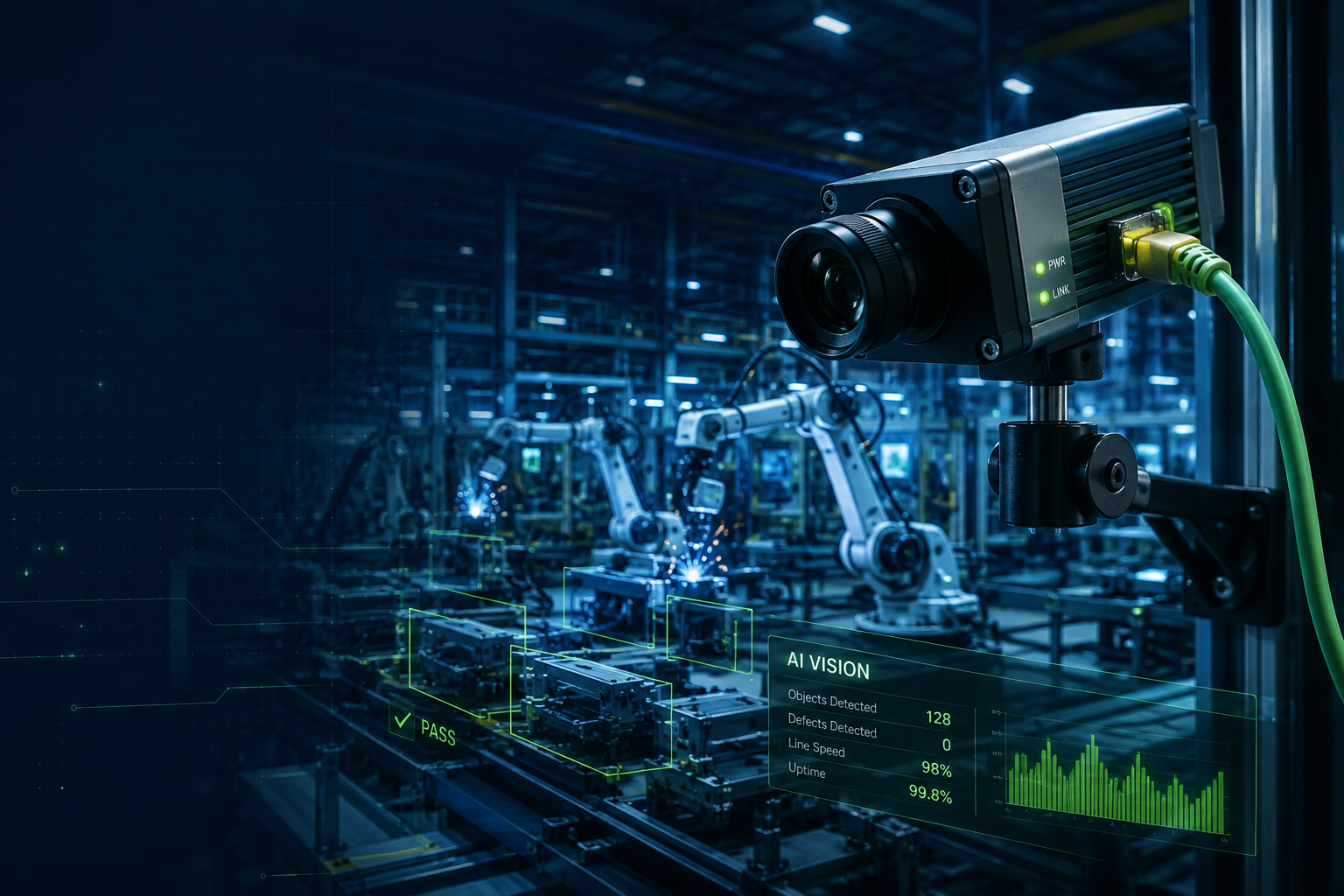
Overview AI has launched OV Spark and Spark Pro, two industrial inspection cameras that combine image capture, machine learning inference, inspection logic, industrial communications, image storage and operator controls inside one IP66 enclosure.
Spark uses a 1.2MP colour global shutter sensor, while Spark Pro raises resolution to 5MP. Both use the same 70 × 116 × 53mm housing, an autofocus lens and eight individually programmable white LEDs, allowing integrators to choose sensor resolution without changing the basic mechanical format.
Ten inspection tools can be combined within one recipe. Seven use deep learning models for AI Trigger, Alignment, AI Classification, AI Segmentation, AI Count, AI OCR and Anomaly Detection. Barcode, Measurement and Color Match provide three additional tools for checks that do not always require a trained model.
Different inspection problems benefit from different methods. A known dimension can be checked against a numerical tolerance, while a surface defect with variable shape may suit segmentation or anomaly detection. OCR, classification and counting each require different image features. Combining several tools within one recipe allows the camera to make multiple decisions about the same part before returning a final result.
Overview has also added an onboard software agent called Sparky. It can recommend inspection tools, explain those recommendations and answer questions about what the production line has been running. The agent is intended to assist configuration, but it does not remove the need to establish suitable lighting, exposure, working distance, training examples and acceptance limits for the actual part.
The production inspection path remains local to the camera. Overview says recipes, model training, inference, pass or fail decisions, PLC communications, image storage and the operator HMI all run on the device, without requiring cloud connectivity. Optional cloud services can still be used for tasks such as creating synthetic training images.
The cameras use a Qualcomm Dragonwing AI processor with 8GB of RAM and 128GB of onboard storage. Industrial communications include EtherNet/IP, PROFINET, Modbus TCP, MQTT and OPC UA, allowing results to pass directly into control or supervisory systems without a separate industrial PC whose main role is protocol translation.
Triggering can come from a PLC or hardware input, while the AI Trigger function can detect when a part reaches the required position in the image. That can remove a separate presence sensor in suitable applications, but only where line speed, part presentation and camera latency leave enough time to recognise the part before the inspection has to run.
Lighting remains part of the measurement chain. The eight programmable white LEDs give the recipe control over illumination, but glossy surfaces, shallow features and variable part orientation can still require more specialised lighting. A camera with onboard AI cannot recover information that the optics and lighting failed to capture clearly at the sensor.
Overview also provides digital inputs, a digital output and a strobe output for machine integration. Images and results can be transferred to FTP, SFTP or SMB storage, while recipe data can be moved between cameras. These functions support traceability when manufacturers need to retain failed images or reproduce a validated inspection on another line.
The company identifies Mansfield Engineered Components in Ohio as an early production user, where Spark is installed at a final inspection station that previously relied on visual checking by an operator. Overview has not published comparative defect detection or throughput figures for that installation, so it establishes production use without quantifying the improvement.
Processing time still depends on image size, exposure, tool selection and the number of inspection regions. Spark Pro can expose smaller features through its higher resolution, but more pixels also increase the data that has to be handled. Overview advises users to validate recipes at the required production speed rather than assuming the same configuration will suit every line.
Spark and Spark Pro concentrate much of the conventional machine vision stack into the camera. The hardware removes some integration layers, but inspection performance still depends on the physical scene, a repeatable image and a recipe whose limits have been validated against the manufacturing process.