
IN Brief:
- Pickering Interfaces has introduced three PXI/PXIe analogue output modules for functional test and HIL.
- The modules cover waveform generation, isolated DAC outputs, and high-density thermocouple simulation.
- Test systems are being pushed towards more realistic signal and sensor simulation as embedded controllers become more complex.
Pickering Interfaces has introduced three PXI and PXIe analogue output modules for functional test and hardware-in-the-loop applications.
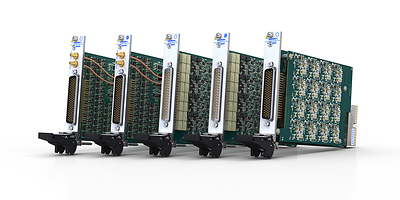
The modules expand Pickering’s signal sourcing and sensor simulation portfolio, covering multi-channel waveform generation, precision digital-to-analogue converter outputs, and high-density thermocouple simulation. They are designed to help engineers stimulate embedded controllers with realistic analogue, sensor, and waveform conditions from modular test systems.
The 41-770 PXI and 43-770 PXIe DAC modules provide up to four fully isolated analogue output channels in a single 3U PXI or PXIe slot. Each channel is independently programmable across multiple voltage and current ranges, with voltage outputs up to ±40V and current outputs up to ±20mA. The modules can also simulate open-circuit conditions, allowing test systems to reproduce wiring faults or failed sensors during fault-injection testing.
The 41-625 PXI and 43-625 PXIe multi-channel waveform generators provide up to 32 independent output channels in a single 3U slot. They support waveform generation from DC to 300kHz, making them suitable for applications such as accelerometer simulation and other multi-channel stimulus requirements. Each channel has independent memory for sine waves, standard waveforms, or user-defined arbitrary waveforms, with Direct Digital Synthesis used for software-controlled frequency adjustment.
The PXI 41-761A analogue output and thermocouple simulator modules provide µV-level thermocouple sensor simulation with built-in fault insertion. With up to 32 isolated channels per slot, they support dense thermocouple simulation without requiring additional external switching or a larger system footprint.
Embedded and industrial controllers are being tested against more complex signal environments. Automotive, aerospace, energy, process control, industrial automation, and safety-related systems all depend on controllers that respond correctly to changing analogue conditions, sensor drift, wiring faults, and transient events. Static voltage levels are no longer enough to represent the operating conditions that firmware and hardware must survive.
Hardware-in-the-loop testing allows controllers to interact with simulated physical systems that would be expensive, unsafe, or impractical to reproduce directly during every test cycle. A thermal control unit, vehicle subsystem, industrial machine, or aerospace controller may need to experience failed thermocouples, open circuits, vibration-like signals, edge-case sensor values, and rapid condition changes before the design can be qualified.
Measurement discipline has become a production-readiness issue across high-reliability electronics. In defence manufacturing, Keysight’s managed test-equipment support for Leonardo UK covers calibration, repair, lifecycle management, and digital asset coordination across multiple sites. Pickering’s modules sit further upstream, where design and validation teams need flexible stimulus hardware to build confidence before production and acceptance testing.
Channel density also affects the economics of test. As sensor counts and control loops rise, test racks can become large, expensive, and difficult to maintain. High-density PXI and PXIe modules allow compact systems to be built while preserving modularity and long-term serviceability. Isolation helps reproduce real-world wiring arrangements and voltage domains without introducing unwanted coupling between channels.
Fault insertion strengthens the value of the modules because many reliability problems are triggered by imperfect signals rather than ideal behaviour. Reproducing open circuits, failed sensors, and out-of-range values in a controlled test environment helps validate diagnostics, alarm handling, shutdown behaviour, and safe-state logic.
The release reinforces the continuing role of PXI and PXIe in automated test. Software-defined instrumentation has expanded the available toolset, but modular hardware remains central where repeatability, lifecycle support, channel density, and realistic analogue behaviour determine whether a validation system can keep pace with increasingly complex embedded designs.

