
IN Brief:
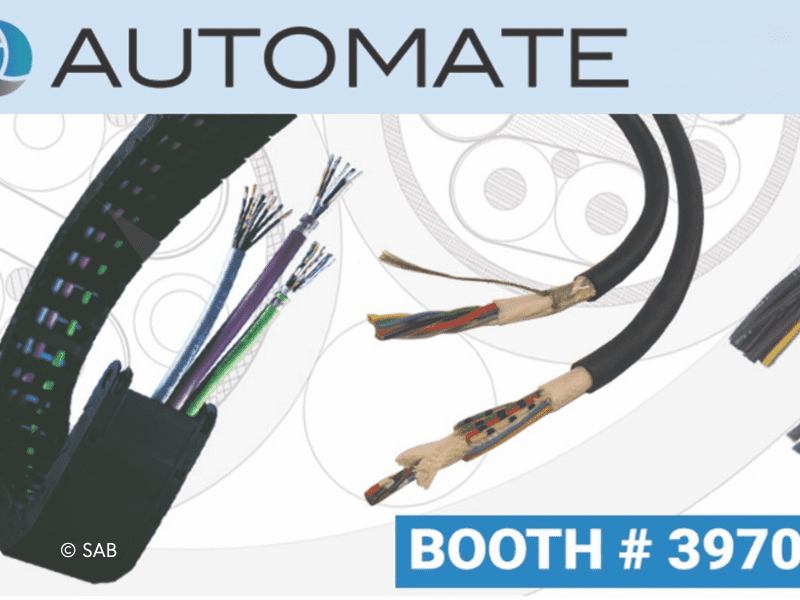
- SAB Cables is showcasing flexible automation cabling for OEMs and machine builders.
- The portfolio includes high-flex control cables, drag-chain cables, compact data cables, and custom-engineered designs.
- Motion-control reliability is pushing cable selection closer to core machine design decisions.
SAB Cables is showcasing flexible automation cabling and connectivity technologies for OEMs, machine builders, robotics developers, and motion-control systems.
The company is using Automate 2026 in Chicago to present high-flex control cables, continuous-motion cable technologies, compact control and data cables, and application-specific cable designs for automated machinery. The portfolio is aimed at systems where repeated bending, torsion, vibration, and constrained routing can produce failures long before the electronics themselves reach end of life.
Cabling is often treated as a late-stage specification, yet it can determine how reliably a machine performs in production. Robots, gantries, inspection platforms, packaging machinery, warehouse automation, test equipment, and pick-and-place systems all depend on cables carrying power, signals, feedback, and data through moving structures. Underspecified cables can create intermittent faults that are difficult to diagnose and expensive to correct once equipment is installed.
High-flex and drag-chain cables are designed to survive repeated motion over long operating lives. That requires conductor constructions, insulation systems, shielding, jacket materials, and mechanical layouts able to tolerate dynamic stress while preserving electrical behaviour. In compact machinery, cable diameter, bend radius, routing, shielding, and connector selection can become as influential as controller or drive choice.
SAB’s portfolio includes continuous-flex and drag-chain cables for high-cycle applications, alongside smaller control and data cables for installations where space is limited. The company is also promoting custom cable engineering, allowing machine builders to adapt materials, shielding, layouts, and mechanical characteristics around specific application requirements.
Customisation is becoming more valuable as automation systems become more varied. A standard cable may be adequate in a fixed panel or lightly moving assembly, but higher-speed axes, collaborative robots, compact enclosures, clean manufacturing environments, harsh industrial sites, and outdoor systems impose different mechanical and environmental demands. Oil resistance, chemical exposure, washdown, temperature range, abrasion, electromagnetic compatibility, and bend behaviour all affect cable life.
Motion-control systems expose the connection between mechanical design and electrical integrity. Encoder feedback, motor power, fieldbus communications, and sensor signals may all share confined paths inside a machine. Poor shielding, excessive mechanical stress, incorrect grounding, or unsuitable cable routing can create noise, data loss, or feedback errors that appear only under motion, load, heat, or vibration.
The same reliability pressure is visible across industrial networking. Rugged Ethernet switches from HMS show how machine-level connectivity is being hardened as control systems, sensors, drives, and diagnostic equipment become more networked. Cables and connectors form the physical layer beneath that shift, and a robust switch cannot compensate for repeated cable failure in a moving assembly.
Robotics adds further stress because movement is rarely uniform across an entire machine. Some sections remain fixed, while others rotate, flex, twist, accelerate, or pass through drag chains. A cable that survives one axis may fail quickly on another, especially where torsion and bending combine. Mechanical routing and cable construction therefore need to be considered together, rather than corrected through service replacement after commissioning.
Maintenance strategy is also changing. Manufacturers want machines that can provide useful diagnostics, support predictive service, and operate with fewer unplanned stoppages. Cable failures are awkward in that context because they can produce intermittent symptoms before a clear break occurs. A machine may pass acceptance testing, then show sporadic faults as production hours accumulate.
SAB’s focus on flexible automation cabling reflects a practical shift in machine design. Uptime is not delivered by control electronics alone; it relies on the conductors, shields, jackets, terminations, and routing decisions that carry power and data through moving equipment. As automation becomes faster, denser, and more connected, cabling is moving from the bill of materials margin to the reliability core of the system.

