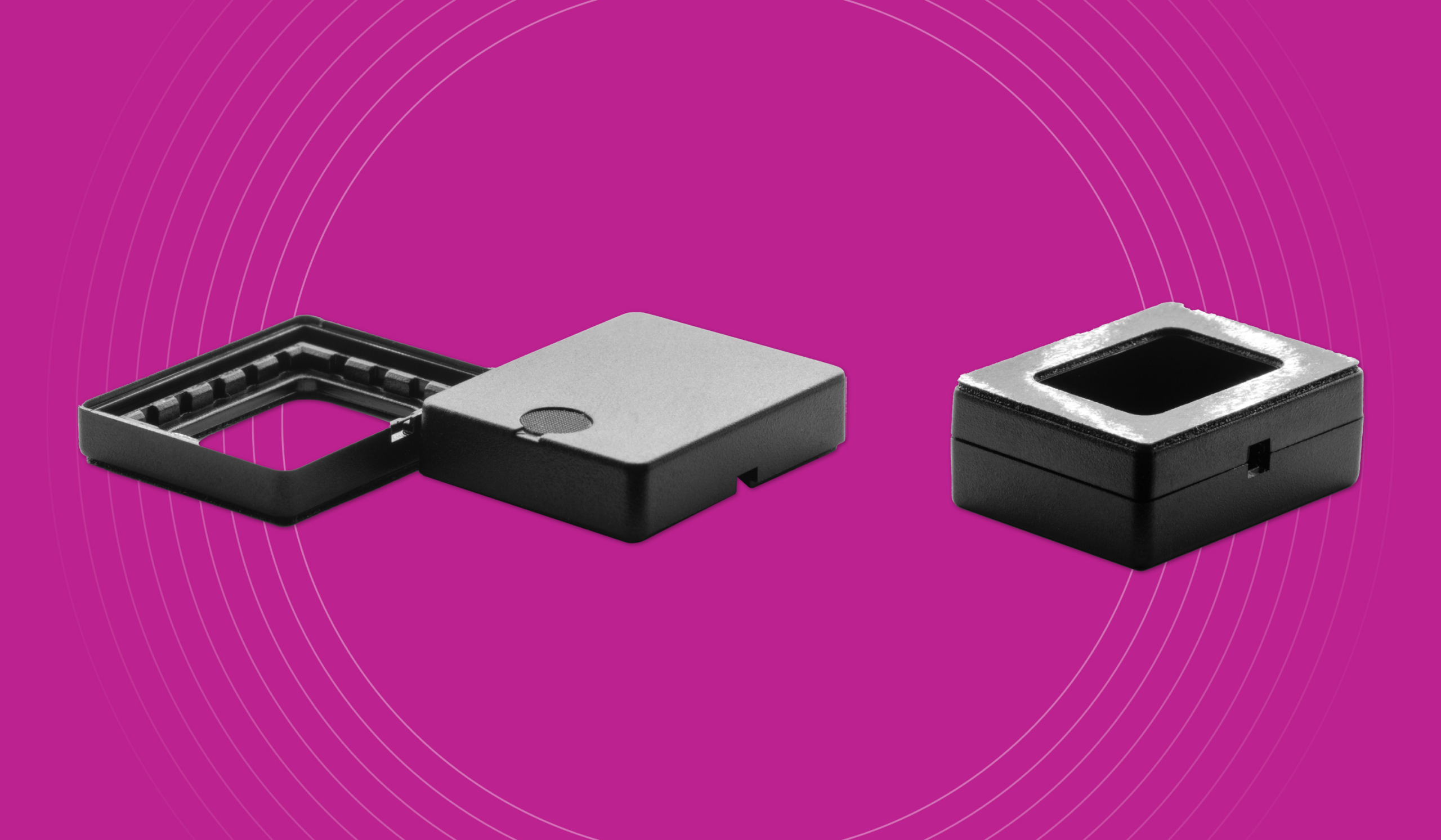
IN Brief:
- Three enclosure sizes support 15 × 11mm, 16 × 9mm, and 18 × 13mm rectangular miniature speakers.
- Each enclosure provides an approximately 1cc controlled rear acoustic volume for performance testing and evaluation.
- The fixtures give designers a repeatable acoustic load before the final product housing has been completed.
Same Sky has detailed three prototyping test enclosures designed to give miniature loudspeakers an approximately 1cc rear acoustic volume during engineering evaluation. The BOX-1511-1CC, BOX-1609-1CC, and BOX-1813-1CC support rectangular speaker frames measuring 15 × 11mm, 16 × 9mm, and 18 × 13mm respectively.
The fixtures address a basic measurement problem in miniature audio design. A loudspeaker intended to work against a defined rear cavity can produce substantially different results when evaluated without that acoustic load, making free-air sampling a poor representation of how the same component will perform inside a finished product.
Rear volume becomes particularly influential as the driver gets smaller. Movement of the diaphragm compresses and expands the air trapped behind it, so the enclosure forms part of the mechanical and acoustic system rather than acting simply as a protective box around the speaker.
Same Sky’s approximately 1cc fixtures provide a repeatable cavity during early component evaluation. Engineers can therefore compare compatible speakers under the same rear-volume condition before the final mechanical enclosure has been designed, rather than fabricating an individual prototype housing around every candidate driver.
The BOX-1511-1CC is intended for 15 × 11mm speakers, the BOX-1609-1CC for 16 × 9mm parts, and the BOX-1813-1CC for 18 × 13mm devices. Same Sky’s documentation describes the products as simple-assembly test enclosures and provides an assembly guide covering installation of the speaker, wire routing, and enclosure preparation.
A fixed test cavity is useful because rear volume affects the restoring force acting on a miniature speaker diaphragm. Making that cavity smaller increases the stiffness contributed by the enclosed air, while leakage, vents, and other mechanical details can alter the resulting frequency response and low-frequency behaviour.
The 1cc value should therefore be treated as a controlled evaluation condition rather than a universal optimum. Different speakers have different diaphragm areas, compliance, resonance, damping, and excursion characteristics, and the final product enclosure may need a different volume or acoustic treatment once the rest of the mechanical design is established.
What the fixtures provide is repeatability. If two candidate speakers are measured in different improvised housings, the enclosure itself can become part of the comparison and obscure differences between the drivers. Using the same defined cavity removes one source of variation before designers begin testing the interaction with the final product structure.
That can be useful in compact industrial terminals, medical devices, access-control equipment, instrumentation, communications hardware, and other embedded products where a speaker has to compete for internal volume with displays, batteries, PCBs, connectors, seals, and structural components.
Mechanical packaging in those products often develops in parallel with the electronics. Audio engineers may need to select a speaker before the final rear volume is available, while mechanical engineers need a credible estimate of the space the audio system requires before they can freeze the enclosure.
A controlled test enclosure gives the two processes a common reference. Speaker samples can be measured earlier, and the results can be used to decide whether the planned product housing needs more acoustic volume, whether additional sealing is required, or whether another driver is a better fit for the available space.
Same Sky’s own enclosure-design guidance emphasises that the rear cavity should be treated as part of the speaker system. Its test boxes bring that principle into the component-sampling stage by replacing an undefined free-air condition with a known volume that can be reproduced across several tests.
The supplied announcement lists distribution pricing from $1.99 per unit and positions the enclosures as both evaluation tools and possible starting points for later mechanical development. Their low unit cost makes them closer to reusable engineering fixtures than specialist acoustic test equipment.
They do not remove the need to measure the finished product. Final housings introduce their own wall materials, seals, vents, internal obstructions, acoustic openings, and resonances, all of which can alter performance after the speaker has been selected.
The more limited benefit comes earlier in the design cycle: the BOX series gives engineers a consistent rear load while component and enclosure decisions are still being made. That makes speaker sampling less dependent on an improvised bench fixture and provides a more useful reference before the real product housing is available.