IN Brief:
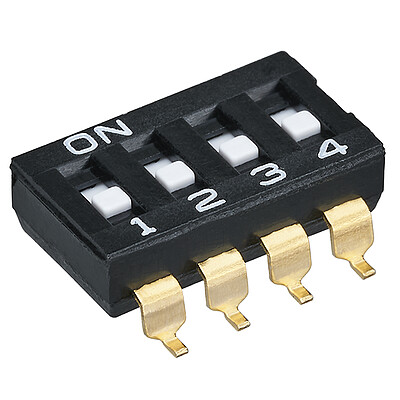
- The DMSD surface-mount DIP switch uses a standard 2.54mm pitch and is offered in 66 variants.
- Electrical ratings extend to 50VDC and 100mA for static contact conditions.
- A −40°C to +85°C range and 2,000-operation lifetime suit configuration functions in industrial equipment.
Schurter has introduced the DMSD family of low-profile surface-mount DIP switches for fixed hardware configuration in industrial controls, medical equipment, communications hardware, servers, robotics, and embedded systems.
The devices retain the established 2.54mm contact pitch while replacing through-hole terminations with gull-wing surface-mount leads. Sixty-six variants cover one to ten positions, plus a 12-position version, with recessed, raised, or film-covered actuators available for different access and handling requirements.
Installed height is 3.6mm, allowing the switch to sit beneath tighter covers and within densely populated assemblies. Reflow-compatible construction also places the component within the main surface-mount process rather than requiring a separate insertion and wave-soldering stage.
Electrical ratings extend to 24VDC and 25mA where contacts are changed regularly, or 50VDC and 100mA where the selected state remains constant. Initial contact resistance is specified at no more than 50mΩ, rising to a maximum of 100mΩ after environmental and mechanical testing.
Gold-plated copper-alloy contacts and terminals are used throughout the switching path, while dielectric strength is rated at 500V for one minute. The mechanism is specified for 2,000 operations, with an operating force not exceeding 8N and an operating-temperature range from −40°C to +85°C.
Mechanical switches continue to serve configuration functions that cannot always be replaced conveniently by software. They can set addresses, boot modes, communications parameters, test states, regional options, or restricted service functions without requiring power, credentials, a display, network access, or a programming tool.
A visible switch state also simplifies commissioning and repair because an engineer can inspect a board and confirm its configuration directly. Settings held in non-volatile memory may require compatible software and a working interface before they can be read, while corrupted or replaced memory can remove the original state entirely.
Some products read the switch only during start-up, creating a controlled boundary between fixed hardware selection and normal operation. That approach prevents a remote command or software fault from altering a protected mode while the equipment is running, although it requires a restart whenever the setting changes.
Every electromechanical contact introduces constraints alongside that simplicity. The body consumes board area, the actuator requires physical access, and contamination or repeated handling can affect contact behaviour, particularly where the enclosure does not protect the switch from dust, moisture, or aggressive cleaning processes.
Placement should therefore follow the intended service model. A switch set once during manufacturing can be positioned for automated test and then protected, whereas a field-adjustable device needs clearance for a tool, visible numbering, safe access, and an enclosure opening that does not compromise ingress protection.
Gull-wing leads support automated optical inspection of the solder joints, although configuration itself may still require electrical verification. Where the selected state controls a safety function, communications address, or regional compliance setting, end-of-line test provides stronger evidence than relying on visual confirmation.
The standard pitch eases schematic and footprint migration, but body outline, actuator travel, solder fillets, inspection access, coating keep-outs, and tool clearance remain part of the layout. Small electromechanical devices can obstruct neighbouring connectors or test points when access is considered only after component placement has been fixed.
Production decisions are also being made against tighter PCB supply conditions. A sharp rise in board orders and new part numbers has underlined the value of settling footprints, panelisation, and assembly routes early enough to avoid repeated revisions when manufacturing capacity is already constrained.
For equipment expected to remain in service for many years, a mechanical state can survive firmware replacement, memory corruption, or the exchange of a control board. Maintenance teams can reproduce the required configuration without relying on an obsolete application, a discontinued cloud service, or records that may no longer be accessible.
The DMSD family applies surface-mount production methods to a conventional configuration component without abandoning the standard 2.54mm pitch. Its usefulness will depend on disciplined placement and verification, but the underlying function remains durable: a compact, inspectable means of fixing hardware behaviour independently of software.