IN Brief:
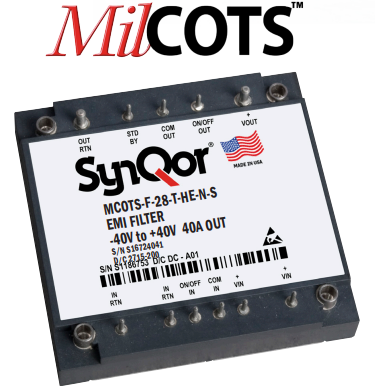
- SynQor has launched the MCOTS-F-28-T-HE transient half-brick DC EMI filter.
- The module supports -40V to 40Vdc input, transients up to 210Vdc, and continuous output up to 600W or 40A.
- The device targets military ground, sea, and airborne power architectures requiring multi-standard compliance.
SynQor has expanded its Military Commercial-Off-The-Shelf power portfolio with the MCOTS-F-28-T-HE transient half-brick DC EMI filter for defence and aerospace power systems.
The filter supports a continuous input range from -40V to 40Vdc and can withstand transients up to 210Vdc. It can deliver up to 600W or 40A continuously and is designed to enable standard and low-input 28Vdc MCOTS converters to meet demanding military and aerospace power requirements.
The module includes active surge, spike, and reverse-polarity protection. During spikes and surges, its integrated buck stage clamps the output to below 50Vdc, protecting downstream converters and electronics. Once started, the filter can continue operating down to an input voltage of 5.8Vdc, while startup inrush current is limited to around 4A and standby current remains below 12mA.
SynQor has designed the MCOTS-F-28-T-HE to support compliance with standards including MIL-STD-461, MIL-STD-1275 B/D, MIL-STD-704, MIL-STD-810G, DO-160E, and DEF-STAN 61-5. The device also includes pass-through ON/OFF control, allowing downstream converters to be controlled without compromising EMI performance.
The product is available through Astute Group as an authorised SynQor distribution partner. Military electronics programmes often require more than a datasheet, with design-in support, authorised supply, lifecycle planning, traceability, and documentation all affecting whether a component can be adopted in a qualified platform.
Defence electronics are carrying denser sensing, communications, computing, and electronic-protection functions across smaller and more mobile platforms. Ground vehicles, ships, aircraft, unmanned systems, and portable mission equipment are taking on more electronic load while still operating from power sources exposed to spikes, surges, cranking events, generator behaviour, lightning-induced transients, EMI, vibration, and thermal stress.
The same growth in electronics content is visible in GCAP’s £4.6bn engineering phase, where future air platforms are increasingly defined by sensors, software, electrical power, digital engineering, and test maturity. That movement is not limited to advanced combat aircraft. Across defence systems, power architectures are being asked to support more compute, sensing, and communications hardware than earlier platform designs anticipated.
Power protection can determine whether mission electronics survive the electrical environment they are deployed into. A converter that behaves well on the bench may fail compliance or suffer reduced lifetime when exposed to real platform transients. Filters and protection modules sit between standards compliance, reliability, and integration schedule, particularly where redesign late in qualification would carry disproportionate cost.
EMI control becomes more difficult as platforms add radios, radars, electronic-warfare systems, displays, processors, actuators, and power converters inside constrained physical spaces. Poor attenuation or unstable converter behaviour can create noise paths that affect sensitive receivers, control electronics, or mission equipment. A matched filter and converter combination can reduce integration risk where electromagnetic behaviour has to be proven against demanding standards.
The MCOTS model reflects the way defence programmes balance standardisation with rugged performance. Fully custom power designs may offer tight optimisation, but they can add development time, qualification cost, and supply-chain risk. Qualified commercial-off-the-shelf modules give integrators a faster route where electrical, mechanical, thermal, and standards requirements align with available products.
SynQor’s MCOTS-F-28-T-HE extends that route for higher-power 28Vdc defence systems requiring transient suppression, EMI filtering, and protection against harsh input events. As military electronics absorb more compute, sensing, and communications functions, the reliability of the power chain will remain one of the quieter but decisive parts of platform engineering.