IN Brief:
- The AHP2356A supports GPS, Galileo, GLONASS, BeiDou, and QZSS frequency bands.
- A two-stage low-noise amplifier and integrated filtering strengthen the receiver’s RF front end.
- Final accuracy depends on installation, multipath control, receiver design, correction data, and complementary sensors.
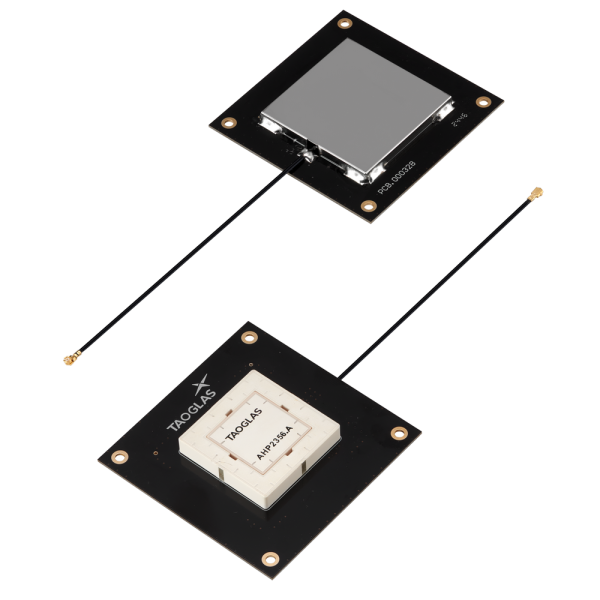
Taoglas has introduced the AHP2356A active multiband global navigation satellite system antenna for precision positioning, autonomous machinery, robotics, surveying, asset tracking, and agricultural equipment.
The antenna supports GPS and QZSS L1 and L2 signals, Galileo E1 and E5b, GLONASS G1, and BeiDou B1C and B1I. Its patch element measures 35mm by 35mm by 6mm, while the characterised configuration uses a 70mm square ground plane and an overall height of 11mm.
Behind the radiating element, a two-stage low-noise amplifier increases receiver sensitivity and compensates for losses through the cable and connector. Integrated filtering suppresses energy outside the navigation bands before it reaches the GNSS receiver, reducing the risk of desensitisation from nearby transmitters.
The AHP2356A.07.0100C variant is supplied with 100mm of 1.37mm coaxial cable and an I-PEX MHF I connector. Taoglas has tuned and measured the antenna on its specified 70mm by 70mm ground plane, whose dimensions form part of the RF design rather than a neutral mechanical detail.
Access to several constellations increases the number of satellites available to the receiver and can improve the geometry used to calculate position. Where buildings, machinery, or terrain obstruct part of the sky, the wider signal set also reduces the likelihood that the system loses a usable solution.
Dual-frequency reception allows a compatible receiver to estimate and correct part of the ionospheric delay affecting satellite signals. Combined with real-time kinematic or precise-point-positioning correction data, a suitable receiver, and a controlled installation, the architecture can support centimetre-level accuracy.
The antenna alone cannot establish that performance. Position error still depends on the host receiver, correction service, ground plane, enclosure, nearby conductors, cable routing, and the electromagnetic environment created by processors, displays, radios, motors, and switch-mode converters.
Patch antennas are particularly sensitive to the surface beneath them because the ground plane influences impedance, radiation pattern, gain, and polarisation. Moving the component onto a smaller board or placing it close to a battery, shield can, or metal enclosure can shift its response enough to reduce the expected benefit of the active stages.
Multipath adds another source of uncertainty when satellite signals reflect from buildings, vehicles, structural steel, or the ground before reaching the antenna. The delayed signal distorts the calculated range, and no increase in amplifier gain can separate it automatically from the direct path.
A high-gain front end can also amplify unwanted energy if filtering and linearity are inadequate. Cellular radios, private-network transmitters, and high-power digital harmonics may drive the LNA towards compression or create intermodulation products inside the navigation bands, making installation-level interference testing essential.
As dependence on satellite positioning grows, navigation systems are being designed with greater resilience against jamming, spoofing, obstruction, and outages. Work combining Rocket Lab and Iridium capabilities reflects a wider movement towards alternative timing and positioning sources that can supplement GNSS rather than assuming uninterrupted satellite reception.
Industrial platforms commonly fuse satellite measurements with inertial sensors, wheel encoders, cameras, lidar, or local radio beacons. The additional sensors can bridge short interruptions, reject implausible changes, and preserve stable control when a machine moves close to buildings or beneath partial cover.
Such fusion depends on accurate timing and a realistic model of each sensor’s uncertainty. A receiver may continue to output a plausible position after signal quality has deteriorated, so the host system must evaluate satellite count, correction age, dilution of precision, and integrity indicators before using the data in a control loop.
Environmental qualification extends beyond RF performance. Vibration can stress the patch and cable connection, temperature changes can shift resonance and amplifier gain, while condensation or contamination can alter dielectric conditions around an exposed antenna. The final enclosure has to preserve the characterised geometry without compromising sealing or serviceability.
The AHP2356A gives designers a compact multiband front end with amplification and filtering already integrated. Its contribution to precise navigation will be set by the complete signal chain — antenna placement, receiver architecture, correction data, interference control, and the complementary sensors that maintain confidence when satellite conditions deteriorate.