
IN Brief:
- The 34 PHE measures absolute electrical angle across ten complete mechanical turns.
- Hall-effect sensing removes the sliding contact used by conventional multi-turn potentiometers.
- Dual counter-tracking outputs support fault detection in industrial, transport, and actuator systems.
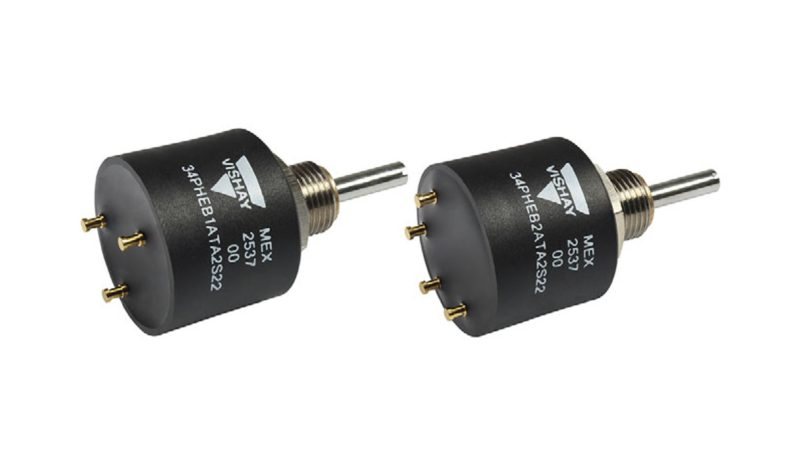
Vishay has introduced the 34 PHE non-contacting Hall-effect position sensor, which measures absolute movement across ten complete mechanical turns without a homing sequence or backup battery.
The device provides a total electrical angle of 3,600° with 1° resolution and linearity specified at ±1% of full stroke. Housed in a 22.2mm body, it is intended for servo loops, valve controls, industrial actuators, solar trackers, agricultural machinery, rail systems, and marine equipment.
Hall-effect measurement replaces the resistive track and sliding wiper used in a conventional multi-turn potentiometer. With no electrical contact moving across the sensing element, the 34 PHE carries an operating-life rating above ten million cycles.
Absolute position is available as soon as power is applied, allowing machinery to resume from a known state without driving towards an end stop or reference switch. Removing that routine shortens start-up and avoids the mechanical movement required to establish position after every interruption.
Output configurations include single or dual analogue ratiometric signals and pulse-width modulation. In the dual-output version, the signals counter-track one another, enabling the host controller to detect an open circuit, short circuit, or reading that falls outside the permitted relationship between channels.
The sensor operates from a 5V supply with a tolerance of ±10%, while typical current consumption remains below 8.5mA in a single-output configuration. Input protection covers reverse voltage to -14V and overvoltage to +28V, accommodating wiring errors and supply disturbances found in mobile and industrial equipment.
An IP65 enclosure provides protection against dust and water jets, while the assembly is rated for vibration to 20g and shock to 50g. Those limits suit feedback mechanisms mounted close to motors, hydraulic systems, mobile structures, or outdoor actuators rather than inside a protected cabinet.
Multi-turn absolute measurement can also be implemented through geared potentiometers, optical encoders, magnetic encoders, or single-turn sensors combined with electronic turn counting. Each arrangement carries a different balance of resolution, cost, mechanical complexity, retained position, environmental tolerance, and service life.
Although Hall sensing removes contact wear, the complete assembly still depends on shaft coupling, bearing play, gear backlash, end loading, and mounting tolerance. Those mechanical errors can exceed the sensor’s specified linearity if the feedback shaft is poorly supported or connected through an imprecise transmission.
Magnetic conditions require similar attention because motors, solenoids, steel structures, and high-current conductors can alter the field surrounding the device. Stray-field immunity, magnet stability, temperature drift, air-gap tolerance, and shaft alignment all enter the final position-error budget.
Magnetic sensing is spreading through drives and actuator systems as designers replace switches and wear-prone feedback components. Recent 3D Hall switches developed by TDK address motor and drive detection at shorter travel, while the 34 PHE extends the same contactless principle across continuous ten-turn measurement.
Redundant outputs add diagnostic coverage where an incorrect position could damage machinery or create unsafe motion. Counter-tracking channels make disagreement visible, although the controller still needs defined plausibility limits, independent supply monitoring, and a controlled response when both signals are affected by a common fault.
The manufacturer places the new device at approximately 40% below the cost of its previous-generation multi-turn Hall sensor. Lower component cost could extend absolute contactless feedback into applications that previously accepted potentiometer wear, periodic recalibration, or mechanical reference switches.
Lifetime economics will nevertheless depend on the surrounding mechanism and control system. Removing a homing switch, reducing maintenance access, or avoiding a field failure may outweigh a difference in sensor price, whereas a heavily geared assembly could continue to impose its own wear and backlash limits.
Calibration strategy also deserves attention when the sensor is installed in a serviceable actuator. The controller can compensate for assembly tolerances and end-point variation during production, but replacement procedures must preserve those corrections or provide a straightforward route to recalibration in the field.
By combining long travel, absolute measurement, environmental protection, and dual-channel diagnostics, the 34 PHE gives designers another route away from contact-based position feedback. Accurate operation across millions of cycles will still depend on disciplined mechanical integration and control logic around the sensing element.

