IN Brief:
- SCHRACK RSY is a compact PCB power relay rated up to 10A and 277VAC for industrial, HVAC, building, and drive applications.
- The family supports operation from -40°C to 105°C, with more than 5A switching capability at the upper temperature limit.
- TE says redesigned materials, components, and automated manufacturing reduce product carbon footprint by about 15% against the MSR predecessor.
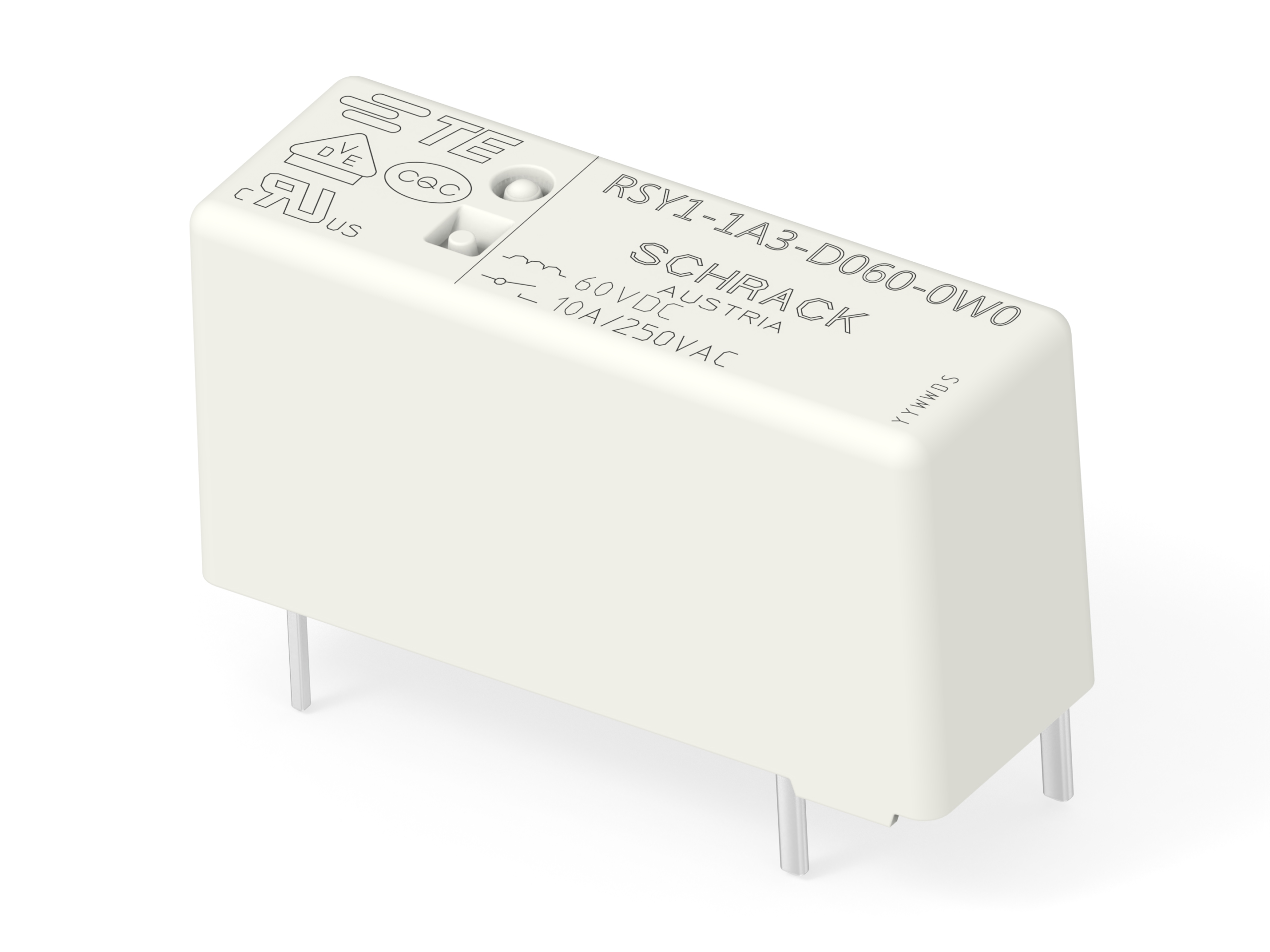
TE Connectivity has introduced the SCHRACK RSY family of compact PCB power relays for factory automation, HVAC, building systems, motion control, and drives, extending the thermal and electrical operating range of its long-established MSR platform. Initial devices use a normally open Form A contact and support switching loads up to 10A at 277VAC.
The wider family is specified for operation from -40°C to 105°C, with TE quoting more than 5A switching capability at the upper temperature limit. That derating is significant because a relay’s headline room-temperature current figure does not describe its behaviour inside a crowded controller, drive, HVAC unit, or building-automation enclosure where the coil and surrounding electronics can raise local temperature substantially.
Electrical load behaviour adds another constraint. Motors, solenoids, capacitive inputs, transformers, and switched-mode power supplies can draw inrush currents considerably above their steady-state demand, placing greater stress on contacts during opening and closing. TE says the RSY contact system has been redesigned to improve endurance under inrush and DC loads while maintaining reliable operation at much smaller signal levels.
The company specifies a minimum recommended contact load of 5V and 1mA over more than one million cycles. Low-level switching can be difficult for an electromechanical contact because there may be little electrical energy available to break through oxidation, contamination, or surface films, making contact material, geometry, force, and environmental protection important even where the current itself appears trivial.
RSY uses a monostable magnetic system with a more sensitive coil intended to reduce heat generation. Lower coil dissipation can give equipment designers additional thermal margin when several relays sit close together, although the completed system still has to account for coil voltage, duty cycle, PCB copper, ambient conditions, and heating produced by the load path.
The new platform is intended as a compatible successor to TE’s SCHRACK MSR relay, which has been used for more than three decades. Maintaining the existing PCB footprint gives equipment manufacturers a route to update the component without automatically changing board layout or assembly tooling, although electrical ratings, qualification, and application conditions still have to be checked before an existing design is migrated.
That compatibility can be valuable in industrial electronics with long product lives. Changing the mechanical footprint of an established relay can trigger PCB revision, manufacturing documentation changes, component-placement updates, qualification work, and another round of system testing even when the basic switching requirement remains unchanged.
TE is also extending the family beyond the initial normally open devices. Changeover Form C contacts and through-hole-reflow variants are planned, allowing the same relay platform to cover a wider range of switching architectures and PCB assembly processes. The company’s current RSY material lists through-hole reflow solderability among the family capabilities.
HVAC provides an additional design requirement because equipment manufacturers are moving towards lower-global-warming-potential refrigerants, including A2L and A3 classifications with differing flammability characteristics. TE lists compliance relevant to those applications, including IEC 60079-1 for A3 environments and UL 60335-2-40 requirements associated with A2L equipment.
Those standards do not make the relay suitable for every refrigerant system without further equipment-level assessment, but they give HVAC designers a component intended to address the electrical switching constraints created by the transition. The same family also targets industrial control panels, robotics, building systems, and motion applications where temperature, inrush current, and service life can dictate relay selection.
Sustainability is being attached to the component itself rather than only the equipment in which it operates. TE says the RSY has an approximately 15% lower product carbon footprint than the MSR predecessor, attributing the reduction to materials selection, redesigned components, and more automated manufacturing. The company is also using higher-capacity automated production as part of the transition to the new platform.
Automation can improve consistency in an electromechanical component where coil winding, magnetic assembly, contact positioning, sealing, and final adjustment all influence performance. It also gives TE a route to replace a mature relay family without creating a supply constraint as customers migrate established designs.
The RSY launch is consequently an incremental component development rather than a radical change in switching technology, and its engineering value sits in that increment. A familiar PCB footprint, higher thermal capability, low-load contact reliability, inrush endurance, and refrigerant-related compliance can remove several compromises from an otherwise routine relay selection. For designers maintaining equipment over long production lives, that is often more useful than another component requiring the board around it to change.