
IN Brief:
- Sustained disk streaming above 25 GB/s is moving long-run capture beyond niche custom systems.
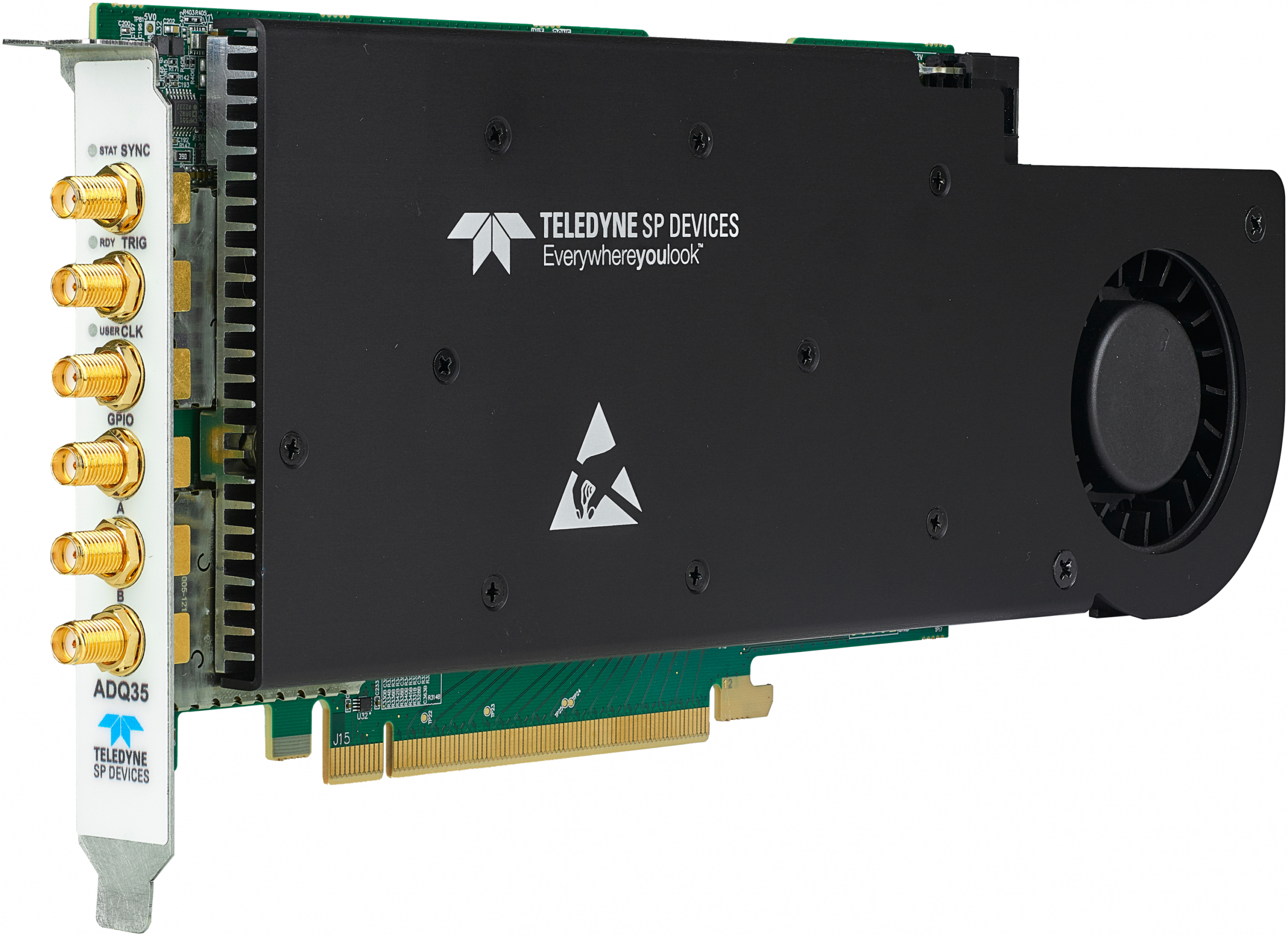
- ADQ35 combines up to 10 GSPS acquisition with libads direct-to-NVMe streaming that bypasses file-system overhead.
- PCIe lane planning, SSD choice, and RAID layout are becoming part of the acquisition architecture itself.
Teledyne SP Devices is pushing high-speed acquisition further into storage-domain design with a combination of its ADQ35 digitizer family and libads NVMe streaming library. Rather than treating disk capture as a post-processing constraint, the architecture writes directly to raw NVMe sectors, allowing continuous recording without the intermediate file-system overhead that usually breaks deterministic throughput once data rates begin to climb.
The ADQ35 sits at the front end of that chain with up to 10 GSPS in single-channel mode or 5 GSPS per channel in dual-channel operation, alongside sustained transfer rates of up to 14 GB/s to CPU or GPU. In Teledyne’s reference architecture, two boards running dual-channel 5 GSPS acquisition generate 25 GB/s of combined throughput, which is then matched with RAID configurations designed either for long-duration recording or shorter burst capture.
The enterprise option centres on five 15.3 TB Kioxia CD8 SSDs in RAID-0, giving 75 TB of capacity and 30 GB/s aggregate write speed. A lower-cost alternative using two 2 TB Kingston Fury Renegade G5 drives can still reach the required throughput envelope, although endurance and SLC-cache behaviour make it better suited to shorter acquisitions rather than extended runs.
That distinction matters because the bottleneck here is no longer converter speed alone. Host PCs need enough PCIe Gen4 or Gen5 lane budget to carry digitizers, GPUs, and NVMe carriers together, and Teledyne’s own guidance makes clear that motherboard layout, PCIe bifurcation, and SSD class all shape whether sustained capture is practical or merely theoretical.
The result is a more system-level view of data acquisition, where storage is treated as part of the signal path. Teledyne has published the disk-streaming configuration details alongside the ADQ35 platform documentation, giving developers a clearer route from bench evaluation to deployable long-duration capture systems.

