IN Brief:
- The TPS4141-Q1 measures unidirectional voltages to 1,200V and bidirectional voltages to ±1,200V.
- Four selectable divider ratios improve use of the connected analogue-to-digital converter’s input range.
- An integrated high-voltage switch disconnects the sensing input and blocks current when open.
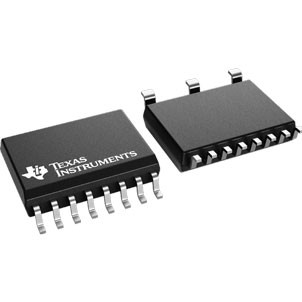
Texas Instruments has released an automotive-qualified high-voltage measurement device that combines a precision resistor divider, programmable-gain amplifier, and disconnect switch in one 11-pin package.
The TPS4141-Q1 supports unidirectional voltage sensing from zero to 1,200V and bidirectional measurements spanning minus 1,200V to plus 1,200V when an external precision reference is connected. Target applications include battery-management systems, traction powertrains, EV chargers, stationary storage, solar equipment, and industrial DC buses.
Two digital control inputs select overall divider ratios of 160, 320, 640, or 1,000. The ratio can remain fixed or change during operation, allowing the attenuated output to use more of the full-scale range available at the following analogue-to-digital converter.
At modest bus voltages, a lower division ratio produces a larger output signal and improves effective measurement resolution. As the input approaches the upper end of the range, the controller can select greater attenuation to prevent the amplifier or ADC from saturating.
An integrated high-voltage switch provides more than 1,200V of standoff between the sensing input and high-voltage ground. The measurement path can therefore be connected or disconnected electronically, while unidirectional current blocking limits current flow when the switch is open.
Supply voltage ranges from 4.5V to 20V, with current consumption specified at 5mA in the active state and 5.5µA when powered down. The DWQ-11 SOIC package measures approximately 10.3mm by 10.3mm and provides at least 8mm of creepage and clearance between the high-voltage sensing pin and the remaining pins.
A conventional high-voltage signal chain may require several precision resistors, protection components, switching, amplification, filtering, and a reference before the signal reaches an ADC. Every external component adds tolerance, temperature drift, leakage, parasitic capacitance, board area, and another surface on which contamination or spacing errors can disturb a high-impedance measurement.
Integrating the divider and amplifier places their matching within one characterised component and reduces the number of exposed high-impedance nodes. Flux residue, moisture, dust, and damaged conformal coating can produce leakage currents large enough to distort precision measurements, particularly when the available signal current has been deliberately kept low to reduce dissipation.
The package’s standoff capability does not establish compliance for the finished product on its own. Creepage, clearance, pollution degree, altitude, transient category, connector construction, enclosure design, and the applicable automotive or industrial standard still determine the required insulation system.
Fast switching around traction inverters, DC-DC converters, and chargers creates additional difficulty because common-mode transients and capacitive coupling can disturb the analogue ground or enter through the measurement network. Layout, filtering, reference stability, and the ADC interface remain influential even when attenuation and amplification have been integrated.
Communications around the same battery pack face comparable noise and isolation demands. Bourns has combined transformer isolation with common-mode filtering for BMS data links, addressing the integrity of signals that must operate beside high-energy switching, long harnesses, and rapidly changing common-mode voltage.
Bidirectional measurement broadens the TPS4141-Q1 beyond checking a positive battery bus. Regenerative drives, bidirectional chargers, energy-storage converters, and test equipment may need to monitor excursions on either side of a selected reference, and the external reference shifts the amplifier output so a unipolar ADC can represent both polarities.
The selectable ratio also allows range and resolution to change across pre-charge, normal operation, regenerative events, isolation testing, and discharge. A fixed attenuation network often leaves much of the ADC range unused during lower-voltage conditions, whereas programmable scaling can preserve more measurement detail without adding parallel analogue paths.
Functional-safety documentation is available to support ISO 26262 and IEC 61508 system development. The device remains one element within the diagnostic architecture, which may also require redundant sensing, plausibility checks, reference monitoring, ADC diagnostics, open-wire detection, and defined safe-state behaviour.
By integrating attenuation, amplification, switching, and range selection, the TPS4141-Q1 reduces the discrete circuitry surrounding a demanding measurement point. Rising vehicle and industrial bus voltages are increasing the value of that integration, provided the wider PCB, insulation, protection, and diagnostic design preserves the accuracy and safety performance available at component level.