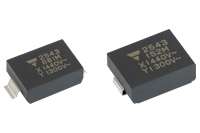
IN Brief:
- SMDY1…S ceramic safety capacitors carry Y1 300VAC and 1,500VDC ratings for mains and high-voltage DC applications.
- Surface-mount construction allows pick-and-place and reflow assembly in designs that would otherwise require through-hole safety capacitors.
- Capacitance spans 10pF to 1,500pF, with samples and production quantities available now.
Vishay Intertechnology has introduced a surface-mount family of Y1 safety capacitors for EMI and RFI filtering, combining a 300VAC safety rating with operation in DC networks up to 1,500V.
The BCcomponents SMDY1…S series uses single-layer ceramic construction and is intended to reduce the PCB area required by high-voltage safety capacitors. Vishay says the devices occupy up to 40% less board space than its previous generation while moving the component into a format compatible with pick-and-place assembly and reflow soldering.
The manufacturing change is as relevant as the headline voltage rating. Safety capacitors retain substantial through-hole use because insulation distances, construction, mechanical requirements, and certification can make them difficult to package in the same way as lower-voltage passive components. An approved Y1 device that can enter the main surface-mount assembly process can remove a separate insertion and soldering stage from suitable boards.
The new capacitors carry a Y1 rating of 300VAC and 1,500VDC, together with an X1 rating of 440VAC. Y-class capacitors are used where a failure could compromise an insulation barrier, and the Y1 classification allows the component to bridge double or reinforced insulation subject to the requirements of the finished equipment.
Vishay also specifies support for DC networks up to 1,500V under IEC 60384-14 Annex H. That gives the family a place in equipment where higher-voltage DC buses are increasingly common, including industrial drives, inverters, power converters, rail systems, uninterruptible power supplies, and charging infrastructure.
Capacitance values span 10pF to 1,500pF. The smaller A case covers 10pF to 680pF, while the B case covers 1,000pF to 1,500pF. Dielectric options include U2J, Y5S, and Y5U, with ±10% and ±20% capacitance tolerances depending on the selected device.
The series complies with IEC 60384-14 and carries approvals from UL, CSA, VDE, ENEC, and CQC. Vishay specifies insulation resistance of at least 10,000MΩ and an operating range from -55°C to +125°C. The devices are RoHS compliant and halogen-free, with flame-resistant epoxy encapsulation meeting UL 94 V-0.
Every component is subjected to end-of-line testing covering AC voltage, capacitance, dissipation factor, insulation resistance, and visual inspection. That test regime is particularly relevant for a component intended to sit across a safety insulation barrier, where the consequences of a defect extend beyond a conventional passive component drifting outside its nominal electrical tolerance.
The target applications include industrial motor drives, welding equipment, inverters, UPS equipment, rail power supplies, HVAC systems, LED drivers, switch-mode power supplies, AC/DC converters, and electric-vehicle charging equipment. Many of those systems are simultaneously moving towards greater power density and higher DC bus voltages.
That creates an awkward PCB problem. Designers are expected to reduce enclosure and board size while preserving creepage, clearance, insulation, and transient withstand requirements that do not shrink simply because the product needs to be smaller. Reducing the footprint of the capacitor can recover some board space, but the surrounding high-voltage layout still has to meet the applicable equipment standards.
The move to surface-mount assembly can also change production economics. A PCB populated almost entirely with SMD components may still require a separate through-hole process for only a handful of safety and power devices. Where a qualified capacitor can be moved into the reflow stage, manufacturers can potentially reduce selective soldering, manual handling, or secondary assembly work.
That does not make a 1,500V design routine. Pad spacing, PCB material, contamination, conformal coating, overvoltage category, pollution degree, and enclosure design remain part of the insulation system. The component approval establishes the capacitor’s suitability for the specified safety class; it does not automatically qualify the assembled board.
Samples and production quantities of the SMDY1…S series are available now, with Vishay quoting lead times of 12 weeks. The practical development is therefore a combination of electrical rating and manufacturability: a Y1 safety component intended to sit more naturally inside an automated surface-mount production flow.