IN Brief:
- The XFD11KxxCA family contains 15 bidirectional TVS devices in commercial and AEC-Q101-qualified versions.
- Stand-off voltages span 33V to 85V, with peak pulse current reaching 207.1A on a 10/1000µs waveform.
- An 8/20µs surge capability of up to 2,140A targets high-power automotive, industrial, storage, server, telecom, and radar applications.
Vishay Intertechnology has introduced a family of bidirectional transient-voltage suppressors designed to provide high surge capability while keeping the clamping voltage comparatively close to device breakdown.
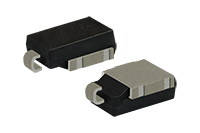
The XFD11KxxCA series contains 15 devices offered in commercial and AEC-Q101-qualified versions in the surface-mount DO-218AC package. Stand-off voltages range from 33V to 85V, covering protection requirements around 12V, 24V, and 48V automotive electrical architectures as well as industrial and infrastructure power systems.
A transient-voltage suppressor normally remains effectively inactive across the protected rail until an overvoltage pushes it into breakdown. The device then conducts surge current away from downstream electronics, limiting the voltage imposed on semiconductors, capacitors, and other circuitry.
How high that protected node rises under load is central to device selection. Vishay specifies a clamping-to-breakdown voltage ratio close to 1.0 for the new family, with maximum clamping voltages from 40.6V to 104V and breakdown voltages spanning 36.7V to 104V across the range.
Reducing the difference between breakdown and clamping voltage can give designers more control over the voltage margin required by downstream components. MOSFETs, capacitors, gate drivers, and power ICs all need to survive the residual transient after the suppressor conducts, so a larger overshoot can force those devices onto higher voltage ratings.
Vishay says the XFD11KxxCA parts deliver peak pulse power dissipation comparable with conventional 11kW TVS devices on a 10/1000µs waveform while retaining the flatter clamping characteristic. Peak pulse current reaches 207.1A on that waveform, approximately 1.6 times the figure quoted by the company for conventional DO-218-compatible devices at equivalent stand-off voltage.
The family is also rated for surge current of up to 2,140A on an 8/20µs waveform. The two figures describe different transient conditions and cannot be treated interchangeably: the longer 10/1000µs pulse represents a different energy profile from the shorter 8/20µs surge.
System design still has to account for the source impedance, expected transient shape, wiring inductance, PCB layout, and repetition rate. A TVS data-sheet clamping voltage is not necessarily the maximum voltage that every downstream component will see once parasitic inductance and interconnect are included.
The devices operate from -55°C to +175°C and have a maximum leakage current of 10µA at stand-off voltage. That temperature range suits power electronics mounted close to converters, motors, batteries, or other heat-generating assemblies where the suppressor cannot be assumed to operate near room temperature.
Vishay lists automotive uses including ADAS controllers, onboard chargers, DC/DC converters, traction inverters, battery-management systems, body controllers, pumps, camera systems, and climate electronics. Outside vehicles, the intended applications include energy storage, industrial servo systems and automation, AI-server hot-swap circuits, telecom power supplies, and radar power systems.
The move towards 48V distribution gives the upper part of the range particular relevance. Increasing distribution voltage reduces current for a given amount of delivered power, but switching loads and inductive paths can still generate transients large enough to threaten lower-voltage electronics connected further down the conversion chain.
Protection has therefore become part of the wider power-density problem. Higher-power systems need suppressors capable of absorbing substantial transient current without forcing large voltage guard bands or occupying disproportionate PCB area.
The XFD11KxxCA devices are RoHS compliant and halogen-free, with moisture sensitivity level 1 and a specified maximum reflow temperature of 245°C. Vishay says samples and production quantities are available now, with lead times of 12 weeks.
The useful engineering distinction is not simply the nominal surge-power figure. Vishay is combining high transient current with a lower clamping ratio, giving designers more scope to contain overvoltage without increasing the voltage rating of every component sitting behind the protection device.