IN Brief:
- The family consists of VCND2040X02, VCND2040SLX02, VCND2045X02 and VCND2045SLX02 variants.
- Vishay specifies up to 6Mbit/s operation and model-dependent rise and fall times as low as 9ns.
- Each device combines an infrared emitter and photodiode in a 4.4 × 2.25 × 1.9mm package.
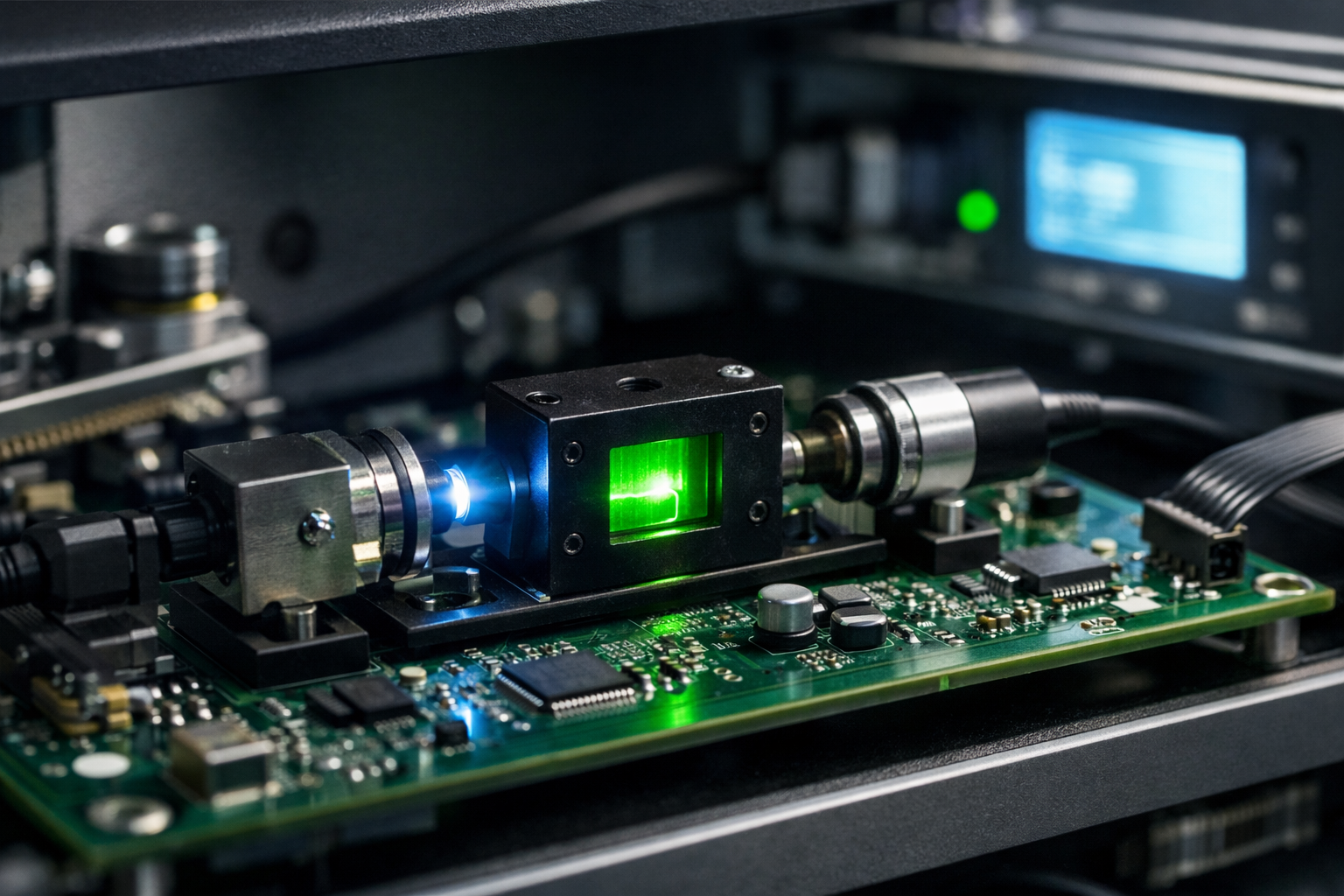
Vishay Intertechnology has introduced four surface-mount optical sensors intended for short-range communication between nodes in battery and industrial equipment. The new VCND2040 and VCND2045 variants combine an infrared emitter with a PIN photodiode in one small package, allowing information to be carried by modulated light rather than a conductive data path between the communicating points. Vishay specifies data rates up to 6Mbit/s for suitable link implementations.
The four part numbers are VCND2040X02, VCND2040SLX02, VCND2045X02 and VCND2045SLX02. All have package dimensions of 4.4mm by 2.25mm by 1.9mm, with mounting options that direct the optical path either above or along the printed circuit board. The two emission configurations have different optical and timing characteristics, so the stated performance range does not apply identically to every variant.
The emitter turns an electrical drive signal into infrared light. At the receiving side, the PIN photodiode generates a current when exposed to incoming optical energy, which must be converted and interpreted by external electronic circuitry. Integrating an emitter and photodiode in one package can simplify component placement, but the sensor is not a complete data modem and does not implement a communications protocol by itself.
Vishay reports typical rise and fall times of 18ns for the single-stack VCND2040 versions and 9ns for the double-stack VCND2045 versions. Faster transitions can support higher signalling rates, although the resulting data rate depends on driver characteristics, receiver circuitry, propagation conditions and the protocol selected. The manufacturer quotes typical radiant power of 8mW for the single-stack devices and 12mW for the double-stack versions under stated test conditions.
Optical arrangements also need to control stray light. An emitter placed close to a photodiode can illuminate the receiver through internal reflections or other paths without crossing the intended communications gap. Vishay has incorporated separate optical lenses and a crosstalk barrier to reduce this coupling, supporting designs in which local transmission and reception must be managed together.
Battery management systems provide one potential use. Separate monitoring nodes can require exchange of measurements or control information while existing at different electrical potentials. An optical path avoids a direct conductive signal connection across its free-space portion, but suitable electrical isolation still depends on the complete assembly, clearances, electronics and mechanical construction. The sensor alone cannot qualify an entire battery system for a specified isolation voltage.
Industrial equipment faces similar interface questions. Conducted interference on a metal cable can affect electrical communications, while an optical path is not subject to the same mechanism. Nevertheless, the sensor’s transmitter and receiver circuits still need robust supplies and electromagnetic compatibility measures. Wireless infrared communication also has its own sensitivity to alignment, obstruction, dirt and unwanted light entering the optical path.
Mechanical layout can determine whether top-view or side-view versions are appropriate. A sensor directed along a circuit board may support a short link between neighbouring modules, while the upward-facing arrangement suits another optical geometry. The mounting tolerances and optical distance must be evaluated for the intended installation rather than inferred from the package dimensions alone.
Vishay says additional optics can extend the available communication distance, including arrangements involving optical fibre. That possibility requires separate optical design and does not establish a universal multi-metre range for the bare devices. The received signal will depend on emitter power, optical coupling, photodiode sensitivity and environmental conditions.
The components are automotive-qualified to AEC-Q102 and use wettable-flank lead frames to support assembly inspection. Qualification of the discrete optoelectronic parts does not remove the need to test the completed electronics under thermal, vibration and electromagnetic conditions. Vishay says samples and production quantities are available, with stated lead times of eight weeks. Selection between the four devices will depend on orientation, required data rate and the optical path of the finished product.