IN Brief:
- Voltcraft's CSP family comprises 12 compact bench supplies spanning output powers from 18W to 90W.
- Four models support battery operation, allowing portable use and mains-independent power during selected measurement tasks.
- Specialist variants add true AC, variable-frequency AC, and symmetrical ±15V DC outputs alongside conventional bench-supply functions.
Voltcraft has expanded its laboratory power-supply range with 12 compact CSP models covering conventional DC output, low-voltage AC sources, symmetrical DC rails, and battery-capable operation. The family is intended for electronics development, maintenance and repair, field measurements, and technical training, with individual models built around different electrical functions rather than one common high-power architecture.
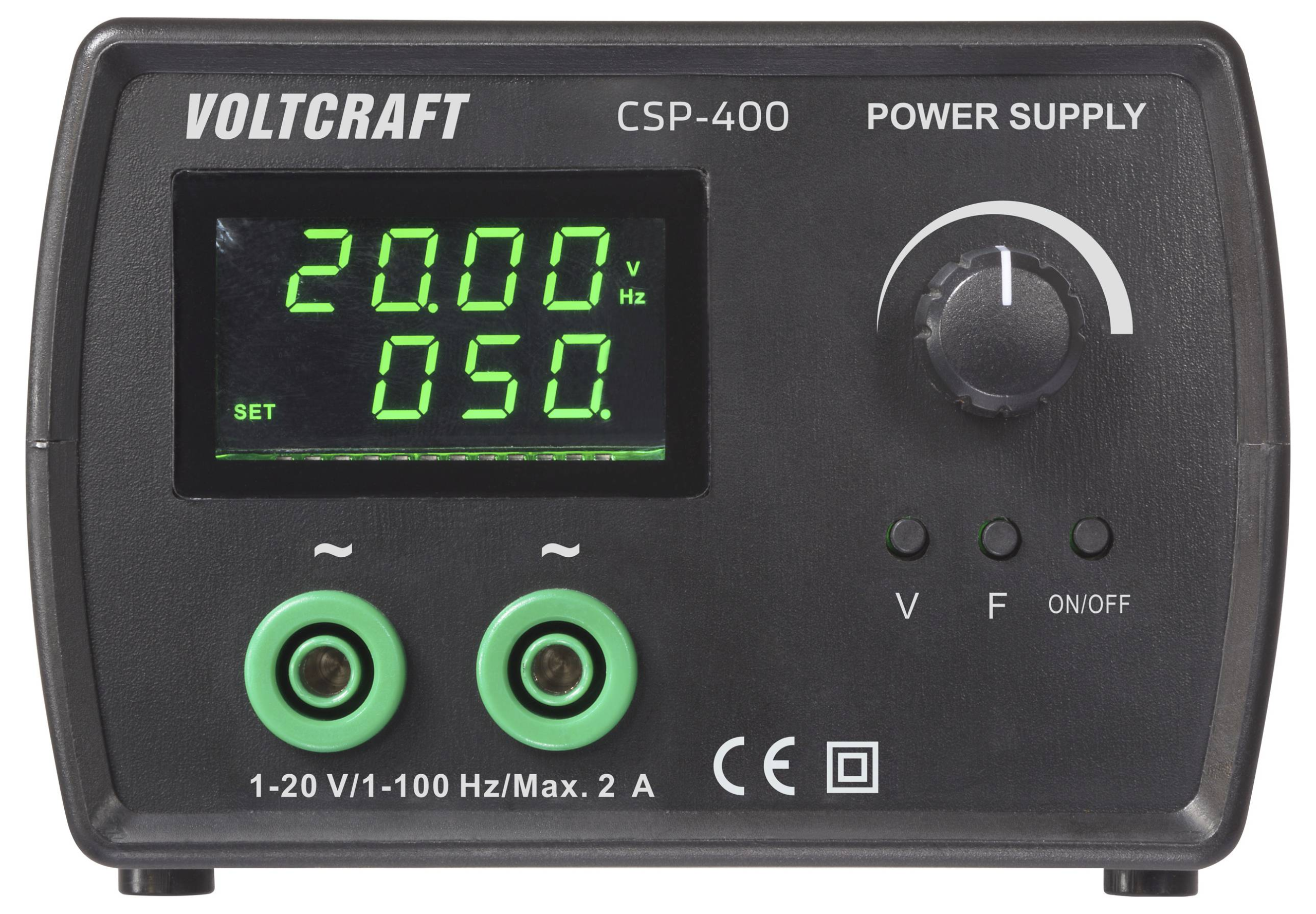
Output power spans 18W to 90W depending on the model, with currents from 1A to 6A and voltage ranges reaching 30V on selected units. CSP-300, CSP-310, CSP-320, and CSP-400 add battery operation, allowing the supply to be used away from a mains outlet or where the engineer wants the source electrically separated from the mains supply.
The CSP-320 illustrates the battery-capable approach. It provides an adjustable 0V to 30V DC output at up to 3A and 90W when operating from its mains adapter, falling to a maximum of 1A in battery mode. The unit can use six replaceable 18650 lithium-ion cells, with Conrad quoting approximately 1.5 hours of operation at full battery-mode load.
Portability is only one reason to remove a bench supply from the mains. Battery operation can provide galvanic isolation from the grid, reducing the possibility of an unwanted mains-referenced ground path when engineers are probing low-voltage electronics. That can be useful during signal measurement or field diagnosis, although connecting an earthed oscilloscope, programmer, communications interface, or other instrument can introduce another ground reference and has to be considered separately.
The CSP family also gives unusual prominence to AC output. Conventional laboratory supplies concentrate heavily on regulated DC because most electronic circuits ultimately need DC rails, leaving engineers to assemble another source when they want a controlled low-voltage AC waveform for transformer, rectifier, reactive-component, or training experiments.
Voltcraft’s CSP-200 provides selectable AC voltages of 2V, 4V, 6V, 8V, 10V, and 12V. That gives laboratories and training benches a controlled source for observing transformer behaviour, rectification, filtering, and other low-voltage AC circuits without relying on direct mains-derived test arrangements.
The CSP-240 extends the idea with an adjustable output from 1V to 15VAC at up to 1.5A and variable frequency from 1Hz to 400Hz. Changing frequency allows engineers or students to observe how capacitors, inductors, transformers, and complete circuits behave away from the fixed 50Hz or 60Hz conditions normally associated with mains-derived AC sources.
That function can be particularly useful alongside an oscilloscope because the behaviour of a reactive circuit becomes visible as frequency changes. It does not replace a general-purpose function generator — the CSP unit is a power source rather than a precision arbitrary waveform instrument — but it provides more current than many signal generators can deliver directly into a test circuit.
Another specialist version, CSP-140, provides symmetrical -15V, 0V, and +15V DC rails. Split supplies remain common in operational-amplifier circuits, analogue instrumentation, audio electronics, sensor interfaces, and educational systems where signals are expected to swing around a zero reference. Producing both rails from one unit avoids using two independent bench supplies in series for relatively modest loads.
The range consequently trades universal programmability for task-specific electrical outputs. Engineers working on a low-power sensor board or analogue circuit may gain little from a large multi-hundred-watt programmable supply if the actual requirement is an isolated 12V source, a true AC output, or a small symmetrical rail. A compact instrument with the correct topology can occupy less bench space and remove adapters or supplementary equipment from the measurement setup.
Battery-capable units also give maintenance engineers a practical option when the equipment under test is not conveniently located beside a laboratory supply. Current capability remains modest compared with larger bench instruments, but the CSP range is aimed at circuit development and diagnostic work rather than powering high-current industrial loads.
Conrad’s live product catalogue confirms the CSP-320 at 90W, 0V to 30V DC and up to 3A, while the CSP-240 is listed at 22.5W with 1V to 15VAC output. The catalogue also shows CSP-300 and other variants within the same series, reinforcing the decision to spread different output functions across a larger number of compact models instead of building them all into one chassis.
The result is a range whose more useful specification is not maximum wattage but the type of source available at the terminals. DC, adjustable AC, symmetrical rails, and battery isolation solve different bench problems, and engineers still have to select voltage, current, ripple, grounding, and safety performance against the circuit being tested. Voltcraft’s CSP family gives them a broader set of small instruments for doing that without automatically moving to a larger programmable supply.