IN Brief:
- Teledyne says it has started production on Tranche 3 FPM awards.
- Modules use radiation-hardened, multi-megapixel infrared detectors for LEO payloads.
- SDA’s Tranche 3 plan expands to 72 satellites across eight orbital planes.
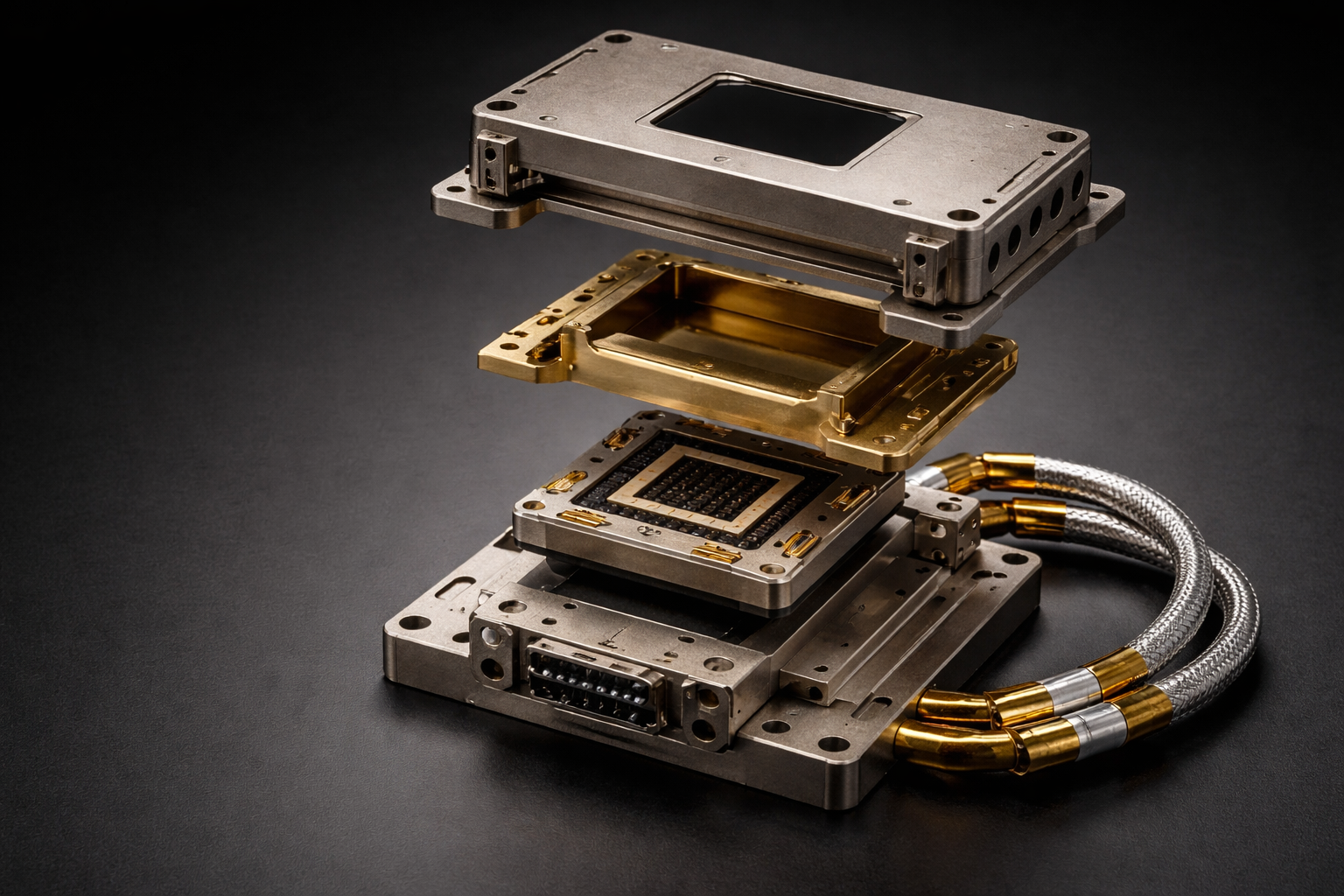
Teledyne Technologies has started production on multiple awards to deliver infrared Focal Plane Modules (FPMs) for the Space Development Agency’s Tracking Layer Tranche 3 programme, a key sensor layer within the Proliferated Warfighter Space Architecture.
The company describes the FPMs as “state-of-the-art” modules built around radiation-hardened, multi-megapixel detectors, targeting higher sensitivity, precision, and reliability in the space environment. The focus for Tranche 3 is expanded capability against advanced threats, including hypersonic glide vehicles, where shorter timelines and complex trajectories place a premium on low-latency detection, consistent calibration, and robust on-orbit performance.
Unlike many satellite payload announcements, the Tranche 3 context is unusually concrete. In December 2025, SDA said it had awarded four agreements worth approximately $3.5 billion to build 72 Tracking Layer satellites for Tranche 3, split across missile warning and missile tracking infrared sensors, and missile warning, tracking, and defence payloads. SDA said the tranche is organised across eight orbital planes and is planned for launch in fiscal year 2029, with each team delivering and operating 18 spacecraft.
SDA also set expectations on the broader payload architecture: each Tracking Layer spacecraft is equipped with an IR mission payload, optical communication terminals, Ka-band communications payloads, and an S-band backup telemetry, tracking, and command system. The agency’s design intent is interoperability across the wider architecture, particularly with the Transport Layer’s low-latency mesh network, to move mission data quickly to the tactical edge.
For Teledyne, the production start signals the shift from programme capture to delivery execution, where detector yield, module-level reliability, and radiation-hard assurance processes become as important as headline performance. In a proliferated constellation, sensor performance is not a single-satellite brag — it is a fleet statistic. Module-to-module consistency, calibration stability, and supply continuity determine whether the architecture behaves like an operational layer or a sparse demonstration.
Megan Tremer, President of Teledyne Imaging Sensors, said: “Teledyne is proud to continue our longstanding partnership with the Space Development Agency established in Tranches 0, 1, and 2,” adding that the company expects to introduce feature upgrades aligned with SDA’s spiral development model and timeline.
Tranche 3 is also an instructive marker for the wider IR detector market. As LEO sensing architectures scale, suppliers that can industrialise space-qualified focal plane production at predictable cadence will define a growing share of the high-end detector pipeline, not just for defence missions, but for adjacent civil and commercial sensing programmes that borrow the same manufacturing discipline.