
IN Brief:
- MIKROE has introduced Life Metrics Click for biomedical and wearable electronics evaluation.
- The board combines the ams OSRAM AS7058A AFE with optical, temperature, and motion sensing.
- Multi-parameter biosignal boards are helping shorten early-stage development of compact health electronics.
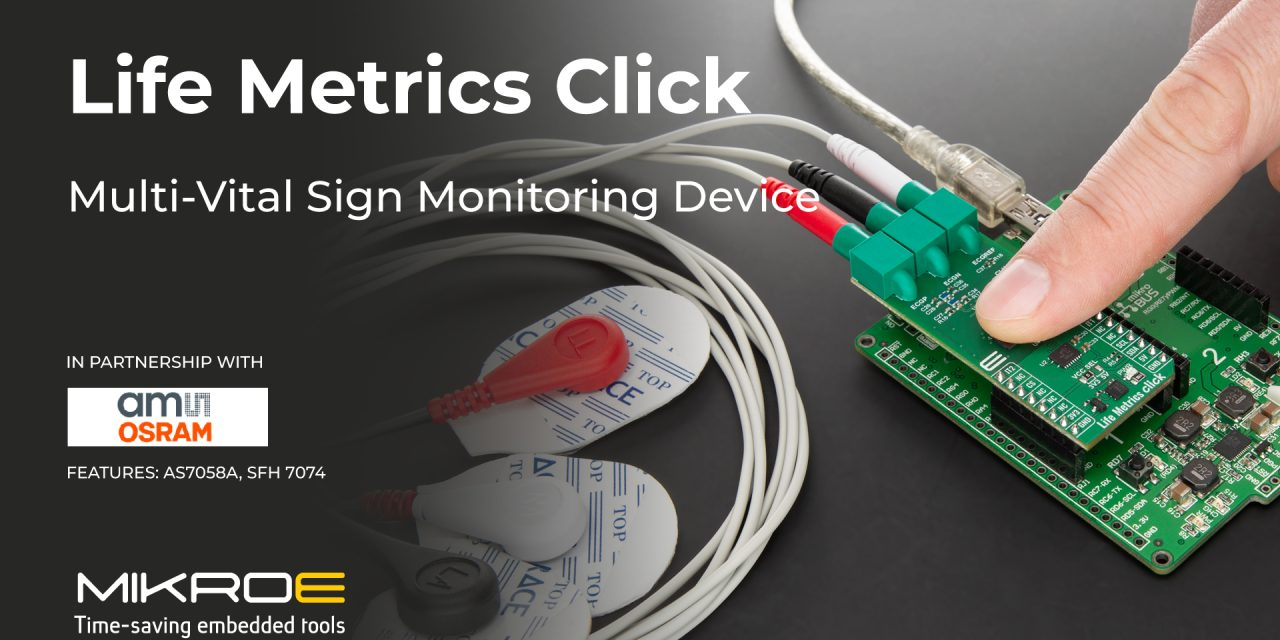
MIKROE has introduced Life Metrics Click, a biomedical sensor add-on board designed for multi-parameter vital sign monitoring in wearable, biometric, and embedded health applications.
The board is based on the ams OSRAM AS7058A multi-vital sign analogue front end and integrates the SFH 7074 optical biomonitoring sensor. It supports photoplethysmography, electrocardiogram, bioelectrical impedance, and electrodermal activity measurements, alongside temperature sensing through an AS6223A sensor and motion tracking using the LIS2DH12 three-axis accelerometer.
Life Metrics Click uses MIKROE’s mikroBUS format and communicates through an I2C interface. It includes dedicated ECG connectors, interrupt signalling, a 1.8V low-noise architecture, and bidirectional level shifting. The board also supports ClickID, allowing host systems to identify the board automatically, and is supplied with mikroSDK open-source libraries.
The board gives engineers a compact route into early biomedical and health-related embedded development. By consolidating several biosignal measurement paths into a single evaluation format, it reduces the need to assemble separate analogue front ends, optical modules, motion sensors, and support circuitry before firmware and algorithm work can begin.
Biomedical analogue design remains highly sensitive to noise, motion, electrode contact, skin condition, optical coupling, and power supply behaviour. Combining PPG, ECG, BioZ, EDA, temperature, and motion data on one board gives developers more scope to explore sensor fusion, artefact rejection, baseline tracking, and power-management trade-offs before committing to custom hardware.
A production medical or wearable design will still require detailed analogue layout, safety assessment, enclosure design, electrode and optical path validation, firmware control, and regulatory planning. Life Metrics Click is more useful at the earlier stage, where engineering teams need to validate the sensing architecture, algorithms, and use case before building a dedicated board.
Wearable and medical electronics are also moving away from single-signal measurement toward multi-parameter systems. Optical, electrical, thermal, and motion inputs can be combined to improve confidence and reduce false readings. Motion data is especially useful because many physiological signals are degraded by movement, pressure variation, and poor coupling during real-world use.
That shift mirrors developments in industrial sensing, where more signal processing is moving closer to the sensor. ST’s in-sensor AI for vibration monitoring showed how embedded interpretation can reduce the load on host systems and improve responsiveness. In health electronics, analogue front ends, embedded processing, and sensor fusion are becoming similarly interdependent.
Life Metrics Click also benefits from MIKROE’s established Click board ecosystem. A standardised expansion format and software library support can reduce early integration overhead, particularly for teams comparing sensors, testing algorithms, or building demonstrators across multiple embedded platforms.
For wearable and biomedical system design, the product is best viewed as a repeatable starting point for evaluating multi-signal health architectures. It helps engineers test the measurement chain before locking down the board, enclosure, and production sensor stack.

