IN Brief:
- Universal Quantum's iQPU uses a commercial 200mm semiconductor foundry process and provides an active ion-trap surface exceeding 400mm².
- The vertically integrated design combines ion transport structures, control electronics, and UQConnect module interfaces.
- The processor is intended for two quantum computers under development for DLR, with complete multi-module performance still to be demonstrated.
Universal Quantum has introduced the iQPU, an integrated trapped-ion quantum processor manufactured using a commercial 200mm semiconductor foundry line. The device combines an active ion-trap computing surface exceeding 400mm² with integrated electronic controls and interfaces for connecting neighbouring processor modules. The architecture is intended to provide a repeatable semiconductor component for quantum computers assembled from multiple processing units.
The processor brings several functions into one vertically integrated structure, including ion trapping, electrical signal routing, magnetic-field control, and application-specific integrated circuitry. Universal Quantum is developing this arrangement to reduce the number of separate control connections required as trapped-ion computing systems become larger. The company’s existing quantum interconnect technology provides the proposed connection between individual processing modules.
Trapped-ion quantum computers use charged atoms as quantum bits, or qubits, held within electromagnetic trapping structures. Their quantum states are manipulated through controlled interactions, while the surrounding system must maintain conditions that limit unwanted disturbances. Increasing the number of qubits requires additional trapping capacity, more coordinated control operations, and suitable connections between the parts of the computing system.
The iQPU uses a quantum charge-coupled device architecture, known as QCCD, in which ions can be transported between different operating zones on the processor. Electrical potentials applied to trap electrodes control their movement, allowing qubits to be brought together for supported operations and moved elsewhere when required. This provides a different connectivity arrangement from architectures in which qubits remain at fixed positions throughout computation.
Moving ions between zones requires precise electrical control. Changes to electrode potentials must transport the trapped particles without producing unacceptable heating or loss, while the control sequence must remain coordinated with other quantum operations. As the number of trapping zones increases, the quantity and complexity of electrical signals can become an important system integration constraint.
Universal Quantum addresses part of that constraint by incorporating custom control electronics within the processor stack. The design includes an ion-trap layer, routing structures, magnetic-field control, through-silicon vias, and an ASIC layer. Bringing the control circuitry closer to the trapping structures provides a route to distributing the required signals without adding a separate external connection for every operation.
Through-silicon vias carry electrical connections vertically between layers of the assembly. This changes how control signals can be routed through the processor while helping preserve its edges for module connections. The technique draws on established semiconductor integration principles, although the electrical noise, temperature, and physical requirements of a trapped-ion processor differ from those of conventional computing silicon.
The company is also developing quantum gates driven by global microwave fields rather than relying on a separate individually directed laser beam for every gate operation. Integrated magnetic-field control and electronic addressing form part of that approach. Optical equipment remains necessary for other trapped-ion functions, including appropriate state preparation and measurement, so microwave control does not eliminate the wider optical and environmental requirements of the machine.
The iQPU is designed to operate at approximately 70K, according to the architecture documented for Universal Quantum’s DLR programmes. This is a higher temperature than the millikelvin conditions used by some superconducting quantum processors, but it still requires specialised cooling. The complete system also depends on vacuum equipment, electromagnetic control, and suitable protection against disturbances that could affect quantum operations.
Modular expansion is supported by UQConnect, an interface intended to transfer ions directly between adjacent processor modules. Rather than transmitting an ordinary digital representation of a qubit through a conventional electrical connection, the proposed architecture transports the physical ion carrying the quantum state between trapping structures. Successful transfer requires the connected modules to maintain appropriate electrical and mechanical alignment and preserve the ion’s usable quantum state.
Universal Quantum has previously demonstrated high-speed ion transfer through its interconnect technology, reporting 2,424 transfers per second and 99.999993% connection fidelity. Those results describe earlier interconnect testing and should not be confused with benchmark performance for a complete computer assembled from production iQPUs. Operation across multiple modules will require the interconnect, control electronics, trapping structures, and quantum gates to function together.
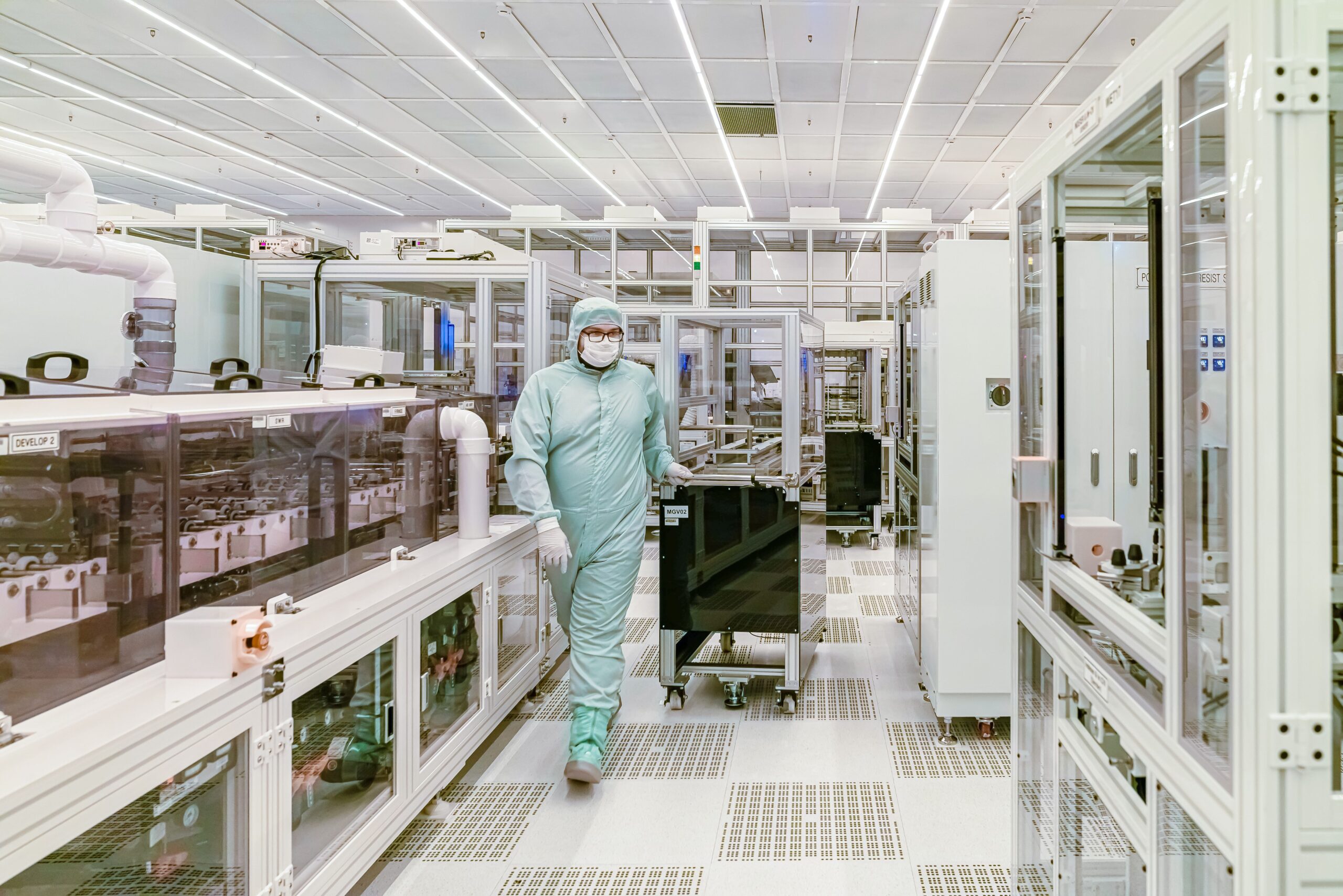
Manufacturing the processor on a commercial 200mm line introduces established semiconductor equipment and process-control methods into production of the specialised ion-trap structures. A repeatable manufacturing process can provide a foundation for producing multiple equivalent modules, but practical scaling still depends on fabrication yield, electrical testing, packaging, and the ability to integrate the resulting devices into functioning quantum systems.
The processor’s active area exceeds 400mm², giving the QCCD architecture space for multiple trapping and transport regions. Physical area alone does not establish the number of usable qubits or the computational performance of the completed processor. These depend on the operation of the trap, the coherence and fidelity of the qubits, gate performance, transport behaviour, and the error-management methods available to the system.
Universal Quantum intends to incorporate the iQPU into customer systems, including the Toccata and Legato quantum computers being developed for the German Aerospace Center’s Quantum Computing Initiative. The programmes are supported by contracts worth approximately €67m. Toccata concentrates on an integrated trapped-ion quantum computing module, while Legato is developing a system that connects multiple modules using the company’s architecture.
These programmes provide opportunities to evaluate the processor within complete computing systems. Individual components can be tested electrically and mechanically during development, but successful operation of the assembled computer requires coordinated ion trapping, transport, quantum gates, readout, and control software. Multi-module operation introduces further tests of the connections and timing between separate processing units.
The iQPU launch follows Universal Quantum’s Series A financing of more than $100m, which is intended to support engineering, manufacturing development, and commercial expansion. The company has positioned semiconductor-compatible fabrication and modular integration as central elements of its approach to larger trapped-ion computers. The financing provides resources for that programme but does not establish that the proposed architecture has reached commercial production scale.
The new processor establishes a defined hardware platform combining the trapping surface, local electronics, and modular connections. The next development stages involve integrating iQPUs into customer machines and validating their operation as interconnected computing systems. Measured qubit performance, module-to-module operation, manufacturing repeatability, and error correction will determine how effectively the architecture scales beyond individual processor demonstrations.