IN Brief:
- Synopsys is supporting NASA Artemis work on spacesuit charging, electrostatic discharge risk, and lunar communications modelling.
- The programme combines lunar-environment simulation, test-informed spacesuit analysis, and RF coverage modelling across realistic Moon topography.
- Lunar exploration is becoming a harsher proving ground for electronics reliability, antenna integration, and system-level digital engineering long before hardware is deployed.
Synopsys is extending its role in NASA’s Artemis programme through a pair of simulation-led efforts focused on spacesuit electronics exposure and lunar communications modelling. The work spans electrostatic charging analysis for Artemis extravehicular systems and RF coverage modelling for future lunar surface connectivity, bringing together environment simulation, antenna analysis, and digital mission engineering in one of the most demanding design contexts now taking shape.
The spacesuit element centres on compatibility with the lunar environment, where fine regolith, plasma effects, and surface charging can combine into a far less forgiving operating envelope than conventional terrestrial systems ever face. Under the current work, Synopsys and EMA are using physics-based workflows to evaluate how complex, multi-layer spacesuit structures behave under relevant lunar plasma conditions, with a focus on charging and discharge events that could affect communications and life-support electronics during surface operations.
That is a serious engineering issue rather than an exotic edge case. Electrostatic discharge inside or around mission hardware can damage or disturb electronics that would already be operating under thermal, mechanical, and power constraints. In a suit-based architecture, the challenge is compounded by the fact that materials, structure, antenna placement, and human factors all intersect in one tightly bounded package. There is little room for shielding, routing, or late-stage redesign once the system architecture is fixed.
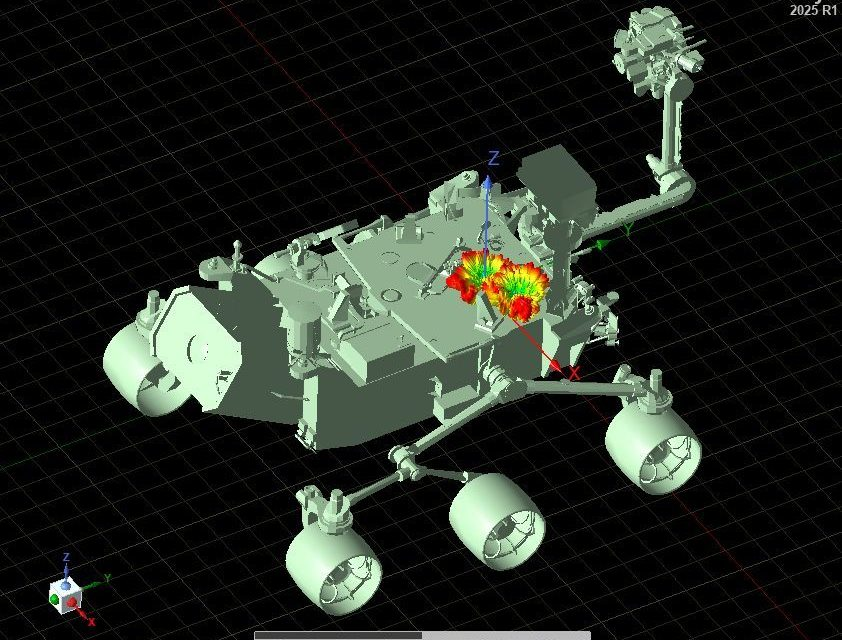
Synopsys is also working with Cesium and NASA Glenn Research Center on lunar communications modelling tied to the Lunar 3GPP effort. In that programme, true-to-reality Moon topography is being brought into a digital mission environment so RF propagation can be analysed against surface features rather than idealised terrain. The resulting models are intended to help engineers understand antenna behaviour on spacesuits and rovers, visualise likely coverage areas, and identify shadow zones caused by craters, rock formations, and line-of-sight interruptions.
Taken together, the two strands say something useful about how deep-space electronics development is changing. The harder the environment becomes, the less sensible it is to treat communications, electromagnetics, packaging, and mission planning as separate downstream disciplines. Lunar systems force those design questions together from the beginning. Suit materials affect charging. Topography affects connectivity. Antenna location affects usable coverage. And once operations extend from a short sortie to a sustained presence, the tolerance for unmodelled behaviour collapses quickly.
That has implications well beyond space. The tools and workflows being applied here point to a wider engineering move toward simulation-first development in environments where live testing is expensive, slow, or only partly representative. In terrestrial sectors that shows up in automotive, aerospace, and industrial autonomy. On the Moon, the same logic becomes unavoidable. The cost of discovering a design weakness after deployment is not just commercial; it can become operationally or physically critical.
There is a second trend here as well: communications design is expanding from device performance into spatial performance. Engineers increasingly need to know not only whether an antenna or radio works in isolation, but how it behaves as part of an installed system moving through a complex environment. That applies in aircraft cabins, urban robotics, factory networks, and now lunar surface operations. In each case, the design question is as much about context as component specification.
Artemis therefore offers a useful marker for the electronics industry. Mission systems are leaning more heavily on integrated simulation stacks that can connect materials behaviour, electromagnetics, hardware geometry, and deployment environment before physical hardware is finalised. As those methods mature, they are likely to influence far more than spaceflight. The underlying lesson is straightforward: in harsh, connected systems, realism in the model increasingly determines how much pain arrives later in the programme.