
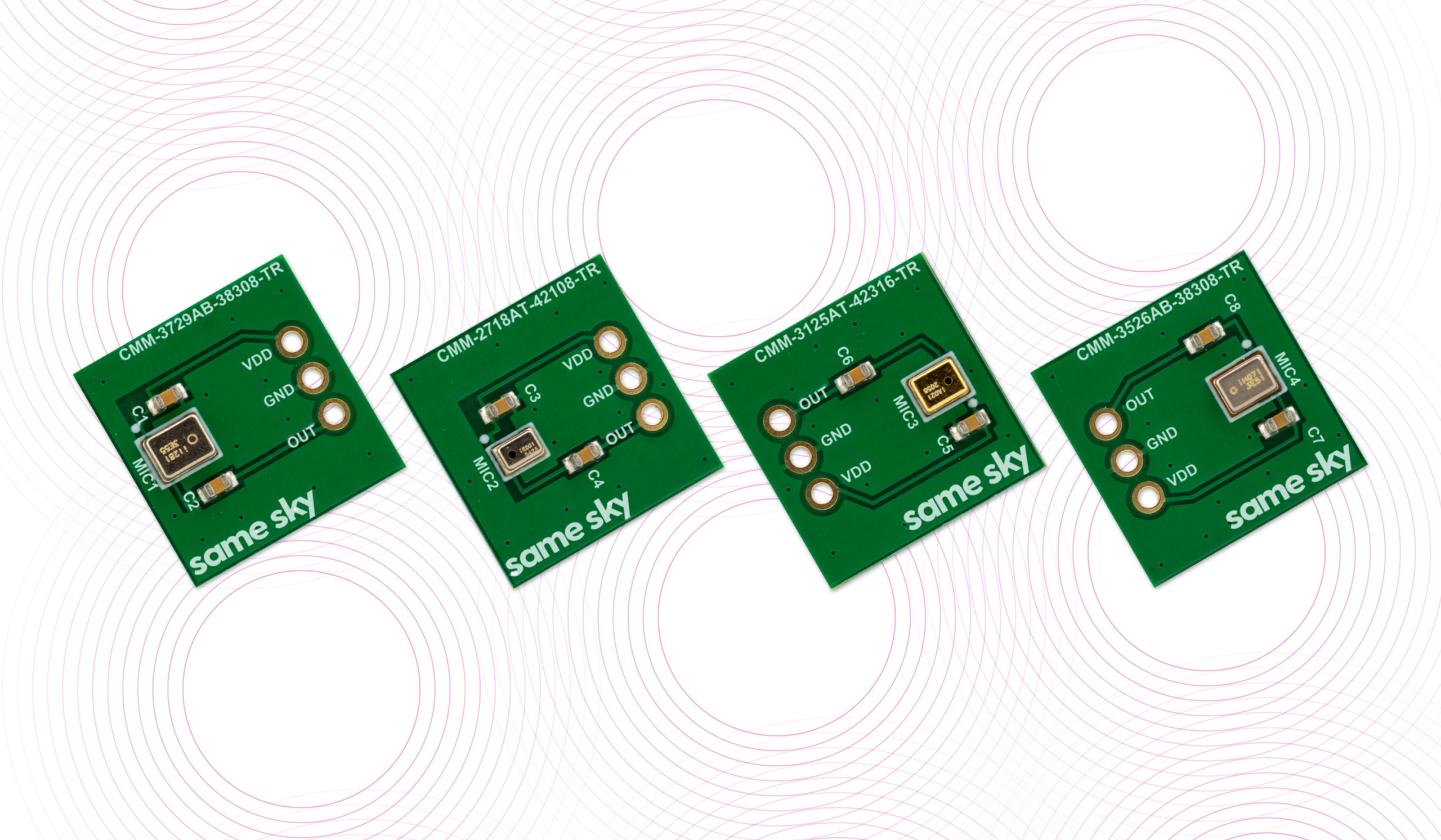
IN Brief:
- Same Sky has introduced seven microphone development kits for prototyping and test.
- Each kit includes four detachable microphone evaluation circuits with plated through-hole I/O terminals.
- The range supports analogue MEMS, digital MEMS, unidirectional, omnidirectional, and noise-cancelling ECM configurations.
Same Sky has introduced seven microphone development kits designed to simplify evaluation and prototyping across analogue MEMS, digital MEMS, and electret condenser microphone technologies.
Each kit contains four independent microphone evaluation circuits with plated through-hole I/O terminals, giving engineers multiple test options during early-stage design. The detachable evaluation circuits each offer a different microphone configuration, covering analogue and digital MEMS microphones as well as unidirectional, omnidirectional, and noise-cancelling electret condenser microphone options.
The kits are available immediately through distribution, with prices starting at $4.48 per unit. The format gives development teams a quick way to compare microphone types, polar patterns, output formats, and electrical interfaces without first building custom evaluation boards.
Microphone selection is rarely determined by a headline sensitivity figure alone. Designers have to consider noise performance, directivity, physical mounting, environmental exposure, acoustic porting, enclosure geometry, and the signal-conditioning chain that sits behind the transducer.
MEMS microphones are widely used in compact embedded systems because they offer small size, automated assembly compatibility, and repeatable performance. Digital MEMS devices can simplify interfacing with microcontrollers and processors, particularly in systems using pulse-density modulation or other digital audio paths. Analogue MEMS options remain useful where designers want direct control over gain, filtering, and the analogue front end.
Electret condenser microphones continue to retain design relevance in many applications, especially where acoustic characteristics, cost targets, or legacy circuitry favour ECM devices. Unidirectional, omnidirectional, and noise-cancelling options allow development teams to examine how microphone choice changes system-level behaviour before committing to a final mechanical and electrical design.
The need for rapid microphone evaluation is growing as voice interfaces, industrial audio monitoring, condition monitoring, wearable devices, building systems, and edge-AI sensing become more common. In many of these applications, the microphone is part of a sensing chain rather than a simple audio pickup. Acoustic data may be used for wake-word detection, fault identification, noise classification, proximity interaction, or environmental monitoring.
That places more pressure on the prototype stage. A microphone that performs well on a bench may behave differently once placed inside a housing, mounted behind a grille, exposed to vibration, or connected to a particular codec or MCU input. Early comparison hardware helps expose those differences before PCB layout, enclosure design, and firmware work narrow the design options.
The kits also fit a broader shift among component suppliers towards lower-friction evaluation hardware. Development schedules often leave little room for building several first-pass test boards before choosing a device. Ready-made circuits can help engineers compare architectures, identify mechanical constraints, and move faster from part selection to proof-of-concept.
Same Sky’s microphone development kits are therefore most useful where acoustic and electrical behaviour need to be assessed together. For audio, sensing, and embedded designs, the final microphone decision is inseparable from the board, housing, firmware, and signal chain around it.

