IN Brief:
- Red Cat will demonstrate Black Widow, FANG, and Blue Ops Variant 7 systems.
- The Variant 7 USV demonstration includes Kymeta satellite communications integration.
- The approach links ISR, FPV, maritime autonomy, software, and resilient communications.
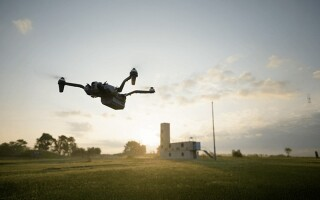
Red Cat will demonstrate autonomous air and maritime systems for special operations missions at SOF Week, including Black Widow ISR drones, FANG FPV platforms, and the Blue Ops Variant 7 uncrewed surface vessel.
The systems form part of an integrated family of autonomous platforms spanning air and maritime domains. Red Cat’s demonstration will include ISR drones, first-person-view systems, uncrewed surface vessel technology, AI-enabled software, computer vision, communications, mission tools, and training elements.
The maritime component includes the Blue Ops Variant 7 USV with Kymeta satellite communications integration. SATCOM gives the vessel a route to operate beyond short-range radio links, supporting distributed maritime missions and operations in degraded communications environments.
Black Widow sits at the air-domain centre of the portfolio, while FANG addresses low-cost, NDAA-compliant FPV requirements for defence and security operations. Blue Ops extends the architecture into uncrewed surface vessels, allowing air and maritime autonomy to be connected through software, communications, and mission workflows.
Defence robotics is moving away from isolated platform development and toward connected system families. ISR drones, FPV platforms, USVs, communications links, and command tools are being combined to create distributed mission architectures in which sensors, operators, and effectors can share data across domains.
That approach increases the electronics burden across the platform stack. Autonomy requires edge processing, inertial and visual sensing, efficient compute, secure communications, and software integration. Maritime autonomy adds environmental sealing, long-duration power management, navigation, corrosion resistance, and beyond-line-of-sight connectivity. FPV and ISR aircraft face separate constraints around weight, payload integration, endurance, and survivability.
The use of SATCOM on the Variant 7 USV shows how unmanned maritime systems are moving beyond short-range control. Flat-panel satellite terminals and resilient networking can keep vessels connected over longer distances, but they add power, mounting, thermal, and integration demands that must be balanced against payload and endurance.
Across defence markets, autonomy is increasingly being treated as a networked capability rather than a single platform category. Domestic manufacturing, rapid iteration, modular payloads, software-defined control, and resilient communications are now part of the same engineering problem.
Red Cat’s SOF Week demonstration brings those elements together across air and maritime operations. By linking ISR, FPV, USV, SATCOM, and mission software, the company is moving toward autonomous systems that can operate as connected assets inside broader operational networks.