IN Brief:
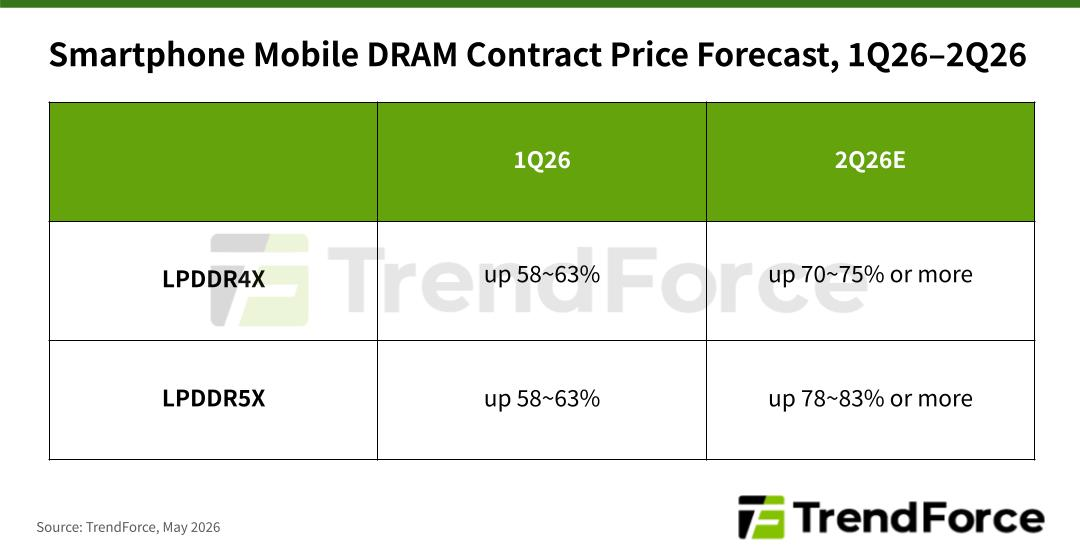
- LPDDR4X contract prices are expected to rise at least 70–75% quarter-on-quarter in 2Q26.
- LPDDR5X contract prices are forecast to rise 78–83% quarter-on-quarter.
- Memory configuration choices are being reshaped by supply pressure and rising cost.
TrendForce has reported another steep rise in mobile DRAM contract pricing for the second quarter of 2026, with LPDDR4X average selling prices expected to increase by at least 70–75% quarter-on-quarter and LPDDR5X prices forecast to rise by 78–83%.
The market researcher said the latest pricing environment is putting further cost pressure on smartphone brands, with Samsung Electronics and SK hynix appearing to take different approaches to contract negotiations. Samsung is moving with a sharper one-step pricing strategy, while preliminary quotations from SK hynix indicate a more gradual increase, with final pricing expected by the end of May.
Memory configuration plans are already changing. High-end smartphones are expected to concentrate more heavily around 12 GB configurations, while adoption of 16 GB options declines. Mid-range models are returning to 8 GB as the core specification, and entry-level devices are mostly clustering around 4 GB.
Average smartphone DRAM capacity is still projected to reach 8.5 GB in 2026, representing annual growth of 10%. Even so, the steady rise in capacity per device is no longer moving without resistance. Memory cost is again becoming a design constraint, shaping product positioning, bill of materials planning, and the balance between local resources and cloud-based services.
Although smartphones are the immediate market affected, LPDDR devices are used well beyond consumer handsets. Embedded computing modules, industrial handhelds, portable medical systems, compact cameras, edge AI hardware, and connected field devices often rely on mobile memory technologies because of their low power, small footprint, and established supply base.
Rising mobile DRAM prices therefore feed into a wider electronics planning problem. Engineering teams using LPDDR parts need to consider not only speed, density, and power consumption, but also allocation risk and lifecycle availability. Products expected to remain in production for several years may become exposed if a chosen memory configuration depends on volatile supply or pricing.
The pressure also reflects the direction of memory manufacturing investment. Suppliers have been prioritising higher-value DRAM capacity, particularly where AI servers and high-bandwidth memory are drawing capital, wafer starts, and packaging capacity. That shift leaves some mobile and lower-density segments more vulnerable to constrained availability and sharper price movements.
Design teams are likely to respond by tightening software memory budgets, reducing the number of memory configurations across product families, consolidating SKUs, or moving selected workloads into connected services where latency, security, and energy constraints allow it. Those decisions are architectural rather than cosmetic, because memory capacity affects software features, update headroom, user interface performance, and long-term support.
For hardware planning in 2026, memory can no longer be treated as a late-stage procurement variable. Capacity, supplier qualification, second sourcing, and product lifecycle assumptions need to be settled early enough to protect both the electrical design and the commercial model behind it.