IN Brief:
- Microchip’s EX-423 EMXO is a 13 mm x 13 mm low-power timing device.
- The oscillator uses an ultra-high vacuum package for improved thermal insulation.
- Target applications include GNSS, military radios, medical devices, seismic systems, and satellite communications.
Microchip Technology has launched the EX-423 Evacuated Miniature Crystal Oscillator, a compact timing device for systems requiring high stability, accuracy, and long-term reliability within limited space and power budgets.
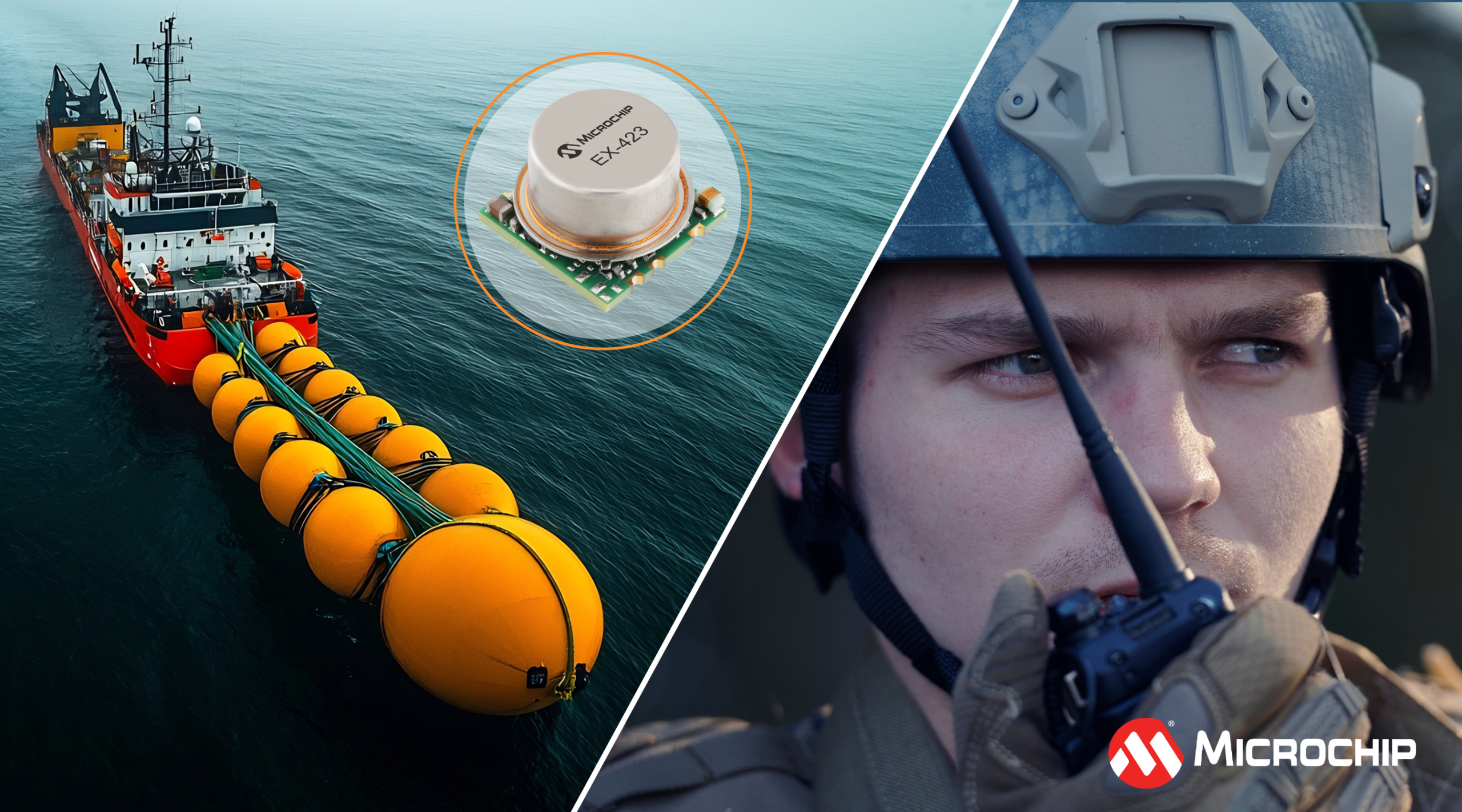
The EX-423 builds on Microchip’s EX-421 portfolio and is supplied in a low-profile 13 mm x 13 mm package. Target applications include GPS/GNSS tracking, military radios, medical devices, Ocean Bottom Node seismic systems, test and measurement equipment, and satellite communications.
The oscillator is sealed in an ultra-high vacuum package, using the evacuated structure to improve thermal insulation around the quartz crystal. The package design supports frequency stability while reducing the power normally associated with tightly controlled thermal environments.
A four-point mount is used for the quartz crystal to improve shock survivability and reduce g-sensitivity. In systems exposed to movement, vibration, shock, or demanding field conditions, acceleration effects can translate directly into timing error and RF performance degradation.
The EX-423 combines ultra-low phase noise, tight temperature control, short-term stability, fast warm-up, and long-term frequency stability. It operates across a standard 10–20 MHz frequency range, consumes 1 W during warm-up, and draws as little as 0.2 W at +25°C in steady state.
“When developing the EX-423, we focused on the key parameters designers use to evaluate high-performance reference oscillators,” said Randy Brudzinski, corporate vice president of Microchip’s frequency and time systems business unit. “Delivering this level of performance in a rugged, small footprint helps customers simplify designs without compromising timing accuracy.”
Compact timing systems are under growing pressure as RF, sensing, medical, and communications equipment move into smaller and more mobile form factors. Many designs require oscillator performance closer to larger oven-controlled devices, but cannot absorb the same volume, heat, or power draw. Battery-powered GNSS trackers, portable RF equipment, distributed sensing platforms, and compact satcom terminals all need stable reference signals without carrying a large energy penalty.
Frequency stability also becomes more demanding as systems are distributed across wider operating environments. In satellite communications, test equipment, seismic acquisition, and secure radios, oscillator noise and drift can affect synchronisation, channel performance, measurement accuracy, and signal integrity. A weak reference clock can degrade performance across the RF chain or measurement path long before the fault is visible at board level.
The EX-423’s use of vacuum packaging places mechanical and thermal design at the centre of oscillator performance. As timing components are pushed into smaller packages with lower power budgets, stability depends increasingly on how the crystal is mounted, insulated, and protected from environmental stress.
The EX-423 EMXO is available now, supported through Microchip’s frequency and time systems portfolio, which spans miniature component oscillators, plug-in timing server cards, and multi-rack time scale systems.