IN Brief:
- Infineon is coordinating Moore4Power, a €91m European smart power electronics project.
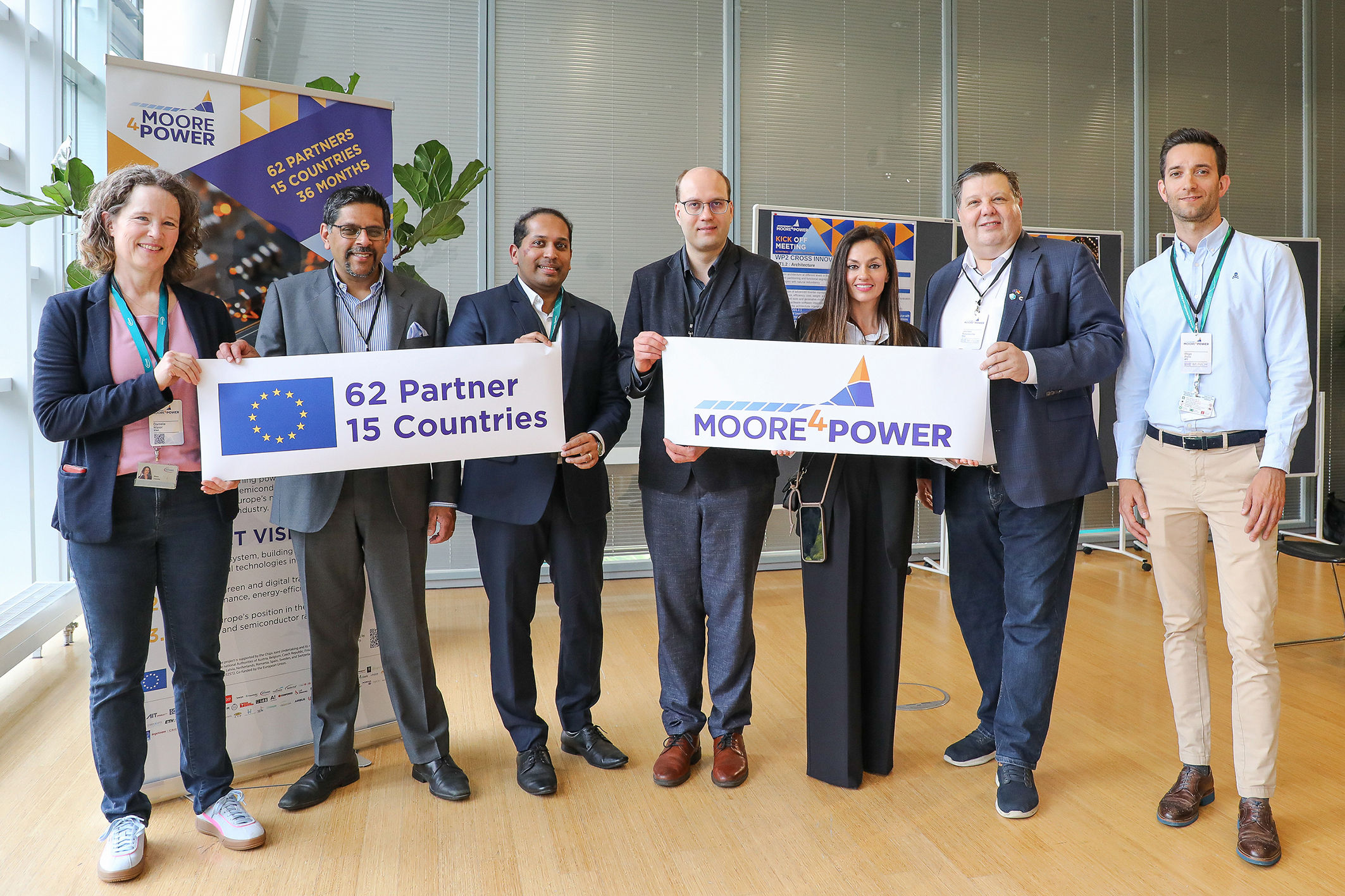
- The three-year programme brings together 62 partners from 15 countries under the Chips Joint Undertaking.
- The project will develop heterogeneous integration across silicon, SiC, GaN, sensing, control, and communication functions.
Infineon Technologies is coordinating Moore4Power, a €91m European semiconductor research project focused on next-generation smart power electronics for energy, mobility, rail, and industrial applications.
The three-year programme, formally titled More than Moore for Disruptive Innovations in Power Electronics, brings together 62 partners from 15 European countries. The consortium includes large companies, SMEs, universities, and research institutes, with co-funding from participating countries and the Horizon Europe Chips Joint Undertaking.
Moore4Power shifts the emphasis from transistor scaling toward system-level integration. Its technical focus is heterogeneous integration, combining silicon, silicon carbide, and gallium nitride with sensing, control, and communication functions to create compact power systems that use each semiconductor technology where it performs best.
Power chiplet technology is also part of the programme, with modular architectures intended to support scalable product variants and more flexible industrialisation. The project builds on PowerizeD, an earlier Chips JU-funded programme completed in 2025 that focused on advances in power electronics efficiency and reliability.
The target applications show how strategic power conversion has become. In wind energy, the project will explore advanced power electronics for turbine conversion stages. In e-mobility, the aim is to support bidirectional charging with efficiency up to 99%. In railway systems, the consortium is targeting propulsion-loss reductions of at least 30%.
Development methods are also part of the programme. Moore4Power will use AI-assisted models, digital twins, and automated workflows to shorten validation cycles, with a stated goal of reducing the time from first fab samples to a validated datasheet release to one week. The project will also develop digital product passports embedded in power modules via wireless access, providing lifecycle data such as operating conditions, state of health, and remaining lifetime.
Those goals sit close to Infineon’s wider power-electronics activity. Infineon and DG Matrix are already targeting AI power bottlenecks with silicon carbide, while Infineon’s 320A AI power modules show the same pressure at the high-current board level.
Power electronics is now central to Europe’s industrial and semiconductor strategy because it connects decarbonisation, electrified transport, grid equipment, factory automation, and energy resilience. Efficiency gains at the conversion stage reduce thermal load, material use, and operating cost, while more integrated power modules can simplify equipment design and reduce system volume.
Moore4Power also reflects a practical limit in semiconductor progress. When simple scaling stops delivering the required efficiency or cost improvements, the performance burden moves into packaging, integration, control, sensing, and lifecycle intelligence. For power electronics, the next competitive step is less about making one device smaller and more about making the whole conversion system smarter, denser, and easier to industrialise.