
IN Brief:
- ROHM has released the ROHM PLECS Simulator for online power electronics circuit verification.
- The tool supports rapid loss, temperature, and waveform checks across predefined power circuit topologies.
- Simulation is becoming a front-end selection tool as power designs move towards higher density, faster switching, and tighter thermal margins.
ROHM has released the ROHM PLECS Simulator, a web-based tool that allows power electronics designers to evaluate device loss, temperature rise, and circuit behaviour during early-stage power circuit development.
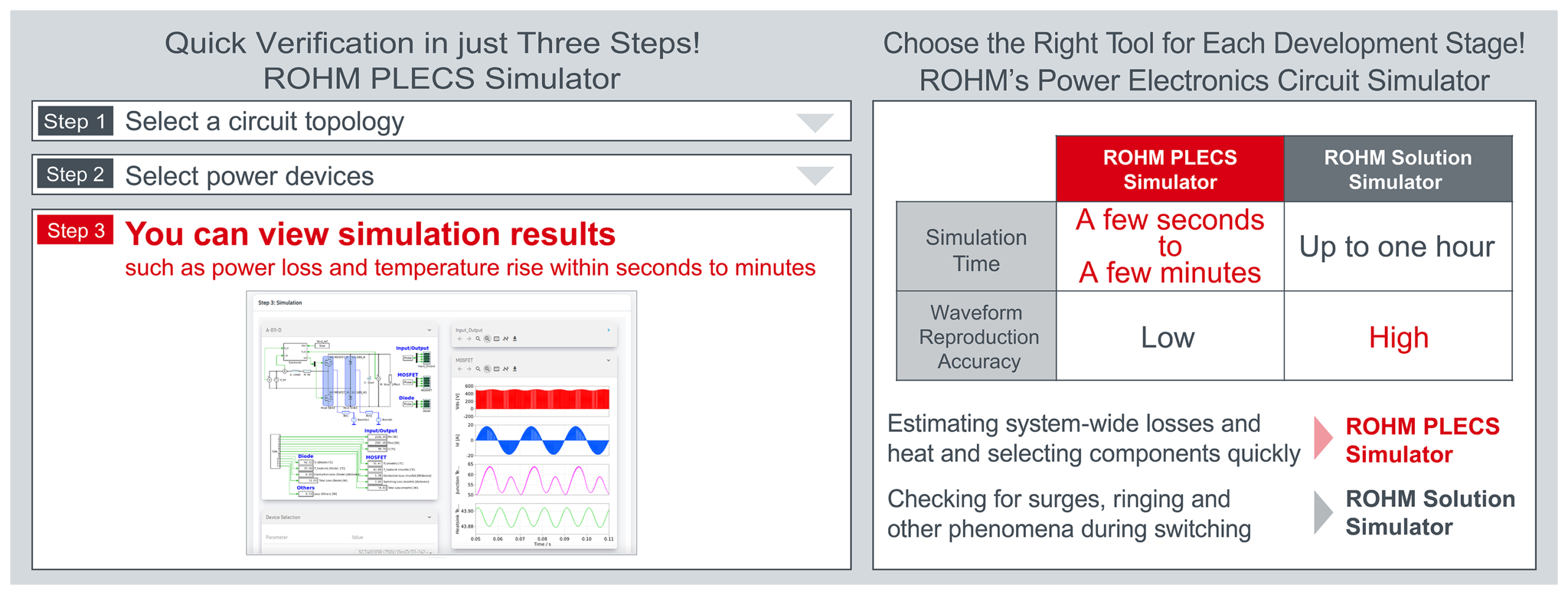
The simulator is based on PLECS software and is available through ROHM’s website. It allows users to select a predefined circuit topology, choose ROHM power devices, and quickly check losses, temperature, waveforms, device capacity, and heat-sink thermal characteristics.
The tool is designed for the early concept and device-selection phase, where engineers need to compare possible devices and circuit approaches before committing time and cost to detailed hardware prototypes. ROHM says the simulator can complete loss and thermal calculations in seconds to minutes.
The topology list includes PFC, inverter, and DC/DC converter circuits. Available examples include AC-DC boost PFC, totem-pole PFC, three-phase Vienna PFC, single-phase full-bridge inverters, three-phase motor-drive inverters, boost converters, buck converters, flyback converters, forward converters, LLC full-bridge converters, LLC half-bridge converters, and phase-shift full-bridge converters. Discrete and DOT-247 package options are represented across different topologies.
The simulator is available free of charge with MyROHM registration, while a trial version of a totem-pole circuit can be used without registration. ROHM also provides a quick-start guide, topology documents, and support videos covering simulator operation and device selection.
The new tool complements the existing ROHM Solution Simulator, which supports more detailed circuit simulation and waveform verification. The PLECS-based platform focuses on rapid loss and thermal screening, while the Solution Simulator remains suited to more detailed verification later in development.
Power electronics development is being pushed by higher power density, faster switching, wide-bandgap devices, tighter efficiency targets, and stricter thermal constraints. Engineers are expected to evaluate MOSFETs, SiC devices, IGBTs, power modules, magnetics, heatsinking, control behaviour, and package options earlier in the design cycle, often before the final mechanical architecture has been settled.
That pressure is visible across recent power semiconductor activity. Microchip’s 3.3kV SiC modules for medium-voltage conversion and TDK’s PCIM focus on AI data-centre power both point to power systems where device selection, loss modelling, and thermal behaviour have to be understood early.
Loss and thermal simulation are especially valuable at the selection stage because data-sheet specifications rarely tell the whole story. Device conduction loss, switching loss, package thermal resistance, topology selection, cooling assumptions, and switching frequency interact. A device that looks attractive from one headline parameter may be less suitable once the operating waveform, ambient condition, and heat path are considered.
That interaction becomes sharper with SiC and GaN. Faster switching can reduce some losses and shrink passives, but it can also increase EMI, layout sensitivity, and gate-drive demands. Power modules can simplify assembly and raise current capability, while still requiring careful modelling around thermal paths and switching behaviour.
The ROHM PLECS Simulator strengthens the company’s design-support ecosystem as much as its device portfolio. Power semiconductor suppliers are increasingly expected to provide models, reference designs, thermal data, and workflow tools alongside the components themselves. As conversion stages become harder to design by rule of thumb, accessible simulation is becoming part of the product offering.

