
IN Brief:
- P&N Europe GmbH is supplying compact thermoelectric coolers for optical transceiver and laser package applications.
- The TECs target thermal stability in TOSA designs, coherent optical systems, telecom networks, and data-centre transceivers.
- Optical module thermal management is becoming more critical as 400G, 800G, 1.6T, and future links raise density and performance demands.
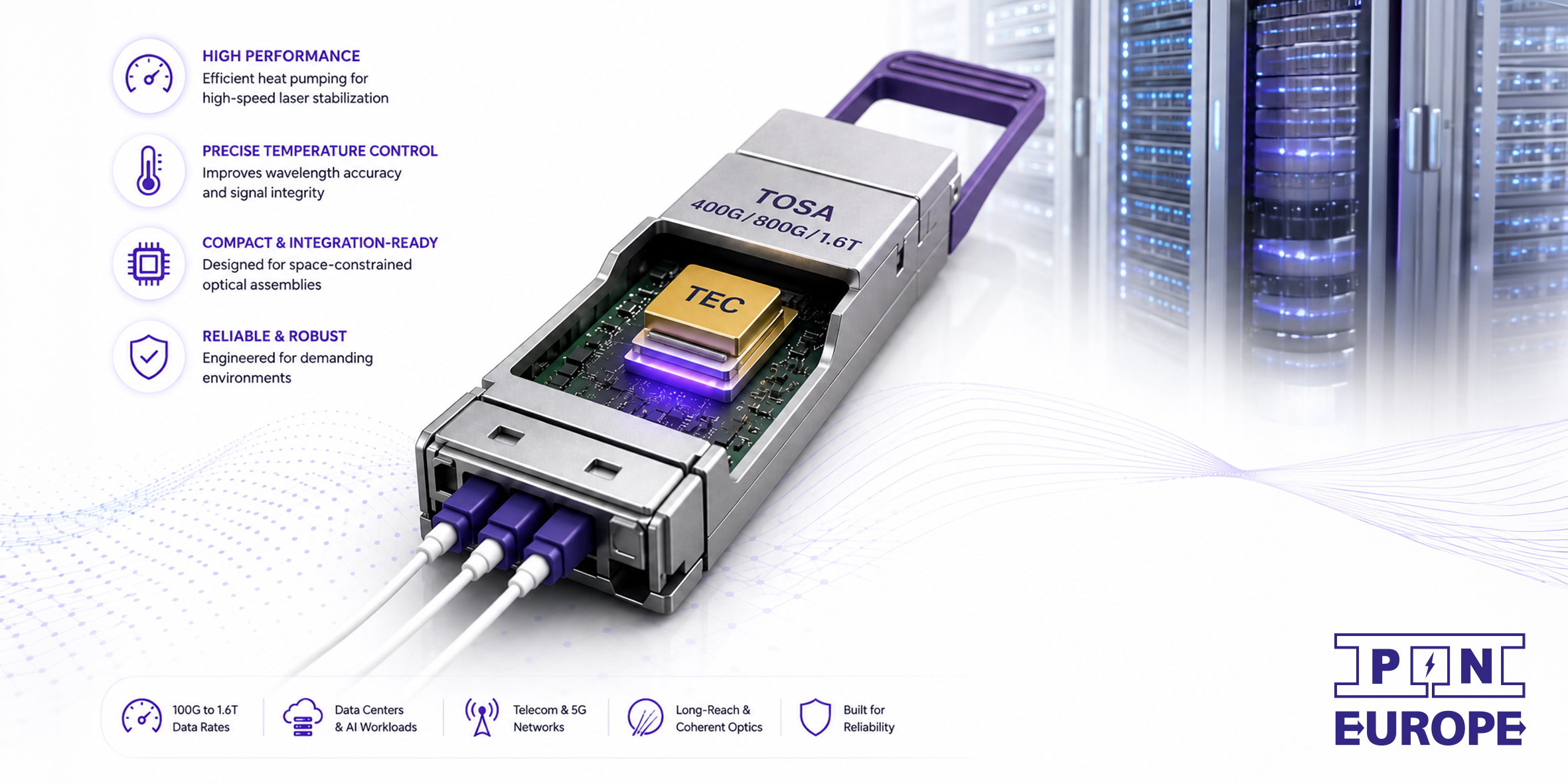
P&N Europe GmbH is targeting high-speed optical transceiver assemblies with compact thermoelectric coolers designed to stabilise laser performance in data-centre, AI, telecom, and coherent optical systems.
The company supplies thermoelectric coolers for integration into optical assemblies including transmit optical subassemblies and laser packages. The devices are intended to provide localised temperature control close to the laser source, where wavelength stability, optical output power, modulation behaviour, and long-term reliability are sensitive to thermal variation.
P&N’s TEC offering is aimed at compact transceiver formats such as QSFP, QSFP-DD, OSFP, CFPx, and related module architectures. The designs balance cooling capacity, footprint, height, electrical efficiency, mechanical integration, and thermal-path optimisation.
The company provides customised thermoelectric cooler solutions for different package requirements. Dimensions, ceramic substrates, metallisation, lead configurations, soldering options, and electrical interfaces can be adapted to the customer’s optical assembly concept.
P&N manufactures thermoelectric modules and assemblies under DIN ISO 9001:2015 processes, with component testing available for demanding industry requirements. Its manufacturing base is in China, while P&N Europe supports European applications and distribution channels from Germany.
Optical transceiver design is being pushed by the growth of AI clusters, cloud platforms, 5G infrastructure, and long-reach telecom networks. As data rates rise, optical performance depends not only on photonic device capability or signal processing, but on the ability to hold the laser within a narrow temperature range inside a densely packaged module.
Temperature drift can affect wavelength accuracy, optical power, modulation quality, and bit-error performance. That becomes more difficult in long-reach, coherent, and high-speed systems, where 400G and 800G links are already placing heavy demands on module thermal design, while 1.6T and future-generation links increase the pressure on every part of the optical and electrical stack.
The same mixed-domain challenge is visible in test and simulation. Keysight’s 220GHz optical component test platform and its electrical-optical-electrical simulation capability in ADS 2026 both reflect a market where optical links are no longer isolated optics projects. They are electrical, photonic, thermal, and packaging problems joined together.
Thermoelectric coolers provide active heat pumping directly at the temperature-sensitive device. In TOSA designs, that means stabilising the laser rather than relying entirely on the wider module or host equipment thermal environment. The trade-off is that TECs also consume power and add integration complexity, so efficiency and package fit become central to the design.
For module engineers, the challenge is not simply adding cooling capacity. A TEC has to deliver enough heat pumping without creating an unacceptable power penalty or mechanical burden. It must align with the laser package, maintain a clean thermal path, tolerate manufacturing processes, and operate consistently over the lifetime of the transceiver.
Higher lane rates and denser front-panel connectivity leave less room for thermal overdesign. Components that once sat comfortably inside a module budget may now determine whether a product can meet reach, reliability, and power limits at the same time.
P&N’s focus on compact, customised TECs reflects the direction of optical module design. Thermal control is becoming an engineered subsystem shaped by package geometry, electrical efficiency, optical stability, and manufacturability. As transceiver speeds climb, the cooler next to the laser is becoming as important to link performance as the silicon driving it.

