IN Brief:
- Thales Netherlands will expand radar production, development, and test capacity in Hengelo.
- The programme includes a test tower, near-field test site, anechoic chamber, PCB production, and training facilities.
- European defence electronics capacity is shifting from development capability towards scalable production readiness.
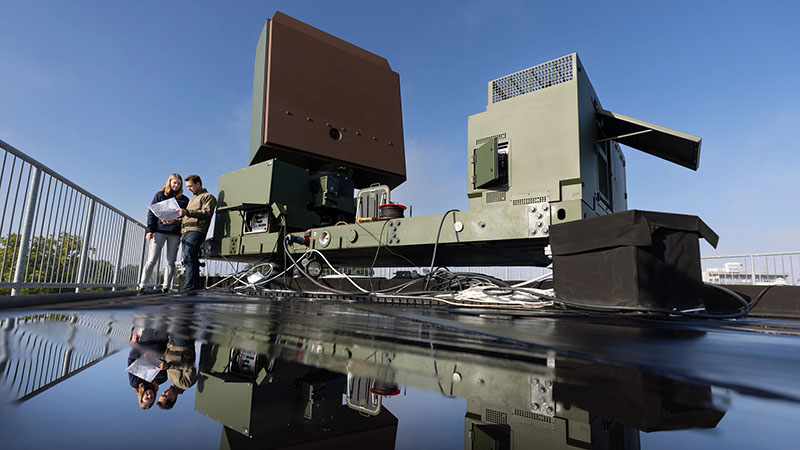
Thales Netherlands and the Dutch Ministry of Defence are expanding radar production, development, and test capacity in Hengelo as demand rises for advanced sensor and air-defence systems.
The strategic collaboration includes a new test tower, a near-field radar test site with an anechoic chamber, expanded complex PCB production, and additional training facilities. The programme is expected to raise Thales’ antenna production capacity in the Netherlands by 60% between 2025 and 2028.
Thales has operated in the Dutch defence and radar sector for more than a century, supplying systems used by the Netherlands and export customers. The latest expansion concentrates on manufacturing and test infrastructure rather than a single radar product, strengthening the industrial base behind future radar supply.
Radar capability depends on antennas, RF electronics, digital processing, power systems, software, calibration, environmental qualification, and integration discipline. Expanding output therefore requires more than extra floor space. Near-field measurement, anechoic testing, skilled technicians, PCB manufacturing, system integration, and training capacity all have to grow together.
European defence electronics demand is being reshaped by air and missile defence, naval protection, drone warfare, electronic attack, and persistent surveillance. Radar systems must detect smaller, faster, lower-signature, and more numerous targets while operating in increasingly contested electromagnetic environments.
Those requirements place pressure on RF front ends, phased-array design, digital beamforming, signal processing, thermal management, and software update capability. Production readiness has become a central part of defence capability, since a radar design that cannot be manufactured, tested, repaired, and upgraded at pace is poorly matched to current security conditions.
Industrialisation has become a recurring theme across European defence technology. On IN Defence, Renault and Thales have moved the Toutatis counter-drone system onto a production path, pairing vehicle manufacturing with electronic detection and effector integration. The Hengelo expansion follows the same manufacturing logic, but at the level of radar production, antenna capacity, and test infrastructure.
The inclusion of complex PCB capacity is especially significant. Advanced radar electronics require high-reliability boards capable of supporting RF performance, dense interconnect, thermal control, and harsh operating conditions. PCB supply is now a strategic layer in defence electronics, where qualification, traceability, security, and long lifecycle support restrict the use of generic supply routes.
Test infrastructure is equally decisive. Near-field radar testing and anechoic facilities allow systems to be characterised and calibrated in controlled environments, reducing reliance on open-range testing for every production and development step. That improves repeatability, fault isolation, and feedback between manufacturing and engineering teams.
As radar arrays become more digitally controlled and software-defined, test capacity must also handle more complex verification. Hardware performance, software behaviour, signal processing, calibration, and electromagnetic performance increasingly have to be validated as connected parts of one system.
The Dutch Ministry of Defence is acting as both customer and capacity enabler. That approach can help aggregate demand and reduce the fragmentation that often slows European defence manufacturing. Where common equipment families, shared production assets, and national procurement converge, suppliers can plan capacity with more confidence.
Radar remains one of the clearest domains where electronics capability and industrial capacity are inseparable. Better algorithms, stronger RF front ends, and more capable arrays only become operational assets when systems can be built, tested, delivered, maintained, and upgraded at scale. The Hengelo expansion strengthens that manufacturing layer behind Europe’s sensor and air-defence requirements.