
IN Brief:
- Acbel is presenting EV power solutions at Power2Drive Europe in Munich.
- The showcase includes 400V and 800V onboard charger and DC/DC conversion technology.
- EV platforms are forcing tighter integration between power density, bidirectional energy flow, safety, and charging infrastructure.
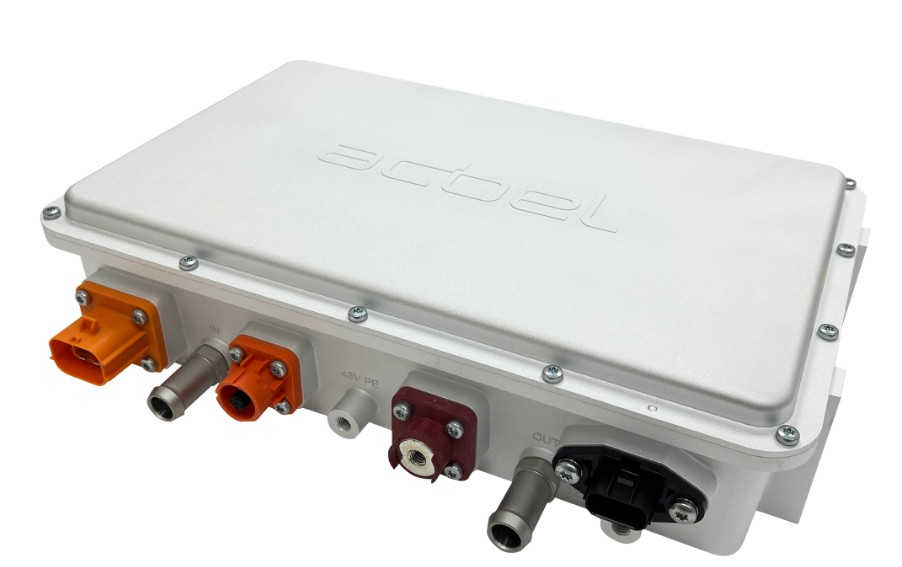
Acbel Polytech is presenting EV power conversion technologies at Power2Drive Europe in Munich, with its vehicle-side display centred on 400V and 800V onboard power architectures.
The showcase includes 2-in-1 power conversion units that combine an onboard charger and DC/DC converter in a single package. The 400V and 800V Combo series integrates an 11kW onboard charger with bidirectional vehicle-to-load capability and a 3kW DC/DC converter, targeting EV platforms where packaging space, conversion efficiency, and system integration are under sustained pressure.
Power2Drive Europe, held at Messe München, sits within The smarter E Europe exhibition ecosystem and has become a major meeting point for charging infrastructure, e-mobility, grid integration, and power electronics suppliers. Vehicle-side conversion, station-side charging, and grid-facing energy systems are now developing in closer technical alignment as higher charging power changes the electrical architecture around EV deployment.
The integration of onboard charging and DC/DC conversion is not only a packaging exercise. EV platforms have to manage high-voltage battery charging, low-voltage auxiliary supply, isolation, thermal behaviour, functional safety, electromagnetic compatibility, and bidirectional power modes within a tightly constrained electrical and mechanical envelope. Combining functions can reduce volume and harness complexity, while raising the demands placed on thermal design, protection, validation, and service planning.
The move to 800V platforms is changing power electronics requirements across the vehicle. Higher battery voltage can support faster charging and reduced current for a given power level, but it also increases demands on insulation, switching devices, connectors, sensing, test procedures, and system safety. A higher-voltage platform requires the full power path to be robust enough for production vehicles, charging networks, and variable operating environments.
Acbel’s inclusion of vehicle-to-load capability reflects another change in EV power architecture. Bidirectional energy flow is moving from a premium feature towards a more common design consideration, supporting external loads, backup power, vehicle-to-home applications, and wider energy-system integration. That requires power stages and control software that can operate safely across more modes than a conventional unidirectional charger.
Compact conversion is also moving into adjacent energy infrastructure. Infineon’s 100V CoolGaN devices in BRC Solar’s module-level power optimisers show the same movement towards efficient conversion closer to the point where energy is generated, stored, or consumed. EV onboard power and solar optimisation operate at different voltage and power levels, but both depend on higher switching performance, tighter thermal control, and more compact power stages.
That direction strengthens the role of wide-bandgap semiconductors, advanced magnetics, thermal interface materials, digital control, and high-reliability interconnects. It also complicates qualification. EV power systems must survive vibration, thermal cycling, moisture, load transients, vehicle lifetime requirements, and charging conditions that vary between networks and regions.
Charging infrastructure adds another layer of complexity. Faster chargers and bidirectional charging models increase the need for coordination between vehicle-side and station-side electronics. Misalignment between onboard charging capability, connector standards, grid constraints, and charging protocols can limit the value of otherwise capable hardware.
Suppliers working across vehicle power and infrastructure can treat the charging interface as a system rather than a boundary. That becomes increasingly important as EV platforms move beyond simple charging into energy services, fleet management, depot charging, and interaction with local power systems.
Acbel’s Munich display reflects the broadening of the EV supply chain. Power conversion is no longer a supporting subsystem hidden behind battery and drivetrain headlines. Onboard chargers, DC/DC converters, charging modules, cooling systems, connectors, and control software now influence vehicle cost, charging experience, platform flexibility, and energy-service potential.
As EV platforms move towards higher voltage and more bidirectional energy use, the power electronics behind them will carry more of the vehicle’s commercial and technical value. Integrated conversion units are becoming one of the clearest places where that shift is visible.

