IN Brief:
- Infineon has started production of the RASIC CTRX8188F 8Tx8Rx radar transceiver.
- The MMIC supports centralised radar architectures, 4D imaging radar, and HD radar systems.
- Automotive radar is shifting from edge-heavy sensor nodes towards central processing and scalable platform architectures.
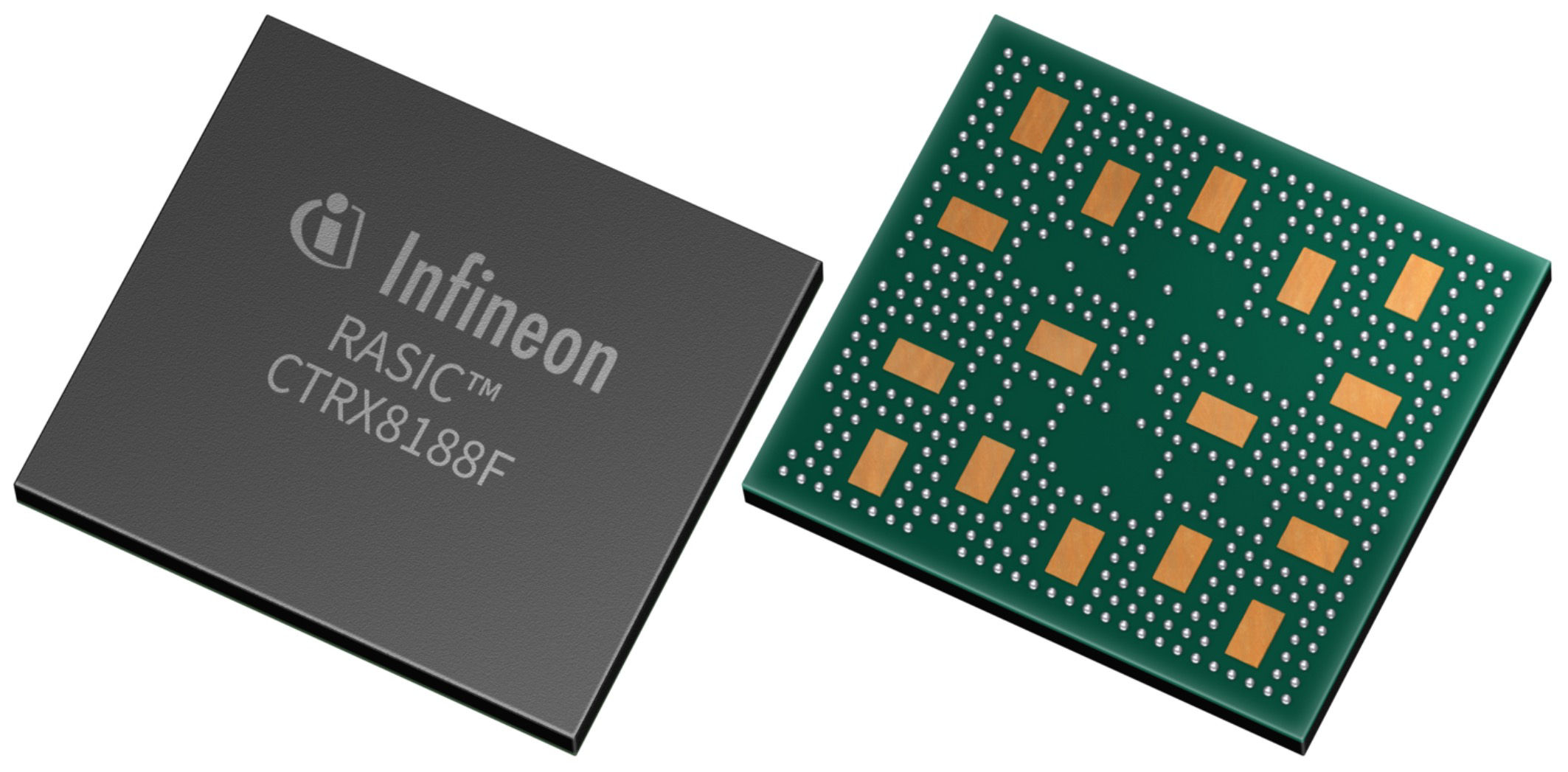
Infineon Technologies has started production of the RASIC CTRX8188F, an 8Tx8Rx automotive radar transceiver developed for centralised radar architectures in advanced driver assistance and automated driving systems.
The device is built for 4D and HD imaging radar systems, with a path from Level 2 driver assistance through to higher-end automated driving platforms. It is designed to work with edge processing in combination with Infineon’s AURIX TC45 family, while also supporting architectures in which raw radar data is moved to a central vehicle computer.
Centralised radar changes the design balance inside the vehicle, moving part of the processing burden away from individual sensor nodes and towards a higher-performance compute layer. Instead of treating each radar unit as a largely self-contained subsystem, vehicle platforms can aggregate data from multiple radar points, support stronger sensor fusion, and scale capability across model ranges with fewer hardware variants.
The CTRX8188F is based on Infineon’s second-generation CMOS radar technology and supports cascading configurations beyond 32Tx32Rx channels. That gives system designers a route to build different radar tiers from the same underlying platform, covering lower-cost ADAS applications as well as higher-resolution imaging radar deployments.
Infineon says the MMIC delivers signal-to-noise ratio and noise-figure performance suitable for 4D and HD imaging radar systems capable of detecting vulnerable road users and vehicles at distances of up to 400 metres. The device also includes a configurable CSI-2 interface intended to support integration with existing and emerging SerDes and asymmetric Ethernet communication technologies.
“The automotive radar market is at an inflection point. Centralized architectures are redefining how radar systems are designed, and the CTRX8188F positions Infineon and our customers at the leading edge of this transition,” said Dr Frank Findeis, Head of RF business line at Infineon.
Radar is moving into a more demanding position within vehicle sensing. Cameras and lidar continue to carry much of the perception debate, but radar remains central to all-weather operation, range measurement, velocity detection, and sensor redundancy. Higher-resolution radar becomes particularly valuable as software-defined vehicles consolidate more functions into central compute platforms.
The same integration pressure is visible across wider electronics design. Infineon’s 100V CoolGaN devices, used in BRC Solar’s module-level power optimisers, show how semiconductor selection is increasingly tied to system architecture rather than direct component substitution. Radar follows the same pattern: the RF device matters, but so do the data path, compute location, interface strategy, and software stack around it.
Centralised radar also raises requirements around timing, synchronisation, bandwidth, and functional safety. Moving raw or semi-processed radar data through the vehicle network increases the need for deterministic communication, robust data integrity, and low-latency compute paths. Poorly implemented centralisation can simply move complexity from the sensor to the network; disciplined architecture can reduce duplication while improving sensing performance.
The defence and industrial electronics context reinforces the same shift. Thales’ expansion of radar production and test capacity in Hengelo shows how RF front ends, antenna manufacturing, PCB capability, calibration, and digital processing are becoming industrial capacity questions as much as technology questions. Automotive radar sits in a different certification environment, but the pressure towards scalable sensor production and repeatable test is common across both markets.
Productive samples of the CTRX8188F radar MMIC and CARKIT modules are available now. The development platform supports both centralised and edge radar architectures, giving vehicle electronics teams a route to evaluate system choices before committing to full platform decisions.
The device strengthens Infineon’s position in automotive radar silicon as the market moves from incremental sensor improvement towards platform-level perception architecture. Higher radar resolution is only part of the shift. The larger change is radar’s migration from a peripheral safety function into a core data source for central vehicle intelligence.