IN Brief:
- Infineon’s 100V CoolGaN devices will be used in BRC Solar power optimisers.
- The design targets compact panel-level MPPT with high efficiency and power density.
- GaN is moving deeper into renewable-energy power conversion beyond consumer charging applications.
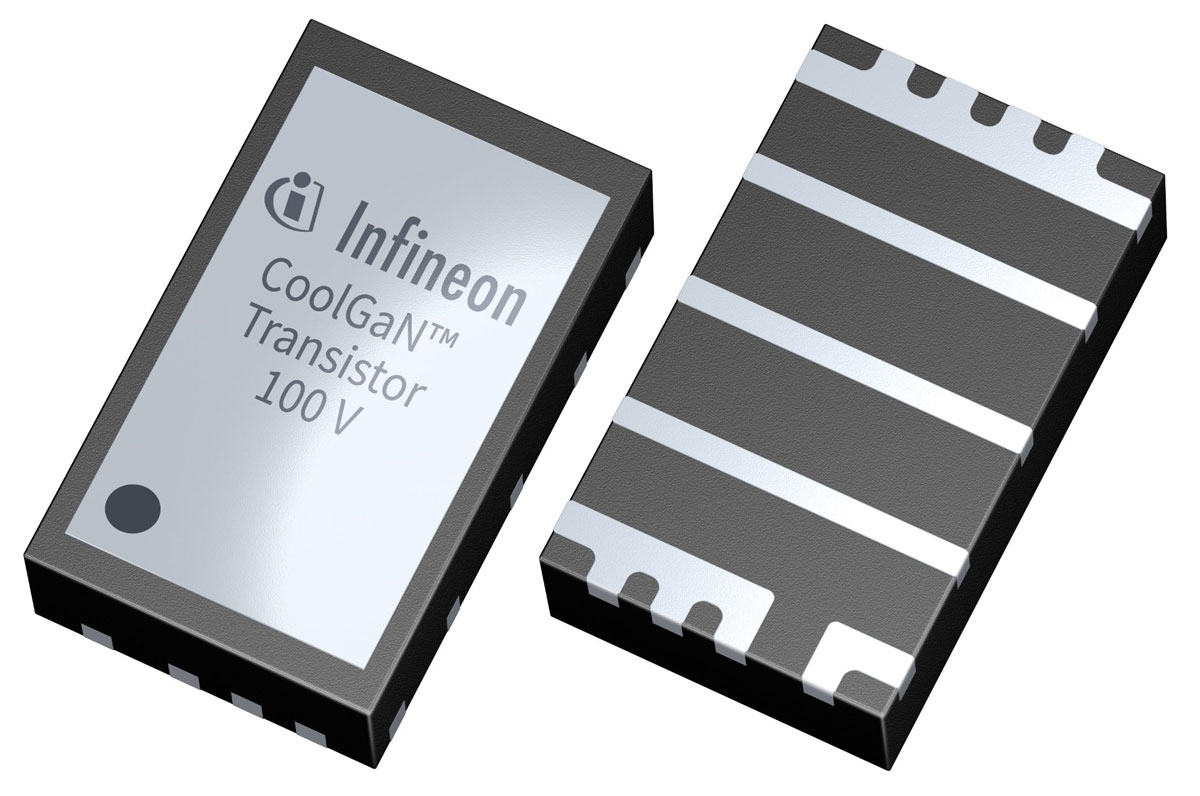
Infineon Technologies has been selected by BRC Solar to supply 100V CoolGaN transistors for the German company’s Power Optimizer platform.
The devices will act as the core switching technology in BRC Solar’s module-level power electronics, enabling panel-level maximum power-point tracking in rooftop photovoltaic installations. The CoolGaN Transistor 100V family is supplied in a compact 3mm x 5mm package and supports high-frequency switching, efficiency, and power density in restricted solar electronics.
BRC Solar develops power optimisers for photovoltaic systems, including the M600-E and M605-M products. The architecture addresses a familiar problem in rooftop installations: when optimisation is handled at string level, shading or mismatch on one module can reduce output across the wider string. Panel-level MPPT allows each module to operate closer to its own optimum point.
GaN switching devices suit this application because they can operate at higher frequencies with lower switching losses than conventional silicon MOSFETs in many converter designs. Higher switching frequency can reduce magnetics size, improve conversion efficiency, and enable compact power stages to be built into space-constrained module-level hardware.
The selection also extends GaN beyond its early association with adapters, chargers, and compact consumer power supplies. Renewable-energy electronics, data-centre power systems, industrial converters, automotive auxiliaries, and energy storage are all creating demand for higher-frequency, higher-efficiency switching devices.
Rooftop photovoltaic systems impose a difficult mix of electrical and environmental constraints. Module-level power electronics must operate outdoors, handle thermal cycling, support long field life, maintain high conversion efficiency across variable load conditions, and fit within cost-sensitive installation models. Power density is useful only when reliability, electromagnetic compatibility, thermal paths, and installation simplicity are preserved.
Wide-bandgap semiconductors are already reshaping infrastructure power design. SemiQ has expanded its SiC power-module portfolio, while Power Integrations has introduced auxiliary PSU reference designs for 800VDC AI data-centre architectures. GaN and SiC serve different voltage and application spaces, but both are being pulled forward by the same requirement for lower losses, smaller converters, and tighter thermal performance.
SiC remains strongly associated with higher-voltage industrial, grid, EV, and traction applications. GaN is extending its reach in lower- and mid-voltage conversion, where switching speed and compact form factor can change the size and efficiency of the power stage. Solar optimisers sit squarely in that expanding middle ground.
The design challenge reaches beyond the transistor. Gate-drive behaviour, layout parasitics, protection, thermal spreading, EMI control, firmware, and production test all determine whether GaN performance is realised in a field product. In panel-level electronics, each extra percentage point of efficiency must be balanced against component stress, lifetime, and service exposure.
More electronically managed solar systems also depend on monitoring and data visibility. Module-level optimisers can help installers and operators see individual panel performance, diagnose faults, and manage installations affected by shading, mixed roof orientations, or gradual module mismatch. That diagnostic value strengthens the case for electronics at the panel level, provided hardware cost and reliability remain controlled.
The Infineon-BRC Solar design shows GaN moving into an infrastructure application where compact conversion and field durability both matter. As solar installations become more distributed and electronically optimised, wide-bandgap devices are likely to become a larger part of the power architecture behind rooftop energy systems.