
IN Brief:
- TE Connectivity has introduced AMP SMC essential connectors in a 1.27mm pitch.
- The series supports up to 1.7A, 125°C operation, and IEC 60603 Class 2 vibration and shock requirements.
- Industrial interconnect selection is becoming more segmented as equipment makers balance performance, cost, and qualification effort.
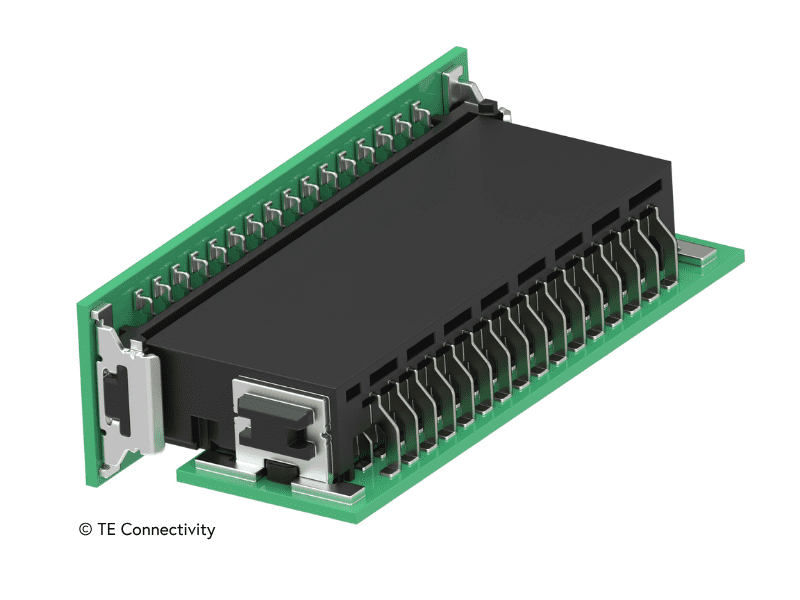
TE Connectivity has expanded its 1.27mm pitch connector portfolio with the AMP SMC essential connector series for industrial board-to-board and board-to-wire applications.
The range complements TE’s existing ERNI SMC portfolio by giving equipment manufacturers a lower-cost option for applications that do not require the highest mechanical performance grade. The new connectors support currents of up to 1.7A, operate at temperatures up to 125°C, and meet IEC 60603 Class 2 requirements for vibration and shock resistance.
Several features from the wider SMC family have been retained. Double-sided spring contacts support electrical continuity, locating pegs add mechanical stability, polarisation reduces the risk of incorrect mating, and lead-in chamfers support blind mating by accommodating misalignment of up to ±0.7mm during assembly.
Industrial products often contain several connector environments inside the same equipment, from protected internal board links through to higher-stress interfaces exposed to servicing, motion, or vibration. Applying the most mechanically robust connector across every interface adds cost, while under-specification can turn a small interconnect choice into a reliability problem.
AMP SMC adds another tier inside the same pitch class. That gives product teams more room to create platform designs where one family of equipment can use several connector grades across control boards, I/O modules, compact drives, process equipment, and automation hardware without moving between unrelated formats.
Industrial electronics are becoming denser, more modular, and more serviceable. Control platforms, sensor nodes, robotics hardware, power modules, and communications equipment increasingly need compact interconnects that support dependable signal and power paths without forcing larger board outlines or more complex mechanical structures.
Manufacturing discipline also shapes connector choice. Blind mating, polarisation, automated placement compatibility, mechanical reinforcement, and inspection all affect production yield and service reliability once a design moves beyond prototype builds. A connector that performs adequately on the bench can create assembly ambiguity if it is difficult to align, mate, or verify inside a constrained enclosure.
Cooling, power density, and modularity are also changing the surrounding interconnect market. Recent additions of Amphenol cooling connectors through Inelco Hunter show how connector selection is increasingly tied to thermal architecture, energy flow, and subsystem packaging rather than treated as a generic catalogue choice.
Bill-of-material rationalisation remains a persistent pressure in industrial equipment. Multiple connector families increase purchasing complexity, qualification work, documentation, tooling, spare-part management, and supplier exposure. A tiered family around a familiar 1.27mm format can reduce that fragmentation when the chosen grade matches the mechanical and electrical demands of each interface.
AMP SMC is aimed at applications where a compact, cost-conscious, and mechanically supported connector is sufficient, without forcing the specification burden of a higher-grade product into every board connection. That distinction becomes more valuable as industrial equipment combines higher electronics density with tighter margin control and shorter product development cycles.

