
IN Brief:
- Inelco Hunter is offering Amphenol liquid-cooling connectors for demanding energy applications.
- The connectors target AI data centres, EV charging, energy storage, and high-thermal-load systems.
- Power-dense electronics are turning coolant interfaces into critical reliability components.
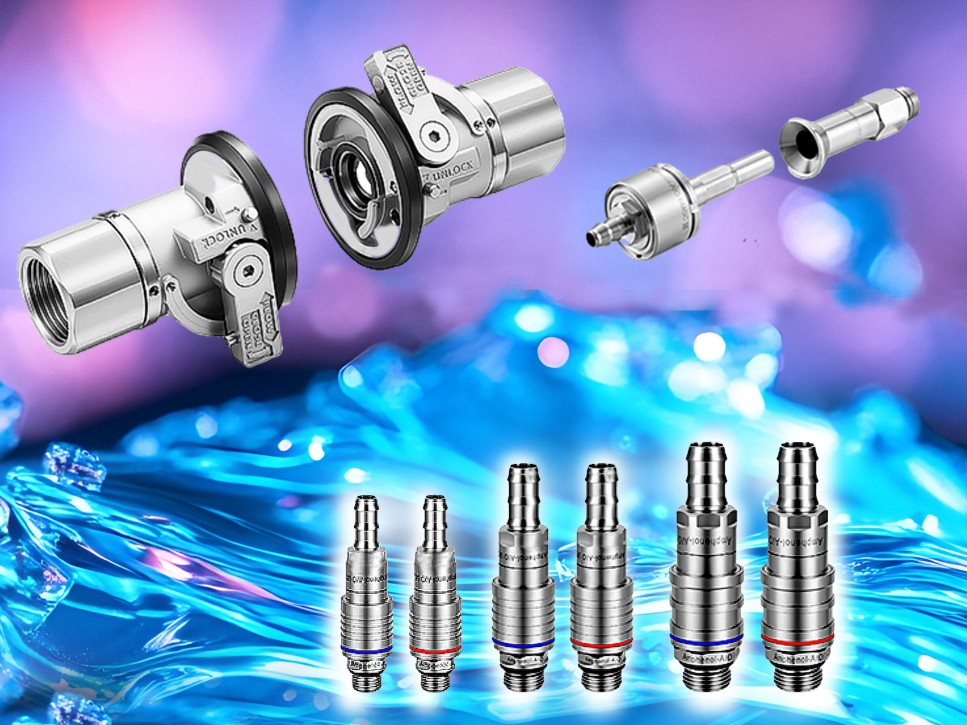
Inelco Hunter is offering Amphenol Industrial Operations’ liquid-cooling connector range for high-thermal-load energy and electronics applications.
The connectors are designed for systems such as AI data centres, EV charging stations, energy storage systems, hyperscale computing, and next-generation power infrastructure. Amphenol’s liquid-cooling portfolio includes quick-disconnect and blind-mate options developed for coolant loops where reliability, serviceability, and compact packaging are critical.
Liquid cooling is moving from specialist high-performance computing into mainstream power-dense electronics. AI accelerators, high-current processors, energy storage converters, EV charging modules, and dense industrial computing systems are pushing air cooling beyond practical limits. As heat flux rises, the coolant interface becomes a functional part of the electronics system rather than a peripheral mechanical fitting.
Connectors in these systems must maintain sealing performance, withstand repeated mating cycles, support coolant flow, resist corrosion, and fit into confined equipment layouts. A leak or pressure failure can compromise electronics, uptime, safety, and service cost. The connector is therefore one of the smaller but more consequential components in the thermal-management chain.
Amphenol’s liquid-cooling systems are engineered for secure fluid connections, bidirectional dry-break performance, and corrosion-resistant materials. The portfolio includes connector options for compact tray-level connections, blind-mate interfaces, and higher-flow sourceline applications across AI data centres, energy storage, and EV charging.
AI data centres create one of the most demanding use cases. Rack power densities are rising as accelerators and high-bandwidth memory are packed more tightly into servers. Every additional watt consumed near the processor has to be removed without compromising reliability or service access. Direct-to-chip cooling, cold plates, manifolds, and quick disconnects are now central to infrastructure design.
The electrical and thermal problems are converging around the processor package. Lotus Microsystems’ vStrata vertical power delivery platform moves conversion closer to high-current AI processors, shortening current paths and reducing last-inch distribution losses. That kind of integration improves electrical performance but concentrates thermal and mechanical constraints around the load.
EV charging presents a different but related problem. Fast chargers and high-power modules generate significant heat across power stages, cables, connectors, and conversion electronics. Higher charging rates make liquid cooling more attractive, but infrastructure equipment must remain serviceable, safe, and robust in public or semi-public environments.
Energy storage systems add requirements around long duty cycles, outdoor environments, system uptime, and safety. Power conversion equipment in storage installations may operate under variable load, thermal cycling, and constrained enclosure conditions. Reliable coolant connections help maintain converter performance while reducing thermal derating and premature component stress.
The wider direction is the convergence of electrical, thermal, and mechanical design. In older systems, connectors, cooling, and power delivery could often be treated as parallel engineering tasks. In current high-density systems, each one shapes the others. Connector placement affects service access and pressure drop. Cooling architecture affects board layout and enclosure design. Power density affects coolant flow and thermal margin.
Distribution availability also has practical value during prototype and validation phases. Liquid-cooling hardware often has to be selected before final mechanical integration is complete, and lead times can shape the speed at which thermal loops are evaluated. UK and European access through Inelco Hunter gives developers another route to assess connector options as liquid cooling becomes more common.
As AI infrastructure, EV charging, and energy storage scale, liquid cooling will become a more routine design discipline. The reliability of the coolant interface will sit alongside semiconductor efficiency, power-stage design, and software control as part of the system’s operating margin.

