IN Brief:
- Molex has introduced the HSAutoLink G connector system for multi-gigabit automotive Ethernet.
- The system supports up to 25Gbps for ADAS, radar, LiDAR, zonal architectures, displays, and central compute modules.
- Vehicle networks are shifting towards higher-speed links as sensing and centralised compute place greater demand on the physical layer.
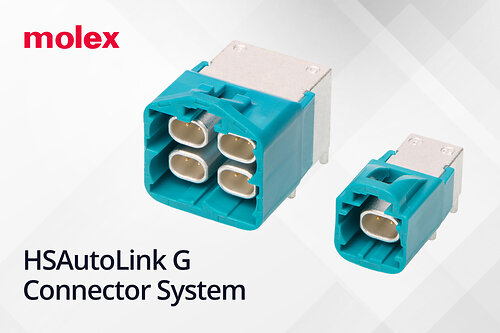
Molex has expanded its HSAutoLink interconnect portfolio with the HSAutoLink G connector system, supporting multi-gigabit automotive Ethernet connections up to 25Gbps.
The system is designed for software-defined vehicle architectures, including ADAS, radar, LiDAR, zonal control, immersive displays, and central compute modules. It uses a compact USCAR-compatible interface, giving automotive OEMs and tier-one suppliers a higher-speed link option while preserving compatibility with established automotive interface footprints.
HSAutoLink G is available as a family covering terminals, connectors, PCB headers, and cables. The design includes advanced EMI shielding, controlled differential impedance, multiple uniform ground contacts, and an anti-stubbing feature intended to protect contacts during mating. Molex is also using a reversible housing shroud to improve packaging and routing flexibility.
The product builds on the wider HSAutoLink family, which has been used in automotive applications since 2008. Molex says more than 700 million HSAutoLink connectors and cables have been delivered to the automotive industry. HSAutoLink G samples are becoming available for early qualification and design-in testing.
Vehicle electrical architectures are moving away from isolated electronic control units towards zonal and centralised compute structures. Cameras, radar, LiDAR, displays, telematics, and driver-assistance subsystems are producing larger volumes of data, while software-defined platforms need scalable links between sensors, domain controllers, and central processors.
Higher-resolution sensing is already reshaping the semiconductor layer, with production of advanced radar MMICs pushing more data into vehicle networks. Those sensors depend on physical connections that can move data reliably under vibration, temperature variation, dense harness routing, connector cycling, and electromagnetic noise.
The connector is therefore part of the compute architecture. A data-rate figure only becomes useful when the physical interface can maintain signal integrity across real vehicle conditions and full platform lifecycles. Controlled impedance, shielding, grounding, and robust mating features sit at the boundary between electrical performance and vehicle assembly.
USCAR compatibility gives the system a practical route into established design environments. Automotive platforms move through long validation cycles, and even a technically superior interface can face resistance if it forces major changes to packaging, tooling, harness design, or supplier qualification. A footprint-compatible upgrade path can reduce disruption as platforms move from established differential links towards higher-speed Ethernet.
The same pressure is visible across the vehicle electronics stack. Radar, vision, central compute, zonal control, and electric power systems are converging inside architectures that need more bandwidth without adding unacceptable weight, cost, or complexity. Cabling and connectors can become bottlenecks when the electrical architecture demands more speed than the physical layer can support.
Supply continuity also carries weight in automotive design. Programmes run over long lifecycles, and connector availability can affect platform continuity as sharply as semiconductor shortages. Standardised interfaces, validated assemblies, and second-source planning remain central to keeping vehicle production and service support stable.
HSAutoLink G addresses a practical layer of the software-defined vehicle transition. Faster processors and richer sensors need physical networks that can be packaged, assembled, shielded, qualified, and supplied at automotive scale. The shift towards central compute will only move as quickly as the interconnect layer can carry it.