IN Brief:
- PureFize has demonstrated deep-UV emission below 240nm from a phosphor-tunable device platform.
- The concept combines ZnO nanostructure field emission with cathodoluminescent excitation of Far-UVC phosphors.
- The work remains a platform milestone, with system integration still central to future adoption.
PureFize Technologies has demonstrated deep-UV emission below 240nm from a phosphor-tunable device platform based on field emission and cathodoluminescence.
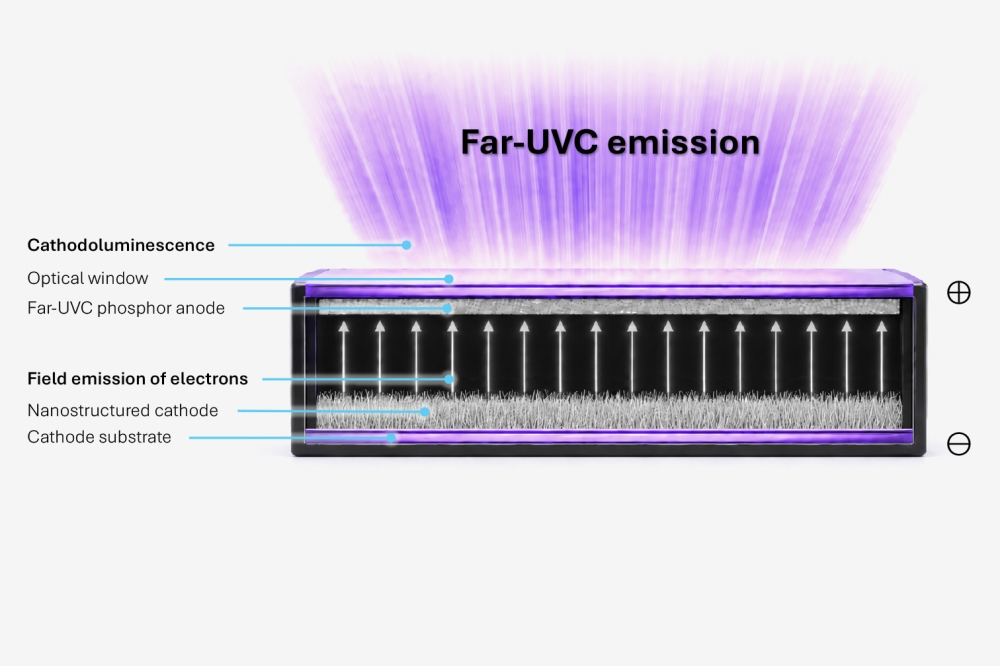
The Swedish company presented the results at the International Conference on Far-UVC Science and Technology 2026. Its device concept combines electron emission from ZnO nanostructures with cathodoluminescent excitation of a Far-UVC phosphor layer, creating an emitter approach that differs from gas-discharge lamps and semiconductor UV sources.
The early prototype data showed deep-UV emission below 240nm, tunable output power, wide-angle emission of approximately 100°, short start-up time, irradiance stability across a wide ambient temperature range, and measured irradiance of around 3.5µW/cm² at 1m with 12W total input power.
Far-UVC technology is attracting interest because it can inactivate microorganisms in air and on surfaces while interacting differently with biological tissue from longer-wavelength germicidal UVC. Any future deployment still has to satisfy exposure limits, optical control, verification, lifetime monitoring, and safety interlocks, particularly if equipment is designed for occupied environments.
PureFize’s architecture separates electron generation from the emitting phosphor material. Electrons are emitted from a nanostructured cathode and accelerated toward a phosphor-coated surface, where cathodoluminescence generates UV output. By changing the phosphor, the emission spectrum can be engineered for different wavelength ranges and applications.
That platform structure gives the technology its technical interest. UV disinfection equipment is rarely defined by the emitter alone, since power conversion, thermal design, optics, mechanical integration, shielding, exposure monitoring, control electronics, and maintenance routines all shape the final system. A tunable source can only become useful if it can be packaged and driven repeatably inside real equipment.
Recent optical and sensing product development has followed a similar path from device physics toward integrated subsystems, with compact 3D LiDAR modules being developed for edge systems. Although LiDAR and Far-UVC address different markets, both require optical functions to be packaged with electronics, calibration, control, and safety features that allow the device to operate outside controlled laboratory conditions.
Potential Far-UVC applications span medical-adjacent spaces, food processing, clean manufacturing, transport, building services, and public infrastructure. Each imposes a different operating envelope. An air-treatment source inside HVAC equipment may prioritise airflow geometry, service life, and maintenance access, while a surface-disinfection module may need tighter optical distribution, shielding, and exposure control.
The wider UV market has also shown how easily headline wavelength can overshadow system engineering. Ageing, output drift, contamination, shadowing, reflectance, airflow, dose distribution, thermal load, and verification all affect performance after installation. New emitter platforms therefore need manufacturability and monitoring strategies as much as strong initial emission data.
PureFize’s Far-UVC demonstration adds another technical route to compact ultraviolet disinfection hardware at a point when the sector is still balancing source performance against cost, safety, lifetime, and integration. Progress from prototype to deployable modules will depend on whether the platform can hold its spectral and output advantages through production, packaging, and field operation.