IN Brief:
- HZB and Humboldt-Universität have achieved 25.5% certified efficiency for a CIGS-perovskite tandem solar cell.
- The result was certified by the European Solar Test Installation and recorded in the Solar Cell Efficiency Tables.
- The work advances thin-film tandem development, although scaling and stability remain central engineering challenges.
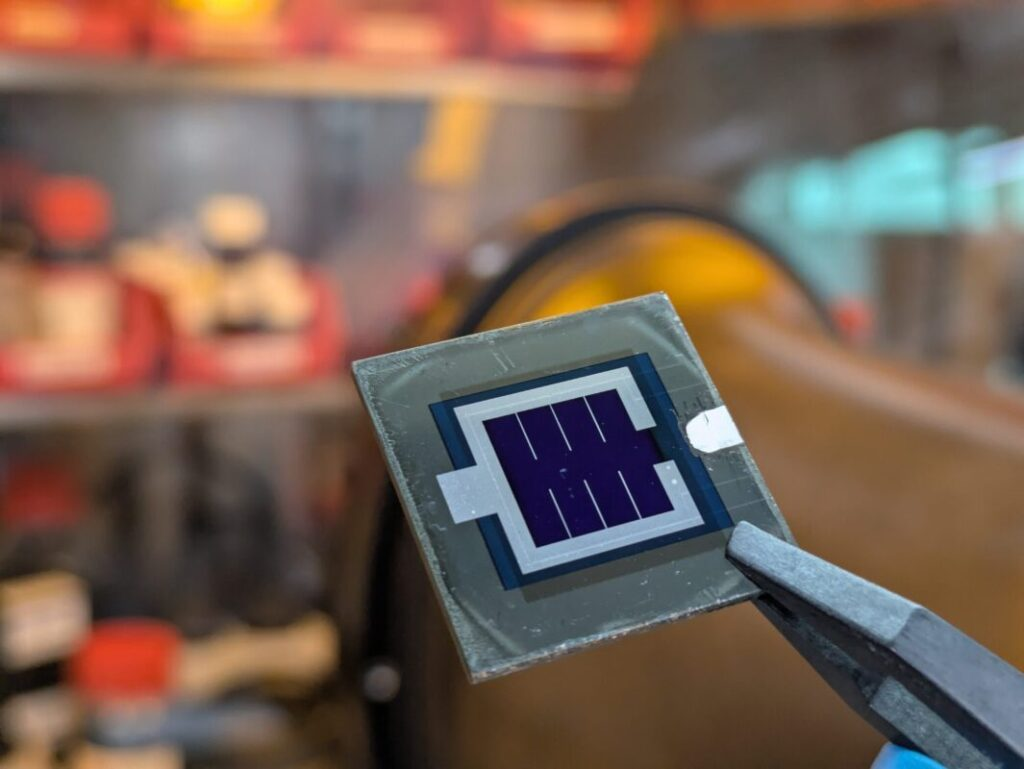
Helmholtz-Zentrum Berlin and Humboldt-Universität researchers have achieved 25.5% certified efficiency for a tandem solar cell combining a perovskite top layer with a copper indium gallium selenide thin-film bottom layer.
The result was certified by the European Solar Test Installation and recorded in the latest Solar Cell Efficiency Tables. The device area was slightly above 1cm², giving the milestone stronger engineering weight than very small laboratory cells that often struggle to translate into larger-area process development.
The work forms part of the EU-funded SOLMATES project, which is exploring integration of CIGS and perovskite technologies. HZB’s previous result under the programme was 24.6%, with the latest cell improving performance through changes to the device stack, contact layers, and interfacial recombination control.
The researchers used CIGSe bottom cells with different band gaps and compared aluminium-doped zinc oxide thicknesses. They also screened combinations of nickel oxide and self-assembled monolayers as hole-transport layers, while refining electron-selective contact processing through initial thermal evaporation of C60 onto an ultra-thin lithium fluoride passivation layer.
Those details are central to tandem photovoltaic design. The theoretical benefit of stacking two absorbers can be lost quickly if interfaces add recombination, resistance, instability, optical loss, or processing damage. Charge has to move through several material boundaries cleanly enough for the second absorber to increase total output rather than merely add manufacturing complexity.
CIGS remains attractive because it is a thin-film semiconductor technology with established manufacturing experience and flexible-substrate potential. Perovskites bring strong absorption and tunable band gaps, making them useful candidates for top cells. Combining the two offers a route to higher efficiency without simply following the silicon-perovskite tandem path.
The same research also produced a mini-module using a similar stack with efficiency around 19.7% over 2.25cm². The gap between cell and mini-module performance is a familiar obstacle in photovoltaics. Scaling introduces uniformity, interconnection, encapsulation, edge loss, defect density, and process-window problems that single small cells can avoid.
Photovoltaic semiconductor gains also have to connect with system-level electronics. Module output, inverter design, optimisation, monitoring, and grid interface all determine the amount of usable energy delivered outside laboratory test conditions. GaN devices used in solar power optimisers show the other side of that equation, where power conversion technology is being refined to extract more energy from variable module conditions.
The thin-film tandem route also raises industrial questions around diversification. Crystalline silicon dominates global solar manufacturing through scale, cost, and process maturity. Any alternative stack must prove efficiency, stability, throughput, yield, supply-chain resilience, and credible module lifetimes before it can move beyond specialist deployment or pilot-line production.
Certified cell records still play a useful role in that progression. They identify material combinations and interface strategies worth carrying into larger-area processing, accelerated lifetime testing, and module development. A 25.5% CIGS-perovskite cell does not create a commercial product by itself, but it strengthens the technical case for thin-film tandem devices as solar manufacturing continues to search for efficiency gains beyond conventional single-junction limits.