IN Brief:
- SEMI has warned that direct intervention in memory markets could distort capacity and pricing decisions during the current supply crunch.
- AI infrastructure demand is pulling wafer, packaging, and capital equipment capacity towards HBM and advanced DRAM.
- The warning reinforces longer memory-planning horizons across embedded, industrial, automotive, medical, aerospace, and defence electronics.
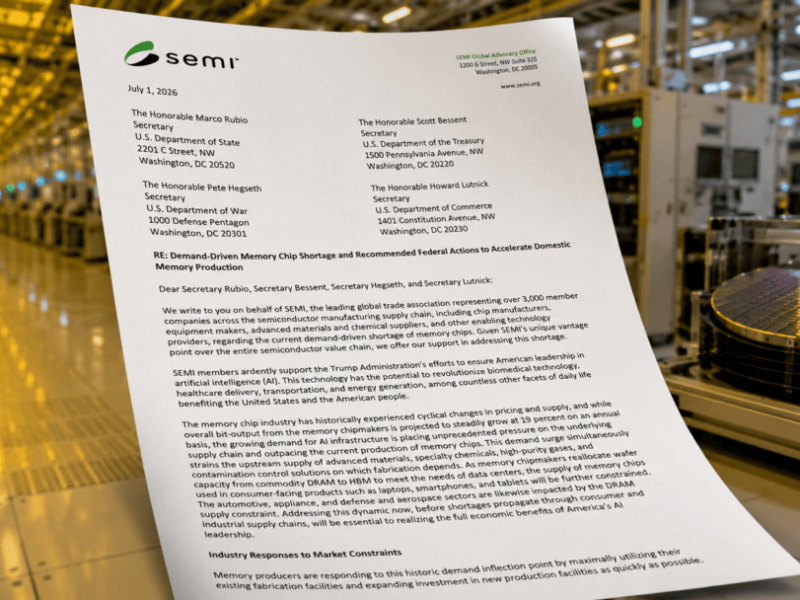
SEMI has warned senior US officials that direct intervention in memory markets could make current supply pressures worse, as AI infrastructure demand pulls wafer capacity, packaging resources, and investment towards high-bandwidth memory and advanced DRAM.
The industry association has argued that the shortage is not being driven by a simple lack of supplier response. Its warning centres on the physical limits of fab capacity, technology transitions, equipment installation timelines, and the accelerating demand profile created by AI data centres. Memory bit output is projected to grow strongly, but the gap between capital investment and qualified production remains wide enough to keep pressure on customers across the electronics chain.
Advanced DRAM capacity is being pulled towards HBM, where demand from GPU and accelerator platforms has changed how memory suppliers allocate their most valuable production and packaging resources. HBM is central to AI compute performance because it delivers very high bandwidth close to the processor package, but its growth also affects conventional DRAM markets, embedded platforms, industrial systems, automotive electronics, and other long-lifecycle equipment.
SEMI’s preferred response is focused on longer-term purchase agreements, investment incentives, regulatory simplification, support for materials and chemical supply chains, and measures that cushion the effect of higher memory-related costs. The association has also pointed to rising capital equipment investment, including higher projected spending on 300mm memory fabs, DRAM, and 3D NAND equipment. That investment may improve future supply, although the lag between capital expenditure, tool installation, process qualification, and reliable volume production remains central to the problem.
Memory has moved back into the design and procurement foreground. Component buyers have seen several previous memory cycles, but the current pressure is structurally different because HBM demand is being driven by a multiyear AI infrastructure build-out rather than a short consumer electronics surge. A shortage shaped by accelerator roadmaps, substrate capacity, and advanced packaging has a different recovery profile from a normal inventory correction.
The same pressure is visible in Kioxia’s 332-layer BiCS FLASH sampling and MEMPHIS Electronic’s memory market warning, where density gains, lifecycle planning, migration, and allocation risk are all moving closer to early-stage product decisions. The question is no longer only whether memory prices rise or fall in a given quarter. It is whether a selected device family, package, grade, or managed memory product will remain available throughout the design, qualification, production, and service life of the system using it.
Embedded and industrial products are particularly exposed to that mismatch between rapid AI demand and slower qualification cycles. Designs using DRAM, NAND, or managed memory often remain in production long after consumer platforms have turned over, while firmware, certification, and service arrangements can make part substitution expensive. A change in memory availability can therefore trigger a chain of engineering work that reaches from PCB layout and firmware to compliance documentation and field support.
Political attention has also tied memory supply to wider economic and strategic policy. AI infrastructure touches energy demand, cloud capacity, data-centre construction, national security, and chip manufacturing incentives. Short-term intervention may appear attractive when shortages become visible, but capacity allocation and pricing controls can create uncertainty for downstream electronics companies already trying to plan around volatile availability.
The memory sector cannot instantly convert demand signals into qualified capacity. Fabs, tools, materials, packaging lines, and customer qualifications all move at industrial timescales, while AI infrastructure demand is being set by aggressive platform roadmaps. Until those cycles realign, memory availability will remain a strategic supply question for manufacturers whose products depend on stable component roadmaps.