
IN Brief:
- Micron has started a ¥1.5tn expansion at its Hiroshima manufacturing site in Japan.
- The project adds cleanroom capacity for advanced DRAM and high-bandwidth memory used in AI systems.
- The 2028 equipment timeline keeps near-term memory supply pressure firmly in place.
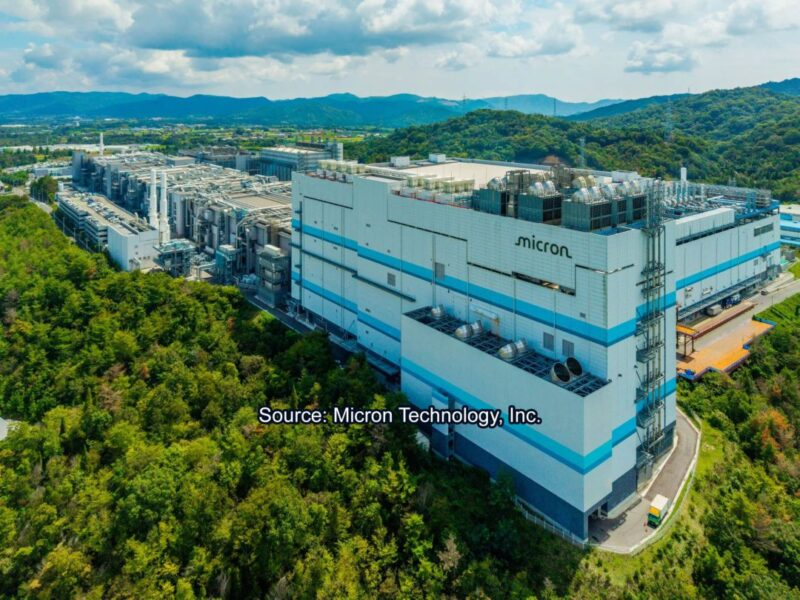
Micron Technology has broken ground on a ¥1.5tn expansion of its Hiroshima manufacturing site, adding cleanroom capacity intended to support advanced DRAM and high-bandwidth memory production for AI systems.
The project is being developed in Higashihiroshima, where Micron Memory Japan operates the country’s only remaining DRAM production base. The first phase covers around 28,000m² of cleanroom space, with manufacturing equipment scheduled to begin moving into the facility during the second half of 2028. The expansion strengthens capacity for the next phase of AI memory demand, rather than offering immediate relief to a constrained market.
The Hiroshima campus combines DRAM production with development activity for advanced memory products, giving the investment a role beyond incremental output. Micron has used the site for work across HBM, DDR5, and LPDDR, connecting the expansion directly to memory technologies that sit close to AI accelerator roadmaps. Japan’s Ministry of Economy, Trade and Industry is supporting the project through public funding for facilities and related R&D.
Japan’s support fits a wider semiconductor strategy built around domestic manufacturing depth, lower exposure to supply shocks, and renewed investment in critical chipmaking capabilities. Memory has become a strategic technology because AI infrastructure is changing both product mix and capacity allocation. HBM now competes for wafer starts, packaging capability, and engineering resources that also affect conventional DRAM and NAND supply.
AI accelerators require stacked memory with high bandwidth and close integration with compute devices. That demand has become one of the clearest pressure points in the electronics supply chain, with effects reaching beyond data centres into embedded, industrial, automotive, medical, and communications systems. Products that rely on predictable access to standard memory families can still be affected when suppliers prioritise high-growth AI platforms.
The same supply-side pressure is visible in Kioxia’s 332-layer BiCS FLASH sampling and MEMPHIS Electronic’s warning over memory market uncertainty. Those developments sit at different points of the memory chain, but they share a common thread: capacity, migration, lifecycle planning, and allocation have moved back into the design and procurement conversation.
Large fabs do not arrive on software timescales. Cleanroom construction, tool delivery, process qualification, yield learning, and customer validation all have to occur before new capacity changes market availability. AI platform demand can move in quarters, while qualified memory capacity is added over years. Micron’s Hiroshima expansion therefore underlines both the scale of investment now being mobilised and the delay before that investment can change supply conditions.
The pressure changes how memory choices are assessed inside electronic systems. Capacity, bandwidth, operating temperature, endurance, package availability, sourcing options, and lifecycle support all need to be considered against the risk of supply disruption. In industrial and embedded applications, changing memory late in a programme can force firmware work, validation repeats, compliance updates, and renewed field-service planning.
AI infrastructure is also altering the commercial hierarchy inside the memory sector. HBM has become a strategic product, not a niche companion to high-performance processors. Suppliers are aligning capital investment with customers that need high-density memory for accelerators, while governments increasingly see memory supply as part of semiconductor resilience and economic security.
Micron’s Hiroshima expansion strengthens Japan’s position in advanced memory manufacturing and gives Micron additional capacity for future HBM and DRAM demand. It also confirms that the memory market is being rebuilt around AI infrastructure cycles, leaving electronics manufacturers to plan around longer supply horizons, tighter allocation discipline, and fewer assumptions about rapid market normalisation.

