IN Brief:
- Melexis has introduced the MLX91229 conventional Hall current sensor.
- The device supports 200A to 2000A measurement with a sigma-delta digital output.
- The sensor targets traction inverters and other noisy high-power automotive systems.
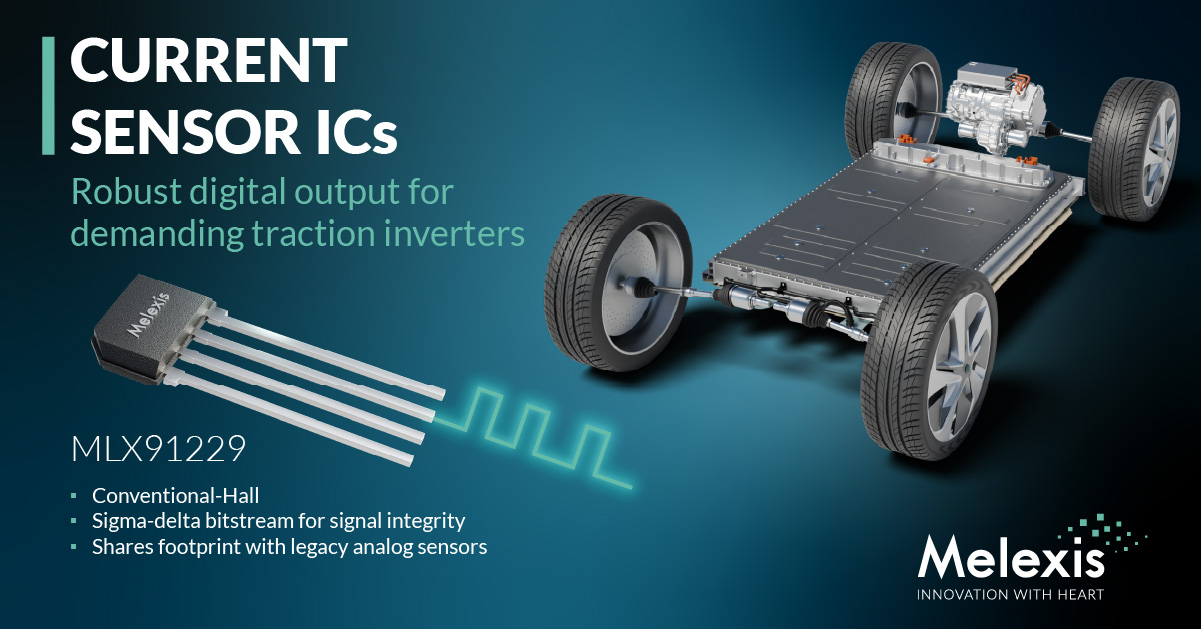
Melexis has introduced the MLX91229, a conventional Hall current sensor designed to improve signal integrity in high-power electric vehicle systems by replacing analogue voltage transmission with a sigma-delta digital bitstream.
The device supports current sensing from 200A to 2000A and is aimed at traction inverters and other automotive power electronics where high-current switching can interfere with standard measurement paths. As electrified drivetrains move toward higher voltages, faster semiconductors, and denser inverter layouts, current measurement has to operate in increasingly noisy electrical environments.
Analogue current sensors typically represent the measured current through small voltage changes, which can be vulnerable to disturbance along the signal path. That places heavy demands on layout, shielding, filtering, grounding, routing, and validation, particularly where a sensor and microcontroller cannot be placed close together or where traces and cabling run near switching nodes.
The MLX91229 changes that interface by encoding current information as a sigma-delta pulse-density stream. The receiving microcontroller reconstructs the measurement from the digital data, reducing sensitivity to interference picked up between the sensor and controller. The analogue sensing element remains essential at the physical interface, but the transmission path gains the robustness of a digital signalling approach.
Melexis has retained compatibility with existing analogue Hall-effect sensor footprints, allowing engineers to evaluate the device without a major mechanical or PCB redesign. That is particularly useful in automotive platforms, where even a small package change can affect qualification, tooling, test coverage, safety analysis, and supplier approval.
Wide-bandgap devices are intensifying the need for cleaner sensing chains. Silicon carbide and gallium nitride power stages can improve converter efficiency and power density, although their fast switching edges increase the burden on measurement, gate-drive, protection, EMI, and layout disciplines. The same systems-level pressure was evident in the 450A GaN power module developed by Dynex, where packaging and thermal control formed part of the power electronics performance story rather than a secondary implementation detail.
Reliable current measurement is central to inverter control. Phase-current feedback, torque control, overcurrent protection, diagnostics, thermal modelling, and functional safety mechanisms all depend on accurate and timely current information. When the measurement chain is compromised, the control system loses visibility of the very power stage it is supposed to regulate.
Digital-output sensing also reflects a broader change in mixed-signal components. Sensor ICs are absorbing more conditioning, encoding, diagnostics, and robustness features, allowing system designers to manage difficult operating environments without adding the same amount of external circuitry. The result is not the disappearance of analogue design skill, but a shift in where that skill is applied.
High-power EV inverters will continue to push sensing closer to the limits of electromagnetic compatibility, thermal packaging, and safety validation. The MLX91229 gives designers another way to preserve measurement integrity as power density rises, switching speeds increase, and packaging space remains constrained.