IN Brief:
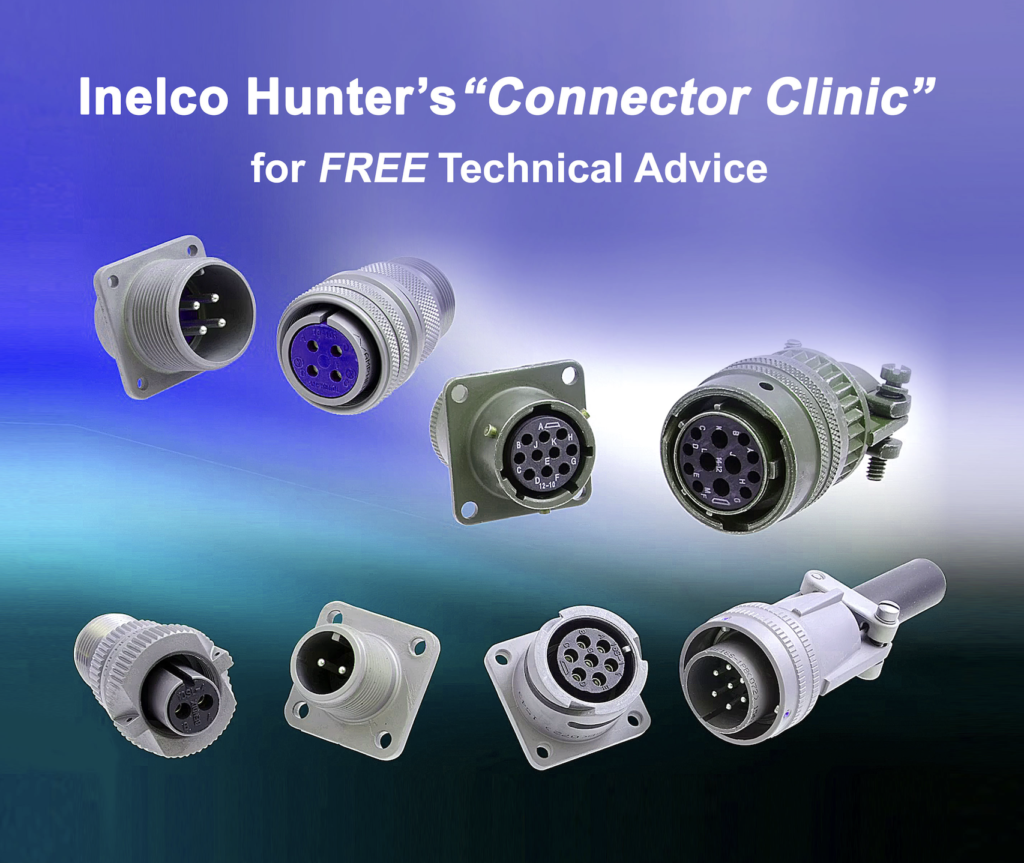
- Inelco Hunter has launched a free remote Connector Clinic service.
- The service supports engineers facing sourcing, pin-out, sealing, continuity, and compliance issues.
- Applications include industrial, high-current, EV, and harsh-environment systems.
Inelco Hunter has launched a Connector Clinic service for companies dealing with interface, pin-out, wiring, assembly, sourcing, sealing, continuity, and interconnect problems.
The service provides a remote diagnosis route for new designs, upgrades, and troubleshooting tasks. Drawings, photos, or a short description of the problem can be submitted for initial review by the company’s technical team, with support covering connector selection, matching, sealing, sourcing, assembly practice, and compliance considerations.
Connector issues often emerge late in a design cycle, even when the surrounding electronics are sound. A connector may be electrically suitable while still being difficult to assemble, poorly sealed, exposed to mechanical stress, incompatible with mating hardware, or difficult to source in production quantities. Once a build has moved beyond prototype stage, those compromises can quickly become costly.
The problem becomes sharper as electronics move into harsher and more power-dense systems. EVs, battery storage, off-highway machinery, industrial automation, marine equipment, medical devices, and defence electronics all place higher demands on interconnects. Current rating, creepage and clearance, vibration, ingress protection, chemical exposure, mating cycles, shielding, thermal performance, and serviceability have to be considered together.
Inelco Hunter has already been extending its activity around more specialised connection requirements, including liquid-cooling connectors for dense electronic systems. That direction reflects a broader change in interconnect design, where connectors increasingly have to handle electrical, mechanical, thermal, environmental, and service constraints at the same time.
Availability is another source of risk. A connector specified early in a programme may become hard to source by the time production begins, or a customer may require an alternative because of qualification, regional supply, or compliance preferences. Substitution is rarely as simple as matching pin count. Mechanical fit, termination, sealing, cable assembly, derating, documentation, and certification can all change.
A diagnostic service can shorten the route between a field or design problem and a workable solution. Fast guidance on suitable alternatives can prevent a small interconnect issue from delaying a prototype build, production batch, or repair. It can also help determine whether the fault sits with connector selection, assembly method, cabling, mating geometry, environmental exposure, or system-level loading.
Connector design remains easy to underestimate because it sits between electrical, mechanical, and environmental engineering. Many reliability problems begin at that boundary, where moisture, heat, vibration, current, handling, and assembly practice meet. Treating the connector as a system component rather than a catalogue line item is becoming harder to avoid.
The Connector Clinic gives Inelco Hunter a structured route into those problems. In demanding electronics applications, the component that joins the system together is often where the most awkward failure modes start.